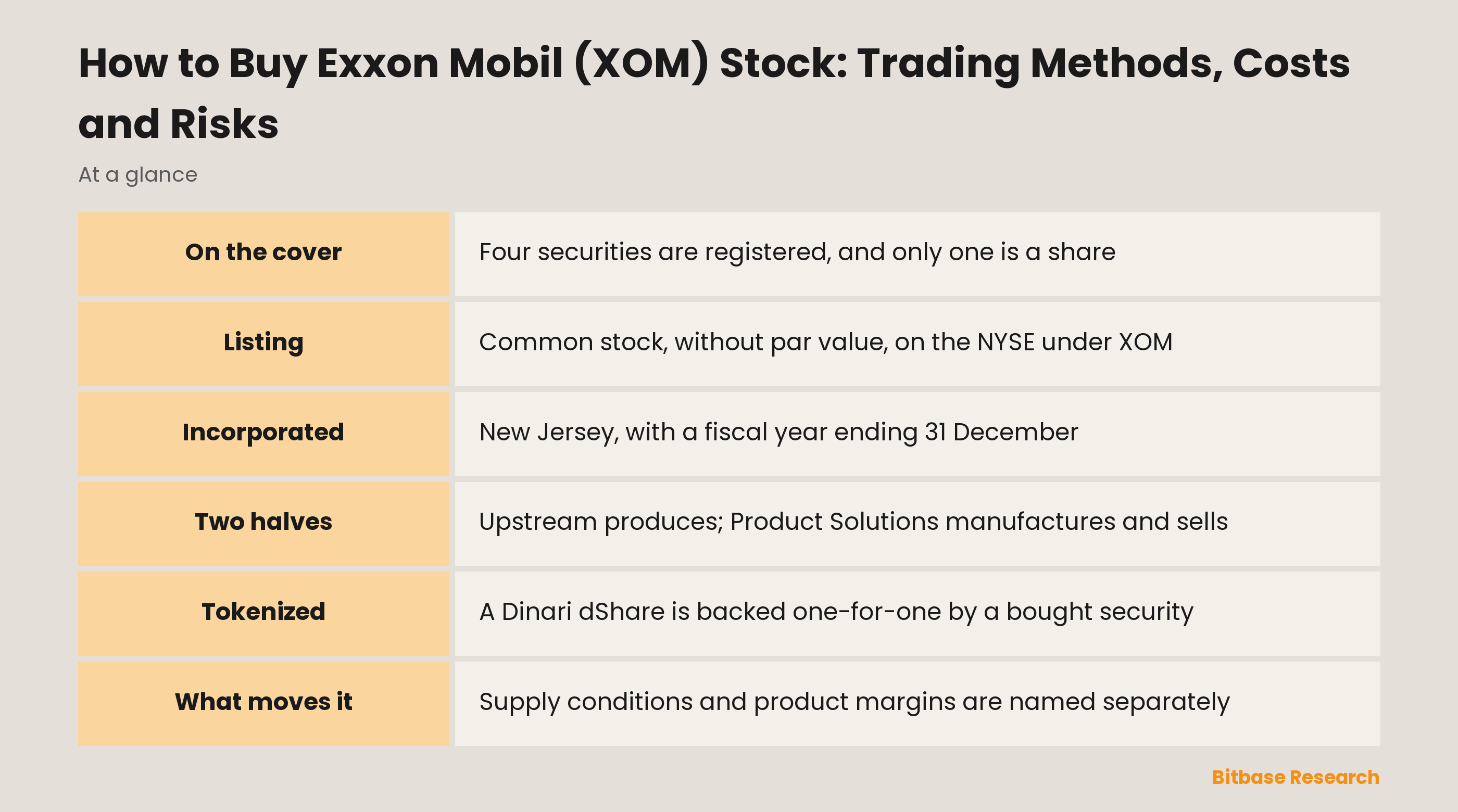
It registers four securities on a single cover page, and only one of them is a share. Exxon Mobil Corporation carries its common stock in New York under XOM, with three series of notes beside it under symbols of their own. Behind all four is a company that produces a commodity in one part of itself and manufactures goods out of it in another, so what moves the share has more than one answer. This profile covers what the annual report says the business is, which security those three letters name, and how the tokenized version is assembled.
What Is Exxon Mobil (XOM)?
The annual report opens with one long sentence about the company. Its "principal business involves exploration for, and production of, crude oil and natural gas; manufacture, trade, transport and sale of crude oil, natural gas, petroleum products, petrochemicals, and a wide variety of specialty products; and pursuit of lower-emission and other new business opportunities."
The cover settles two corporate facts. Exxon Mobil Corporation is incorporated in New Jersey — the state code on the structured cover report reads NJ — and its fiscal year ends on 31 December. The equity registered under these letters is common stock without par value, admitted to the New York Stock Exchange, with three series of notes registered on the same page and the same exchange.
The segment note makes the shape of the business legible. Four reportable segments fall into two halves: "The Upstream segment is organized to explore for and produce crude oil and natural gas. Product Solutions consists of the Energy Products, Chemical Products, and Specialty Products segments, which are organized to manufacture and sell petroleum products and petrochemicals."
| Half | Reportable segment | What the note puts inside it |
|---|---|---|
| Upstream | Upstream | Exploration for and production of crude oil and natural gas |
| Product Solutions | Energy Products | Fuels, aromatics, and catalysts and licensing |
| Product Solutions | Chemical Products | Olefins, polyolefins, and intermediates |
| Product Solutions | Specialty Products | Finished lubricants, basestocks and waxes, synthetics, and elastomers and resins |
One half sells the raw material; the other buys material of that kind and sells what it makes from it.
Why People Trade XOM
An integrated energy company offers what a single-line business cannot: both ends of the same barrel inside one listing. The share is a claim on production and on manufacturing at once, with no prior bet on which is the better place to stand.
That breadth is also why the company reads poorly against any one headline. The report ties demand to activity in general rather than to a product in particular: "The demand for energy and petrochemicals is generally linked closely with broad-based economic activities and levels of prosperity." Demand shifts for reasons unrelated to price too, and the filing names "technological improvements in energy efficiency" among them.
One line will look familiar to anyone arriving from crypto. Market factors, the company says, "may also result in losses from commodity derivatives and other instruments we use to hedge price exposures." The producer of the barrel is itself a user of derivatives on the barrel — the instrument family a trader reaching listed companies with stablecoins tends to meet first.
Registered, Wrapped, or Merely Referenced
Three quite different things carry these letters, and the difference is never in the letters.
The Bitbase market page for XOM is titled Exxon Mobil (Dinari Tokenized Stock) (XOM). Everything turns on the issuer name inside that title: what the page quotes was created by Dinari, with the company serving as reference and not as counterparty. That check belongs to the instrument rather than the venue, across the whole tokenized stock and ETF range.
Dinari's word for the wrapper is a dShare, defined flatly in its documentation: "A dShare is a token 1:1 backed by a security, commonly a U.S. equity." Supply does not respond to appetite for the token — minting and burning wait on a matching brokerage order filling first, routed through Alpaca. What stands behind the token is stock somebody's broker went out and bought.
Cash reaching the security reaches the holder too, on the underlying's timetable rather than one the issuer picks: Dinari works out a distribution when the cash lands and pays direct holders in USD+. Voting, and every other right attaching to a share, is simply absent from those pages. Absence resolves nothing either way, so this profile asserts neither that the wrapper carries such rights nor that it strips them.
Which clock an order lands on is the part most often assumed. The regular US session is one window; pre-market, after-hours and overnight are three more, and those three take limit orders only. A continuous on-chain route covers what remains, for a subset of tickers and in thinner liquidity. Send a market order once the regular session has closed and the venue rewrites it as a marketable limit order, which may then fill in whole, fill in part, or sit untouched.
Third comes a perpetual futures contract, which owns nothing whatsoever. It follows a quoted price, takes stablecoin as margin, and moves funding between the two sides of the book, so holding time becomes a cost or a credit. Which form an order reaches matters more than the ticker does, and the general mechanics of tokenized equities repay reading first.
What Moves XOM
No single price reaches this whole company, and the filing shows it by handling two quantities in two sentences with two causes. "Commodity prices and margins also vary depending on a number of factors affecting supply," it begins, then pulls them apart. On one side: "Increased supply from the development of new or previously inaccessible oil and gas supply sources and technologies to enhance recovery from existing sources tends to reduce commodity prices to the extent such supply increases are not offset by commensurate growth in demand." On the other: "Similarly, increases in industry refining or petrochemical manufacturing capacity relative to demand tend to reduce margins on the affected products."
Lay that beside the segment note and the structure does the rest. Upstream's output is the commodity the first sentence is about; Product Solutions manufactures and sells products, and the second sentence is about the margin earned on making them. Different variables, different developments, different sentences. Nothing here forecasts where either goes; the point is that a model of this company built on one number is modelling something the filing does not describe.
Access sits ahead of all of it. The company writes that "a number of countries limit access to their oil and gas resources, including by restricting leasing, licensing, or permitting activities." Where access is granted, durability is a separate matter: some host countries "lack well-developed legal systems, lack political or governmental stability, may be subject to regime changes."
Policy appears as a catalogue rather than a mood. Government actions aimed at emissions, the filing records, "include adoption of cap and trade regimes, carbon taxes, carbon accounting, carbon-based import duties or other trade tariffs," and the list continues. Each item is a regulatory event with a date attached, not a sentiment that trades.
Then come conditions touching every line at once: results are "exposed to potential negative impacts due to changes in interest rates, inflation, currency exchange rates, changes in usage of the U.S. dollar in global trade." A crypto reader should pause on that last clause. How the dollar is used in world trade appears in the risk factors of the company selling the barrel.
Item 1A gathers this under four headings — Supply and Demand, Government and Political Factors, Climate Change and Energy Transition, and Operational and Other Factors. The section runs on past where the copy consulted here stopped being legible, so read the above as an extract, never an inventory.
Risks and Limits
The wrapper adds a dependency the share does not have. Holding a dShare means relying on an arrangement to keep working: backing held as described, brokerage routing functioning, redemption honoured on whatever terms the issuer currently publishes. Writing the claim to a blockchain moves where it is recorded, not what it rests on.
Sessions are the quiet hazard. Three of the four windows accept limit orders only, and the continuous route covers a subset of tickers. A holder can find themselves watching a price that no order of theirs could currently reach.
Name collisions run both ways. Four securities are registered under this issuer, so a document governing one of the note series governs nothing about the stock. Meanwhile three-letter tickers are reused freely across crypto, and a market page naming no issuer need not concern this company at all.
The wrapper decides your rights, not your exposure. Supply conditions, product margins, access and policy reach every route into this name unchanged.
The filer's own risk section outruns this one. Item 1A is where the company states what it treats as material, and none of the above stands in for reading it end to end.
How to Verify XOM Information
Begin with the structured cover, not the prose. Exxon Mobil files on EDGAR under CIK 34088, commission file number 1-2256, and every annual report folder holds a machine-generated cover report: the file called R1.htm, beside the main document. It gives the registrant name, the state of incorporation, the fiscal year focus, and one row per security registered under Section 12(b), each with a class title, a trading symbol and an exchange. Count the distinct symbols there; narrative text is where miscounts come from.
For what the business consists of, the segment note carries the authority, naming the reportable segments in the company's own words. Put it next to Item 1 for the business as a whole and Item 1A for risk as the filer ranks it.
For the wrapper, Dinari's documentation covers backing, order routing, session windows and distributions; a question it leaves open stays open. For the market, open the XOM price page and read its title before its chart, since the issuer is named there.
Conclusion
One name, four registered securities, and only the share is what most readers mean by XOM. The company underneath produces crude oil and natural gas in one half and manufactures petroleum products and petrochemicals in the other, and its own report attributes commodity prices and product margins to separate supply conditions. That care is the habit worth borrowing.
Choosing a route is choosing a set of dependencies. A share rests on an exchange and a registrar, a dShare on an issuer's arrangement and its session rules, a contract on margin and funding. Settle that choice first; the price is the easier question.
Related reading
Other Bitbase articles on this topic:
- How to Buy QEW: Equal Weighting, Costs and Comparison with QQQ
- How to Buy QQQM and Compare It with QQQ
- How to Buy RSP: Equal Weighting, Costs and Comparison with SPY
- Nasdaq Stock vs the Nasdaq-100 Index: What NDAQ Investors Buy
Disclaimer: This article is educational content from Bitbase Academy, provided for information only. It explains what a company or fund does and how the instruments referenced here differ from one another; it does not constitute investment, trading, tax, or financial advice, and it is neither a recommendation nor an endorsement of any security, token, or trading strategy. A tokenized stock is issued by a third party and is designed to give economic exposure to an underlying asset: it is not a share, it carries no shareholder rights, and it depends on the issuer's structure, eligibility rules, and redemption terms, which the issuer can change. Perpetual futures are leveraged derivatives that hold no underlying asset and can be liquidated, and trading hours, product availability, and eligibility differ by instrument and by jurisdiction and can change at any time. Written as of September 2026; verify everything yourself through company filings, the issuer's own documentation, and the product pages of the venue you trade on.
References
[1] Exxon Mobil FY2025 Form 10-K: Item 1 business description, segment note and Item 1A risk factors (SEC EDGAR) www.sec.gov
[2] The same filing's XBRL cover report: registrant name, state of incorporation and one row per security registered under Section 12(b) www.sec.gov
[3] Dinari documentation: what a dShare is, order routing, session windows and distributions docs.dinari.com