Before Vertiv can book a dollar of revenue from a data center build, the order has already spent time in a backlog the company defines and discloses. That distance between order and delivery is the most useful thing about this ticker, and no route into it closes the gap. A Class A share on the New York Stock Exchange, a tokenized version quoted under an issuer's name, and a perpetual contract that references the price while holding nothing — three claims on one company, and three different sets of rights.
What Is Vertiv (VRT)?
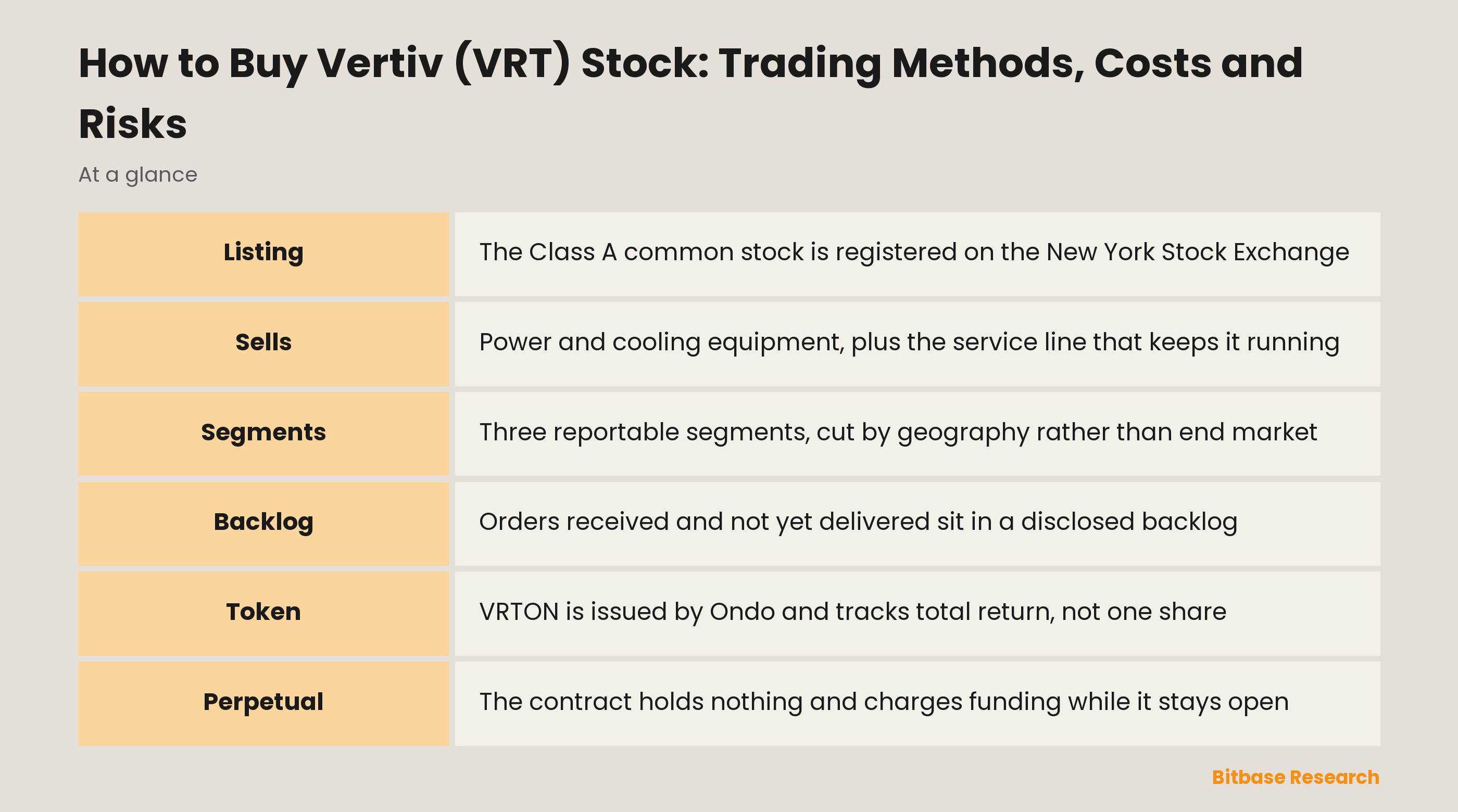
Vertiv Holdings Co is a Delaware corporation, and the security it registers under Section 12(b) is its Class A common stock, trading on the New York Stock Exchange under the symbol VRT. The fiscal year ends on 31 December. All of that is on the cover page of the annual report — the part no price page can settle for you.
Item 1 calls Vertiv a global leader in critical digital infrastructure, then says what it does about it: "we pioneer and deliver end-to-end power and cooling technologies to help our customers stay resilient, optimized, and future-ready." Those are physical goods — power and thermal management, switchgear and busbar, uninterruptible power supplies, air-cooled and liquid-cooled systems, racks and their power distribution — and beside them runs a line the filing names separately: services and spares, from preventative maintenance and acceptance testing through remote monitoring and parts.
Products on one side, services and spares on the other, is the split Vertiv uses when it disaggregates net sales, so it is the split a reader can follow through the statements. The segments are a different cut: "we manage our business across three reportable segments based on our main geographic regions—the Americas, Asia Pacific and Europe, Middle East & Africa." Geography, not end market. No row anywhere in these statements is labeled data centers.
Why People Trade Vertiv Stock
VRT is a way to hold the construction rather than the computing. Power and cooling go into a site before the servers that will use it, which places Vertiv early in a sequence that ends with a workload running. Holding the share is a position on that spending being committed, not on which chip wins afterwards.
The exposure is second-hand, and the company says so. Its first risk factor is about customers rather than products: Vertiv relies, in its own words, "on the continued growth of our customers' critical infrastructure systems, in particular data center and communication infrastructure, to grow our business, operations and revenue." What a holder is exposed to is other companies' capital budgets, filtered through Vertiv winning the order and then delivering it.
The short side inherits the same structure. A view that the spending slows, or that a rival takes part of it, lands on a manufacturer rather than on the operator whose budget actually moved.
One Price, Three Claims: Share, Token and Perpetual
The Bitbase price page for these three letters lists Vertiv (Ondo Tokenized), quoted as VRTON. The issuer's name inside the instrument title is not decoration. It is the part that decides what the instrument is.
Ondo's documentation is specific, and on the point most readers assume, it says the opposite. The token is not one-for-one with a share: "One token does not necessarily represent the value of one share, and the price of one token will not always match the price of the underlying asset." It is built as a total return tracker, with dividends reinvested net of withholding tax rather than paid out. Holders "do not receive shareholder voting rights, statutory information rights or other shareholder rights" — stated flatly, with no qualifier. Trading generally runs 24/5, with pauses possible around corporate actions and risk limits, and the product is generally available to non-US investors subject to jurisdictional and other restrictions.
Third comes the perpetual, which holds neither the share nor the token. It references a price, is margined and settled in stablecoin, passes a funding rate between long and short at every interval, and closes the position itself if margin falls under the maintenance requirement.
| Instrument | What the holder owns | Shareholder rights | Trading calendar | Cost of keeping it open |
|---|---|---|---|---|
| Class A common stock, NYSE: VRT | A registered share in Vertiv Holdings Co | The rights attached to the class | The New York Stock Exchange session | Whatever the broker charges |
| VRTON, tokenized stock issued by Ondo | A claim on the issuer's structure, tracking total return | None | Generally 24/5, pauses possible | No periodic charge of its own; dividends reinvested net of withholding tax |
| Perpetual futures referencing VRT | Nothing; a reference to a price | None | Continuous | Funding at every interval, paid or received |
Across the rows, what changes is not how much exposure arrives but who owes it — the amount of Vertiv can be made identical, the counterparty cannot.
Trading VRT on Bitbase
The price page is the reference surface: quote and chart for the tokenized stock, no position involved, and the instrument title where the issuer gets confirmed first.
The perpetual contract is where a directional position is taken. It is margined and settled in a stablecoin, which is what "buying VRT with USDT" describes in practice: the account currency is USDT and what it holds is exposure, not a share. Going short is the same operation with the sign reversed, and it carries the same running cost, because funding is charged for every interval the position stays open.
Leverage decides sizing rather than direction. Liquidation runs against a mark price instead of the last trade, and the maintenance margin level is published on the contract specification page. Those are venue terms, and venue terms change.
The share is reached elsewhere, at a broker that can route to the New York Stock Exchange — the route that puts a shareholder of record behind the position. Which instruments exist for which company is not uniform, and the tokenized stock listings answer that per ticker.
What Moves VRT
Orders move before revenue does, and the filing defines the gap: "The backlog consists of product and services for which a customer purchase order or purchase commitment has been received and which has not yet been delivered." Demand arrives on one clock, as commitments booked; revenue arrives on a second, as equipment delivered. Watching only the second is watching decisions taken well before.
Because the reportable segments are geographic, a change in where the spending happens is visible and a change in what it is for is not. Money moving between regions shows up as segment mix; money moving from telecom rooms to AI halls inside one region shows up nowhere. Net sales split into products and into services and spares, and neither is an end market either. Any figure saying how much of this company is data centers was built outside the filing.
Currency sits across all of it. Vertiv files a risk heading on "fluctuations in foreign currency exchange rates," and a manufacturer reporting by geography converts before it consolidates. Part of a reported move can be translation rather than demand.
Two constraints the company names about itself close the list. One heading reads "We operate in a highly competitive environment." Another covers its indebtedness and its ability "to comply with the covenants and restrictions contained in our credit agreements." An equipment maker finances the distance between building a unit and being paid for it, so credit terms are part of the operating model.
What moves this stock, then, is the arrival of orders and the ability to fulfill them. AI news counts to the exact extent that it changes one of those.
Risks Specific to Each Route
The token depends on its issuer before it depends on Vertiv. What VRTON is worth follows from Ondo continuing to run the structure and to honor redemption on terms the issuer sets and can change. What a tokenized stock is starts with the issuer, not with the company named in the title.
The calendars do not line up, and news does not wait for them. A New York session, a token schedule running 24/5 with pauses, and a contract that never closes will price one announcement at three different moments. That is how a position gaps against a holder who placed no trade.
Leverage converts a gap into an outcome. Funding accrues for as long as the contract is open, and liquidation is an execution rather than a warning: once maintenance margin is breached, the position closes at whatever the market is paying.
No wrapper reaches the thing underneath. Share, token or contract, the exposure still waits on an order somebody else's board approves and on equipment that has to be built and shipped. The wrapper settles your rights and your counterparty; it has no vote on whether the customer builds.
How to Check Vertiv Yourself
Start on EDGAR under CIK 1674101, where the annual report is filed. The cover page carries the Section 12(b) table, stating one class registered on one exchange, and that table ends any argument about what a three-letter code refers to on somebody else's website.
Item 1 carries the segment sentence in the company's own words, which is the fastest way to discover that a question about end markets has no row waiting for it. Read that description before hunting for a number: it tells you which numbers can exist.
Take product category names from the filing in front of you, not from a summary of an older one. Vertiv's earlier annual reports grouped its offerings under headings the most recent one no longer uses, so an old checklist will look for rows that are not there.
For the backlog, read the definition before any figure attached to it. Knowing it counts commitments received and not yet delivered turns the number into a statement about timing.
Ondo's documentation governs the token — backing, rights and hours. The Vertiv investor relations site republishes the same filings alongside its results dates. And the price page title names the issuer: where a page leaves that name out, what it is about is still undecided, because the same short code on a crypto venue sometimes belongs to an unrelated project.
Conclusion
Vertiv sells the power and the cooling a site needs before it needs a server, books the commitment into a backlog it defines, and recognizes the revenue when the equipment arrives. Everything a holder of this ticker is exposed to runs through that sequence.
The routes differ in what they hand back. The Class A share carries the rights of the class. The Ondo token carries the economics as a total return tracker and no shareholder rights, on a calendar the issuer sets. The perpetual carries direction and charges funding for every interval it stays open. Decide which of those you want before deciding what to pay, because the company underneath all three is the same one, waiting on somebody else's order.
Related reading
Other Bitbase articles on this topic:
- How to Buy Eli Lilly (LLY) Stock: Trading Methods, Costs and Risks
- How to Buy QEW: Equal Weighting, Costs and Comparison with QQQ
- How to Buy QQQM and Compare It with QQQ
- Is Crypto on the Stock Market? Three Places the Two Connect
- What Is The Graph? Subgraphs, Indexers and GRT
Disclaimer: This article is educational content from Bitbase Academy, provided for information only. It explains what a company or fund does and how the instruments referenced here differ from one another; it does not constitute investment, trading, tax, or financial advice, and it is neither a recommendation nor an endorsement of any security, token, or trading strategy. A tokenized stock is issued by a third party and is designed to give economic exposure to an underlying asset: it is not a share, it carries no shareholder rights, and it depends on the issuer's structure, eligibility rules, and redemption terms, which the issuer can change. Perpetual futures are leveraged derivatives that hold no underlying asset and can be liquidated, and trading hours, product availability, and eligibility differ by instrument and by jurisdiction and can change at any time. Written as of September 2026; verify everything yourself through company filings, the issuer's own documentation, and the product pages of the venue you trade on.
References
[1] Vertiv FY2025 Form 10-K: registration, segments, backlog and risk factors (SEC EDGAR) www.sec.gov
[2] Ondo Stocks overview: backing, rights and trading hours (official documentation) docs.ondo.finance
[3] Vertiv investor relations: filings, annual reports and results calendar investors.vertiv.com