Reaching for TLT as the quiet corner of a portfolio is how most people meet this fund, and its own disclosures spend more words on why that instinct misfires than on anything else. Inside is long-dated US government debt, where the borrower is about as dependable as borrowers get and the price is among the most restless on the exchange. That is one fact read from either end of a bond, not two facts in tension. This profile covers what the fund holds, why the price moves on something other than credit, where the costs and payouts are published, and which of three calendars governs a position.
What Is the iShares 20+ Year Treasury Bond ETF (TLT)?
The stated objective fits in one line. The fund "seeks to track the investment results of an index composed of U.S. Treasury bonds with remaining maturities greater than twenty years." Nothing there promises a yield, a repayment or a date. It promises to follow a rule.
The rule belongs to somebody else. The benchmark is the ICE U.S. Treasury 20+ Year Bond Index, whose constituents "are updated on the last calendar day of each month." A bond qualifies while its remaining life stays above that line and drops out once it falls through, so the portfolio is a moving band rather than a fixed set of loans.
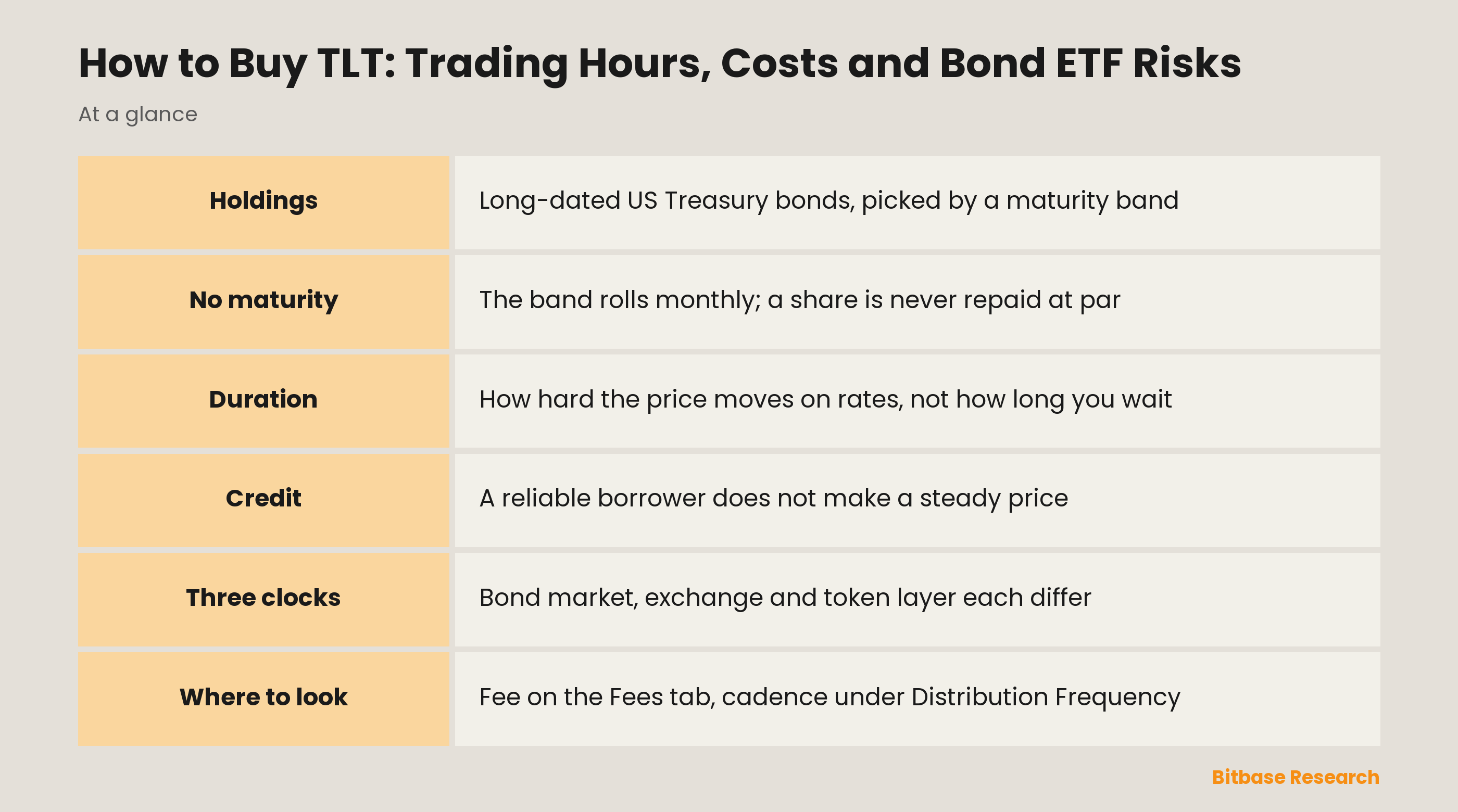
Carry that through the rest of this page, because it upends the usual intuition. An individual Treasury bond has an ending: a date on which the government repays the principal. A band has no ending, and neither does a share in a fund tracking one. The fact sheet puts the shareholder's side plainly — shares of ETFs "are bought and sold at market price (not NAV) and are not individually redeemed from the fund." Leaving means selling at whatever the market pays, never waiting to be repaid at par. The shares are listed on Nasdaq.
Why People Trade TLT
The fund's own description names the appeal without decoration: it "offers a way to gain targeted exposure to long duration government debt." Each phrase is load-bearing. Targeted means the band is chosen and maintained for you; long duration means the price reacts hard to rate moves; government debt means the credit question is close to settled, leaving rates as the live one.
Assembling that by hand is tedious: buy the bonds, watch each age out of the band, sell and replace, reinvest the coupons. One ticker absorbs that work, and an account barred from individual Treasuries can usually hold a listed fund.
A second use has nothing to do with income. Long bond prices move against the general level of interest rates, and move a lot, so the fund also gets traded as an expression of a rate view. One buyer wants it to sit still; the other is there because it will not.
Where the Treasury Bond Ends and the Wrapper Begins
Three objects can carry these letters, and they nest rather than compete.
A Treasury bond is the base: a loan to the US government, paying a coupon, with a date on which the principal comes back.
A fund share is one step out: an interest in a portfolio of those bonds, not in any bond in particular. Expenses come out first, and the share changes hands on Nasdaq at a price that need not match the value of what stands behind it — the gap between a listed fund's price and its net asset value, reported on the fund page under Premium/Discount.
A tokenized version is one step out again, built by a party with no relationship to the fund. The Bitbase market page for this ticker is titled iShares 20 Year Treasury Bond ETF (Dinari Tokenized ETF) (TLT), and the issuer marker in that title, not the three letters, settles which layer the page is pricing. Dinari's structure is the dShare: one token stands against one security, and tokens are issued or retired only once the matching order settles at the broker, which for this issuer is Alpaca. The security behind the token is the fund share, so the token points at a share, the share points at a portfolio, and the portfolio points at debt the Treasury owes.
Each step outward adds a party who has to perform, and none removes the rate exposure at the bottom. Terms differ sharply between issuers of tokenized stocks and ETFs, so read the issuer name before the ticker.
What Moves TLT
Begin where the prospectus does, because two sentences carry most of it: "An increase in interest rates generally will cause the value of fixed-income securities to decline. Securities with longer maturities generally are more sensitive to interest rate changes and subject to greater fluctuations in value." The first gives the direction; the second is why this fund is not a mild version of a bond fund.
The name for that sensitivity is duration, defined in a parenthesis most readers skim: "an instrument's price sensitivity to a change in interest rates." On the fund page it is a row called Effective Duration. Read it as a multiplier rather than a waiting period: how hard the price moves when the rate does, not how long until you get paid.
The multiplier does not hold still either, which is why a row named Convexity sits beside it. Convexity "measures the change in duration for a given change in rates," and where it is positive, "duration lengthens when rates fall and contracts when rates rise."
What moves rates is left deliberately open: "government policy, monetary policy, inflation expectations, perceptions of risk, and supply and demand for fixed-income securities," with changes that "can be sudden and unpredictable" — which is why Treasury yields are a macro variable in their own right.
A slower mover works on income instead of price. As bonds leave the index and cash needs reinvesting, the fund buys at the rates then prevailing; the prospectus warns it "may be required to invest in lower-yielding bonds" when holdings mature or "when bonds in the Underlying Index are substituted." Distributions follow the coupons the portfolio earns.
One driver is largely absent. Direct obligations of the US Treasury "have historically involved little risk of loss of principal if held to maturity, but the market value of such securities is not guaranteed and may fluctuate." Credit is the quiet variable; market value is the loud one.
Risks and Limits
Two sentences sound alike and are not. That the United States is unlikely to default, and that this fund is unlikely to fall, are separate claims, and only the first has support in the documents. The reassurance above carries a condition — if held to maturity — that a shareholder cannot satisfy. A fund share has no maturity date, no par value coming back, and no redemption window for an individual holder. Nor is it insured by "the Federal Deposit Insurance Corporation or any other government agency."
The clock question has three answers. The bonds change hands over the counter on a schedule the Securities Industry and Financial Markets Association publishes as a recommendation covering "the trading of U.S. dollar-denominated government securities" among other instruments, and it carries early closes of its own: several at 2:00 p.m. Eastern, one at noon on Good Friday. The shares trade on the exchange, whose calendar shuts completely on Good Friday and sets its early closes at 1:00 p.m. The tokenized layer keeps a third schedule: Dinari runs the regular US session plus pre-market, after-hours and overnight windows taking limit orders only, with a continuous on-chain route open for a limited set of tickers rather than all of them, and a market order sent outside regular hours becomes a marketable limit order that may fill completely, partly or not at all. Answering "when does TLT trade" in one sentence means quietly picking a layer.
The wrapper is a dependency, not a shortcut. What a dShare is worth rests on Dinari's arrangement holding up: backing held as described, routing functioning, redemption honoured on terms the issuer publishes and can revise. A blockchain relocates the record, not the obligation.
Payouts pass through more hands than a stock dividend does. The cash starts as coupon interest owed by the Treasury, reaches the fund, leaves it as a distribution once expenses are taken, and only then reaches a token holder: Dinari works out the distribution after that cash lands, pays direct holders in USD+, and withholds amounts below a stated minimum entirely.
How to Verify TLT Information
This ticker gets checked on a fund page rather than in a company filing, and that page is arranged as tabs. Fees is where the expense ratio lives, labelled as fees as stated in the prospectus and broken out into a management fee, acquired fund fees and expenses, and other expenses. Read it there rather than from any article, this one included; a figure copied into prose is a figure nobody checks again.
Key Facts holds the structural rows: Benchmark Index, Exchange, Fund Inception, CUSIP and Distribution Frequency. That last row answers how often the fund pays, and the Distributions tab shows what it actually paid. Portfolio Characteristics carries Effective Duration, Convexity, Weighted Avg Maturity and 30 Day SEC Yield, a rate-sensitivity profile that shifts as the portfolio rolls. Documents holds the prospectus and summary prospectus, the source of every sentence quoted here that did not come from the fact sheet.
Each calendar has its own keeper. The exchange publishes the trading calendar for the shares; SIFMA publishes the fixed income schedule separately, and the two do not line up. Dinari's documentation is the authority on backing, routing, sessions and distributions for the token, and anything about dShares missing from it is unverified rather than implied. The Bitbase price page names the issuer in its own title, which is how to confirm which wrapper a quote belongs to.
Conclusion
TLT answers a narrow question well and a broad one badly. The narrow one is how to hold a defined slice of the long end of the Treasury curve without running the roll yourself; the rule does that every month and publishes the result. The broad one, where money should sit when nothing feels safe, it does not answer, because what makes a Treasury dependable is the repayment at the end, and a band has no end.
So read the fee on the Fees tab, treat Effective Duration and Convexity as measures of sensitivity rather than of time, and settle which layer you are buying. A bond, a share in a fund of bonds, and a token issued against that share are three different obligations wearing the same three letters.
Related reading
Other Bitbase articles on this topic:
- How to Buy IBIT: Fees, Trading Hours and Differences from Bitcoin
- How to Buy Intercontinental Exchange (ICE) Stock: Trading Methods, Costs and Risks
- How to Buy Eli Lilly (LLY) Stock: Trading Methods, Costs and Risks
- VIX Futures Trading: The Index Itself Is Not Tradable
- What Is Linea? An Ethereum-Compatible zkEVM Layer 2
Disclaimer: This article is educational content from Bitbase Academy, provided for information only. It explains what a company or fund does and how the instruments referenced here differ from one another; it does not constitute investment, trading, tax, or financial advice, and it is neither a recommendation nor an endorsement of any security, token, or trading strategy. A tokenized stock is issued by a third party and is designed to give economic exposure to an underlying asset: it is not a share, it carries no shareholder rights, and it depends on the issuer's structure, eligibility rules, and redemption terms, which the issuer can change. Perpetual futures are leveraged derivatives that hold no underlying asset and can be liquidated, and trading hours, product availability, and eligibility differ by instrument and by jurisdiction and can change at any time. Written as of September 2026; verify everything yourself through company filings, the issuer's own documentation, and the product pages of the venue you trade on.
References
[1] TLT summary prospectus: index rule and risk factors (SEC EDGAR) www.sec.gov
[2] iShares TLT fund page: the tabs and rows named here www.ishares.com
[3] iShares TLT fact sheet: fund description and glossary www.ishares.com
[4] SIFMA holiday schedule for the US fixed income market www.sifma.org
[5] Exchange trading calendar: holidays and early closes www.nasdaqtrader.com
[6] Dinari documentation: what a dShare is and how it settles docs.dinari.com