Under its own prospectus TQQQ promises one thing and refuses another: it seeks three times (3x) the daily performance of the Nasdaq-100, and does not seek that multiple over any longer period. ProShares resets the exposure between one net asset value calculation and the next, which is why a quarter of index gains and a quarter of TQQQ gains are not related by simple arithmetic. What follows is what the fund holds, where its costs are printed, and what the tokenized version, the perpetual and a Nasdaq-100 future each change about it.
What Is ProShares UltraPro QQQ (TQQQ)?
ProShares UltraPro QQQ is an exchange-traded fund advised by ProShare Advisors, part of ProShares Trust, and its shares trade on The Nasdaq Stock Market under the ticker TQQQ. Its objective is one sentence: the fund "seeks daily investment results, before fees and expenses, that correspond to three times (3x) the daily performance of the Nasdaq-100 Index."
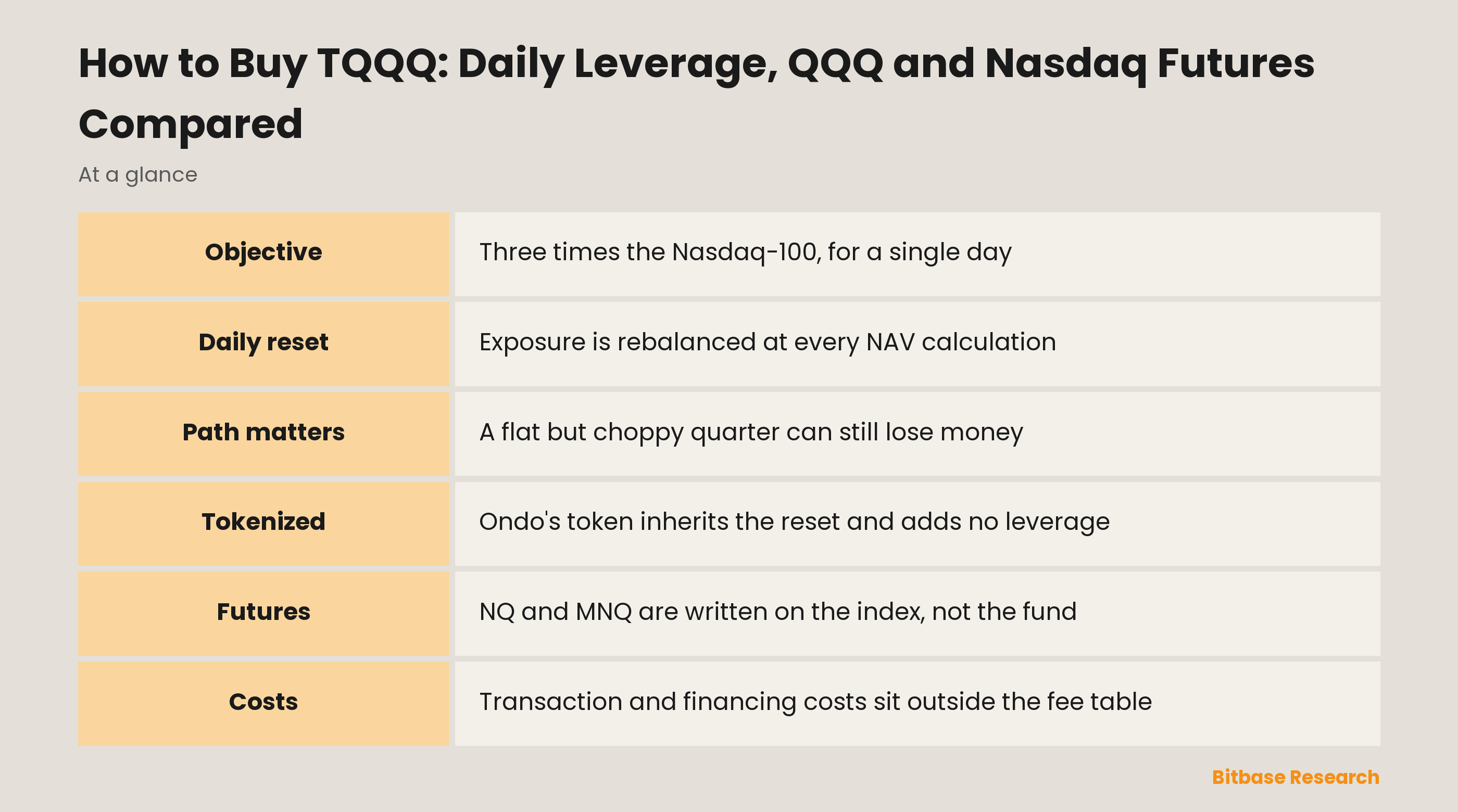
The sentence after that one does more work than the objective itself. The prospectus names the multiple the Daily Target, then states that the fund "does not seek to achieve three times (3x) the daily performance of the Index ... for any period other than a day." A day has a precise meaning here: it is "measured from the time of one net asset value ... calculation to the next", not from the moment an order fills.
What produces the multiple is not a leveraged basket of shares but derivatives: swap agreements with major global financial institutions, and futures contracts. The fund "seeks to rebalance its portfolio each day so that its exposure to the Index is consistent with the Daily Target": after the index rises, exposure has to be increased; after it falls, decreased. Buying strength and selling weakness is what a constant daily multiple requires.
The index itself is maintained by Nasdaq Inc. and measures a hundred of the largest Nasdaq-listed non-financial companies, weighted by market capitalisation, with membership reevaluated each December.
Why People Trade TQQQ
Leverage normally arrives through an account: a margin balance, a maintenance requirement, an intermediary entitled to close a position out. This fund puts it inside the security instead, so a cash account can hold the shares and nobody can call for more money against the position.
The matching constraint is printed in the same document. ProShares attaches a note to its own annual return chart saying those figures "should not be interpreted as suggesting that the Fund should or should not be held for longer periods of time", and warns that over any holding period other than a day the return "may be higher or lower than the Daily Target, and this difference may be significant."
Crypto traders reach for the ticker for reasons unconnected to the companies in it. What a token book and this fund have in common is not a cash flow but the price of money and a long horizon.
What Each Wrapper Holds, and What It Resets
| Route | What it holds | What resets or expires | Where the leverage sits |
|---|---|---|---|
| TQQQ share on Nasdaq | Swaps and futures on the index | Exposure, at every NAV calculation | Inside the fund |
| TQQQON token on Bitbase | Ondo's structure, not a fund share | It inherits the fund's daily reset | Inside the underlying |
| TQQQ perpetual | Nothing at all | Nothing; funding keeps accruing | In the margin account |
| NQ or MNQ futures | Nothing at all | The contract, each quarter | In the notional per contract |
On Bitbase the price page for these four letters lists ProShares UltraPro QQQ (Ondo Tokenized) under the symbol TQQQON: Ondo's instrument, not a fund share and not a claim on one.
Ondo's documentation turns down several assumptions at once. A token is not tied to a single share, and the price of one token will not always match the price of the underlying asset. The structure is a total return tracker, so distributions are folded back into the token's value, net of withholding tax, rather than paid across. On rights the wording leaves no room: holders "do not receive shareholder voting rights, statutory information rights or other shareholder rights." The calendar generally runs 24/5 rather than continuously.
Stacked on this particular fund, that has one consequence worth stating on its own: the token adds no leverage, but nothing in the tokenized layer undoes the daily reset of the underlying either.
The perpetual is a different machine again. It holds nothing, is margined in stablecoin, moves value between the two sides through a periodic funding payment, and is closed against a mark price when margin runs short. Its own leverage is an account ratio, chosen when the position opens and left there. Set that on TQQQ and one position carries two leverage mechanisms on different clocks: one reset at every NAV calculation, one never reset.
Nasdaq-100 futures are the comparison drawn most often and mislabelled most often. NQ, the CME E-mini, is worth $20 per index point and MNQ, the Micro E-mini, is worth $2 per point; both run on a quarterly cycle and stop trading on the third Friday of the contract month. They are written on the index rather than on a fund that references it, so describing NQ as a QQQ future names the wrong underlying. Nothing in them resets daily: size comes from the multiplier and the contract count. How the two differ is laid out in the Nasdaq-100 futures profile.
How to Trade TQQQ on Bitbase
Three surfaces carry this ticker here, and each answers a different question.
The price page holds the quote, the chart and the market data, and it prints the issuer inside the instrument title. Reading that title first is worth the few seconds: the same handful of letters can belong to an unrelated crypto project, and surfaces vary across the list of tokenized stocks.
The spot market trades the Ondo token against a stablecoin, so what is held afterwards is the token described above, with its own calendar and its documented absence of shareholder rights.
The perpetual contract is the leveraged route: margined in stablecoin, marked against an index instead of the last print, with funding running in whichever direction the crowd sits. A position kept for weeks pays or collects that charge many times over.
Two more routes sit outside the venue: a Nasdaq-capable broker buys the fund share itself, the only version registered in a holder's name, and a futures broker reaches NQ or MNQ, where the exposure is to the index rather than to any fund built on it. The unleveraged fund on the same index is covered in the QQQ profile.
What Moves TQQQ
Whatever moves the Nasdaq-100 moves this fund about three times as far for one day, so the index is the obvious input rather than the interesting one, and capitalisation weighting leaves a few very large members deciding most sessions.
The input that gets underrated is volatility itself, which the prospectus treats as a driver of returns rather than as atmosphere. Index volatility "has a negative impact on Fund returns", and results tend to fall short of the Daily Target when index gains or losses are smaller and index volatility is higher. ProShares draws the conclusion from its own table: an investor "may lose money when the Index return is flat" and "may lose money when the Index rises."
Financing enters twice. Interest rate expectations move the valuation of long-duration growth companies, and they also move the cost of the leverage: the prospectus lists "fees, expenses, transaction costs, financing costs associated with the use of derivatives" among the things that adversely affect the Daily Target.
The time of day an order fills matters here in a way it does not for an ordinary fund. Because the multiple runs between NAV calculations, shares bought mid-session will, by ProShares' own warning, perform higher or lower than the Daily Target until the next one.
Risks and Limits
The loss limit is arithmetic rather than rhetoric. ProShares states that if the index "approaches a 33% loss at any point in the day, you could lose your entire investment." The multiple that produces the upside is exactly what makes that sentence possible.
Holding for longer is a different product. Performance over periods longer than a single day "will likely differ from the Daily Target", and the prospectus says the difference may be significant. That is the stated design, not a defect.
The leverage is borrowed from counterparties. Most of the exposure comes from swap agreements, whose terms may permit a counterparty "to immediately close out the transaction with the Fund, including intraday." A market that closes early, closes late or halts creates the problem from the other side: the fund may then be unable to rebalance at all.
Each wrapper adds a failure mode of its own. Fund shares can trade at a premium or a discount to net asset value. The token adds an issuer whose structure, eligibility rules and redemption terms it sets and can change. The perpetual adds funding and a liquidation price on top of an instrument that already resets its leverage daily, a pairing often sized as though it were a single risk.
How to Verify TQQQ Information
Start with the fund's own summary prospectus, filed with the SEC under ProShares Trust and available through EDGAR. Three parts of it settle most questions: the Investment Objective, the Principal Investment Strategies section describing the daily rebalance, and the Holding Period Risk paragraph with its table of estimated returns at different index volatilities.
The expense ratio sits in one place in that document, and reading only the headline figure misses the point of the section. Under Fees and Expenses of the Fund, an Annual Fund Operating Expenses table lists management fees, other expenses, a total before fee waivers, the waiver line itself, and a total after it; a footnote gives the date the contractual waiver runs to, which is why a figure quoted elsewhere can go stale without anything being restated. On the ProShares fund page the same pair sits in the Snapshot panel under About the Fund. The line to read twice is underneath the table: the fund also pays transaction and financing costs, and "these costs are not reflected in the table or the example above."
Nasdaq Inc. publishes the index methodology and the change announcements, Ondo's documentation is the authority on the token's backing, rights and hours, and CME Group publishes separate specifications for the E-mini and the Micro E-mini.
Conclusion
TQQQ is a one-day instrument that can be held for longer, and every complication above follows from that gap: the fund resets between NAV calculations, the volatility of the index decides as much as its direction, and part of the cost never appears in the expense table.
Wrapping it changes the question rather than answering it. The Ondo token is economic exposure to a fund that resets daily, on a 24/5 calendar and with no shareholder rights. The perpetual stacks a second leverage mechanism on the first. A future gives the index without either, in exchange for an expiry date. Work out which clock you intend to hold before working out how much.
Related reading
Other Bitbase articles on this topic:
- How to Buy Eli Lilly (LLY) Stock: Trading Methods, Costs and Risks
- How to Buy QEW: Equal Weighting, Costs and Comparison with QQQ
- How to Buy QQQM and Compare It with QQQ
- HUT Stock Explained: Power, Data Centres and Bitcoin
- What Is Succinct? A Decentralized Proving Network
Disclaimer: This article is educational content from Bitbase Academy, provided for information only. It explains what a company or fund does and how the instruments referenced here differ from one another; it does not constitute investment, trading, tax, or financial advice, and it is neither a recommendation nor an endorsement of any security, token, or trading strategy. A tokenized stock is issued by a third party and is designed to give economic exposure to an underlying asset: it is not a share, it carries no shareholder rights, and it depends on the issuer's structure, eligibility rules, and redemption terms, which the issuer can change. Perpetual futures are leveraged derivatives that hold no underlying asset and can be liquidated, and trading hours, product availability, and eligibility differ by instrument and by jurisdiction and can change at any time. Written as of September 2026; verify everything yourself through company filings, the issuer's own documentation, and the product pages of the venue you trade on.
References
[1] ProShares UltraPro QQQ summary prospectus (SEC EDGAR) www.sec.gov
[2] ProShares TQQQ fund page: snapshot, holdings, distributions www.proshares.com
[3] Ondo Stocks overview: backing, rights, trading hours docs.ondo.finance
[4] CME E-mini Nasdaq-100 contract specifications www.cmegroup.com
[5] CME Micro E-mini Nasdaq-100 contract specifications www.cmegroup.com