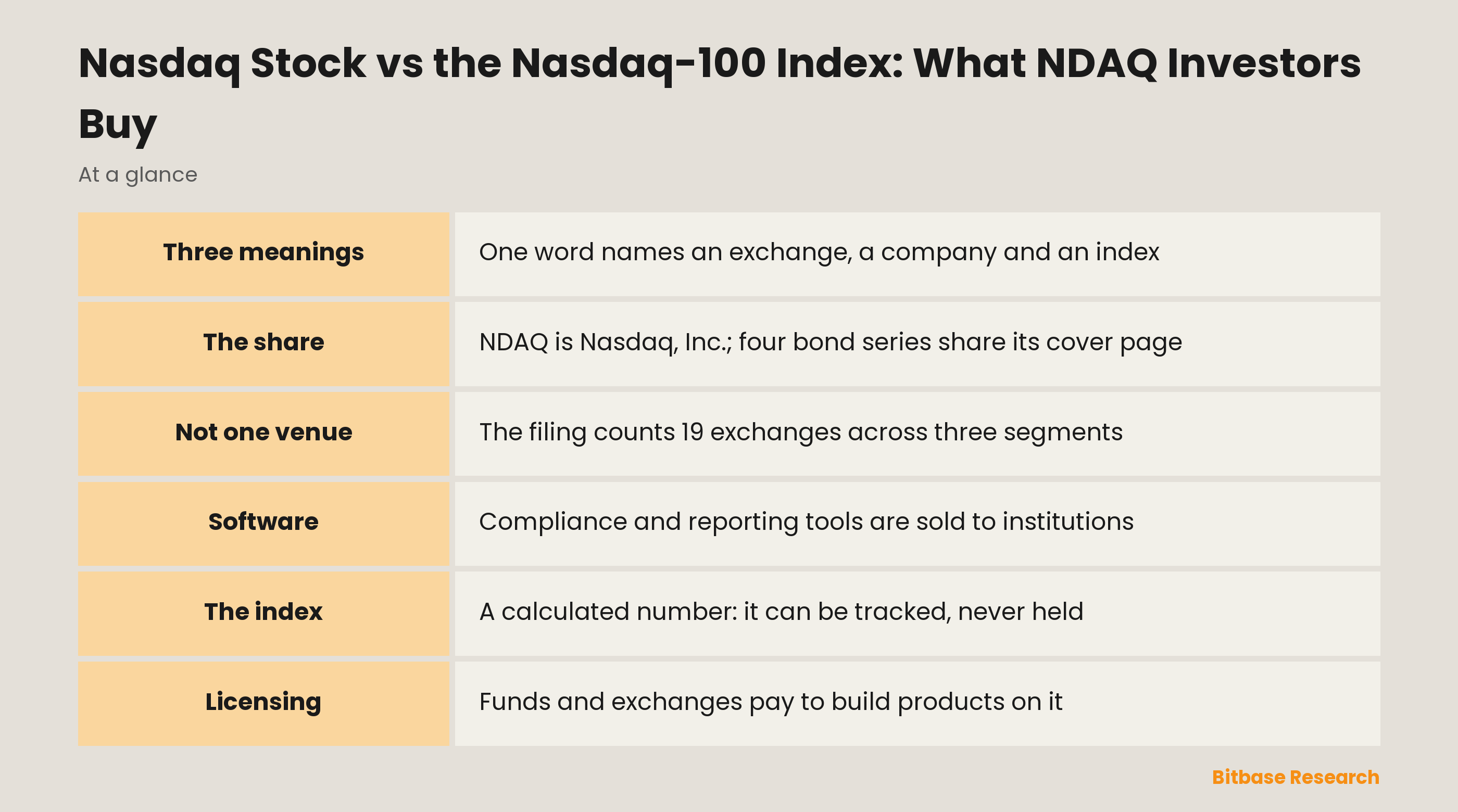
The word Nasdaq does three jobs in ordinary speech, and a search for "Nasdaq stock" rarely says which one it means. An exchange is a place and not a security; the Nasdaq-100 is a calculated number that has to be tracked rather than held; between them sits Nasdaq, Inc., a Delaware company whose common stock carries the ticker NDAQ. This profile separates the three, reads what that company actually sells in its own annual report, and explains why the index turns out to be one of its products.
What Nasdaq, Inc. (NDAQ) Is
The company's description of itself is the first surprise. Its annual report opens by calling Nasdaq "a leading technology platform that powers the world's economies" — not a marketplace, not a stock exchange, a technology platform. The wording is then explained: "We manage, operate and provide our products and services in three business segments: Capital Access Platforms, Financial Technology and Market Services."
Only the last is the business the name evokes, and even that one is plural. Market Services "includes our equity derivative trading and clearing, cash equity trading, fixed income, currency and commodities trading," and the company operates 19 exchanges across asset classes, several of them in the Nordic and Baltic capitals. The venue most people picture — The Nasdaq Stock Market, which the filing calls "the largest single venue of liquidity for trading U.S.-listed cash equities" — is one part of one segment.
Financial Technology sells software, and mostly not to traders. It "comprises Financial Crime Management Technology, Regulatory Technology and Capital Markets Technology businesses." Nasdaq Verafin "provides a cloud-based solution to financial institutions for fraud detection and management, anti-money laundering and countering the financing of terrorism compliance and management." AxiomSL is "a global leader in risk data management and regulatory reporting solutions for the financial industry." Neither product cares what a Nasdaq-100 constituent did today.
Capital Access Platforms holds the piece this article turns on: it "comprises Data & Listing Services, Index and Workflow & Insights." The index business is inside the company.
Two identity facts finish the picture, both worth reading off the filing rather than assuming. Nasdaq, Inc. is incorporated in Delaware, the fiscal year runs to 31 December, and what trades as NDAQ is its common stock, par value one cent — quoted on the market its own subsidiary operates. Four series of senior notes are registered on the same cover page, each with a symbol of its own. Five securities, five symbols, one of them a share.
Why People Trade NDAQ
A buyer of NDAQ acquires a mixture whose parts do not move together. One is geared to market activity: trading and clearing fees rise with the volume passing through the venues. Two are not. Listing revenue is billed to companies for being listed, and compliance software is sold on contracts that outlast any particular week.
That is why the share is not a proxy for the market it hosts. A quiet quarter reduces one input and leaves the other two alone; a spectacular run in large technology names does little for a licence signed with a compliance department.
The listings business is competitive in a way infrastructure usually is not, and the filing names the rival: "Our primary competitor for larger company stock share listings in the U.S. is NYSE." A listing is portable, and the obligation attached to it continues — "Once listed, companies must maintain rigorous listing and corporate governance standards."
For anyone arriving from crypto, one point is worth stating plainly: none of this revenue is denominated in tokens. What carries across is the subject matter — sanctions screening, transaction monitoring and regulatory reporting are a product line here, not an overhead.
The Index Is a Product, Not a Security
An index is a rule plus a number. The Nasdaq-100 is, in its owner's words, the company's "flagship index," and it "includes the top 100 non-financial companies listed on The Nasdaq Stock Market." Nothing there describes an asset. There is no certificate, no order book and no counterparty — only a methodology, a calculation, and products other people build on the output.
Those products are not versions of one another. A fund tracking the index holds constituent securities and issues shares in itself, so what you buy is a stake in the fund, with its fee and tracking error between you and the number; one such fund, unpacked wrapper by wrapper shows how many layers that becomes. A futures contract holds nothing whatsoever. It is a dated agreement on a quarterly cycle — March, June, September, December — that converts index points into money through a fixed multiplier, and the micro-sized version uses a multiplier one tenth as large, which changes the size of a position rather than its leverage or its risk. At expiry it pays out in cash against a price assembled from constituent opening prices rather than any visible quote, and what that settlement references repays a closer reading.
They keep a third calendar too — Sunday evening to Friday afternoon US Eastern time, with a daily maintenance break — which is neither the exchange's session nor a continuous market.
What closes the circle is a sentence in the filing. "Our Index business develops and licenses Nasdaq-branded indices and financial products," it says, and "License fees for our trademark licenses vary by product based on a percentage of underlying assets, dollar value of a product issuance, number of products or number of contracts traded." The fund pays to track the index; so does the exchange listing a contract on it. The index cannot be bought, but the right to build a product on it is sold — by the company whose share is the second meaning of the word.
Two further wrappers sit outside the exchange system altogether. A tokenized stock is a third party's instrument: the issuer defines what stands behind it, who may hold it and how it is redeemed, and can revise those definitions. A perpetual contract removes the underlying entirely, leaving stablecoin margin, a periodic payment from the crowded side to the other, and forced closure when margin thins. Whether a company exists in either shape is decided ticker by ticker, never by fame, and a venue's catalogue of tokenized stocks and futures markets carries the live answer.
What Moves NDAQ
The listings pipeline reaches this company before it reaches anybody's portfolio. New listings enlarge the fee base, and a company that moves its listing takes the fee with it — to a destination the filing is willing to name. Where an issuer chooses to list is a revenue event here, whether or not those shares then do well.
Index licence economics have a shape of their own, and the terms give it away. Fees vary "based on a percentage of underlying assets, dollar value of a product issuance, number of products or number of contracts traded." Money flowing into products that track a Nasdaq index therefore reaches this line in a flat market, and an issuer switching to a rival methodology subtracts from it in a rising one. Those rivals appear in the same document: "We face competition from investment banks, dedicated index providers, markets and other product developers, including S&P Dow Jones Indices, MSCI and FTSE Russell."
Regulation arrives twice here, with opposite signs. A new reporting obligation creates demand for exactly what the Regulatory Technology business sells, while a change to market structure rules lands on the trading and listing businesses as cost and constraint. A rulemaking headline is therefore not automatically good or bad for this share.
Market turbulence moves only part of the company. A violent week lifts volumes through the venues and does nothing to a multi-year software contract or a listing fee already invoiced; those software budgets follow compliance calendars, not sentiment. Reading a volatility spike straight through to this ticker prices one segment and ignores two.
Risks and Limits
The index franchise is contractual, and contracts have counterparties. Licence fees depend on other firms continuing to build on Nasdaq-branded methodologies, against named competitors publishing alternatives. A rulebook is worth what its licensees pay for it.
Software carries a risk an exchange does not. Selling to banks and asset managers means long sales cycles, implementation obligations, and the chance that a customer's own supervisor changes what the product must do.
The name invites the wrong comparison. A view about large listed technology companies is a view about the index, and the index is not this company — separate instruments, separate drivers.
Wrappers change your claim, not the business. A third party's token hands you exposure shaped by its own terms; a leveraged derivative hands you direction, a funding obligation and a price at which the position ends without you.
This profile is not the risk disclosure. Nasdaq, Inc. states its own risks, at its own length, in the Risk Factors section of that annual report. Those pages could not be read in full while this was written, so nothing above should stand in for them.
How to Verify NDAQ Information
Every quotation above comes from one document: the Form 10-K that Nasdaq, Inc. files under CIK 1120193, free to read on SEC EDGAR. Then use a shortcut most readers never learn. A modern filing's cover page also exists as a structured XBRL report, published as R1.htm beside the document itself, and it answers the identity questions without prose — registrant name, state of incorporation, each class registered under Section 12(b), the trading symbol and exchange for each, and the fiscal year. Phrase the question as a count rather than a lookup: how many distinct trading symbols does it report? Here the answer is five, and only one of them is a share.
For the index, go to its owner. Nasdaq publishes the Nasdaq-100 overview and methodology on its index site, and the rules there — the listing requirement, and the exclusion of financial companies — are the definition rather than a description of it.
For contract terms, go to the exchange that lists them: multipliers, tick sizes, listed months, trading hours and settlement procedures live on CME Group's specification pages and are revised there. A crypto venue's own product pages settle what it offers, and nothing else does.
Conclusion
Buying "the Nasdaq" is an incomplete instruction, and the three ways of completing it are not close substitutes. The exchange is a place, and places are not for sale. The index is a licensed rulebook that can only be tracked, through a fund holding the constituents or a contract that expires. NDAQ is a share in the company that operates the first and licenses the second, alongside two businesses selling software and data to institutions that may never trade anything.
That last part is what the name hides. Read the segment descriptions before deciding this ticker is a bet on market activity.
Related reading
Other Bitbase articles on this topic:
- How to Buy RSP: Equal Weighting, Costs and Comparison with SPY
- How to Buy SCHD: Dividend Exposure, Costs and Comparison with QQQ
- How to Buy Snowflake (SNOW) Stock: Trading Methods, Costs and Risks
- Semiconductor Equipment Stocks: The Supply Chain and Investment Risks
Disclaimer: This article is educational content from Bitbase Academy, provided for information only. It explains what a company or fund does and how the instruments referenced here differ from one another; it does not constitute investment, trading, tax, or financial advice, and it is neither a recommendation nor an endorsement of any security, token, or trading strategy. A tokenized stock is issued by a third party and is designed to give economic exposure to an underlying asset: it is not a share, it carries no shareholder rights, and it depends on the issuer's structure, eligibility rules, and redemption terms, which the issuer can change. Perpetual futures are leveraged derivatives that hold no underlying asset and can be liquidated, and trading hours, product availability, and eligibility differ by instrument and by jurisdiction and can change at any time. Written as of September 2026; verify everything yourself through company filings, the issuer's own documentation, and the product pages of the venue you trade on.
References
[1] Nasdaq, Inc. FY2025 Form 10-K, Item 1: segments, index licensing, competition (SEC EDGAR) www.sec.gov
[2] Same filing, XBRL cover page: registrant, state, Section 12(b) classes, symbols, exchange www.sec.gov
[3] Nasdaq-100 Index overview: composition and the exclusion of financial companies indexes.nasdaq.com
[4] CME E-mini Nasdaq-100 specifications: multiplier, listed months, hours, cash settlement www.cmegroup.com