
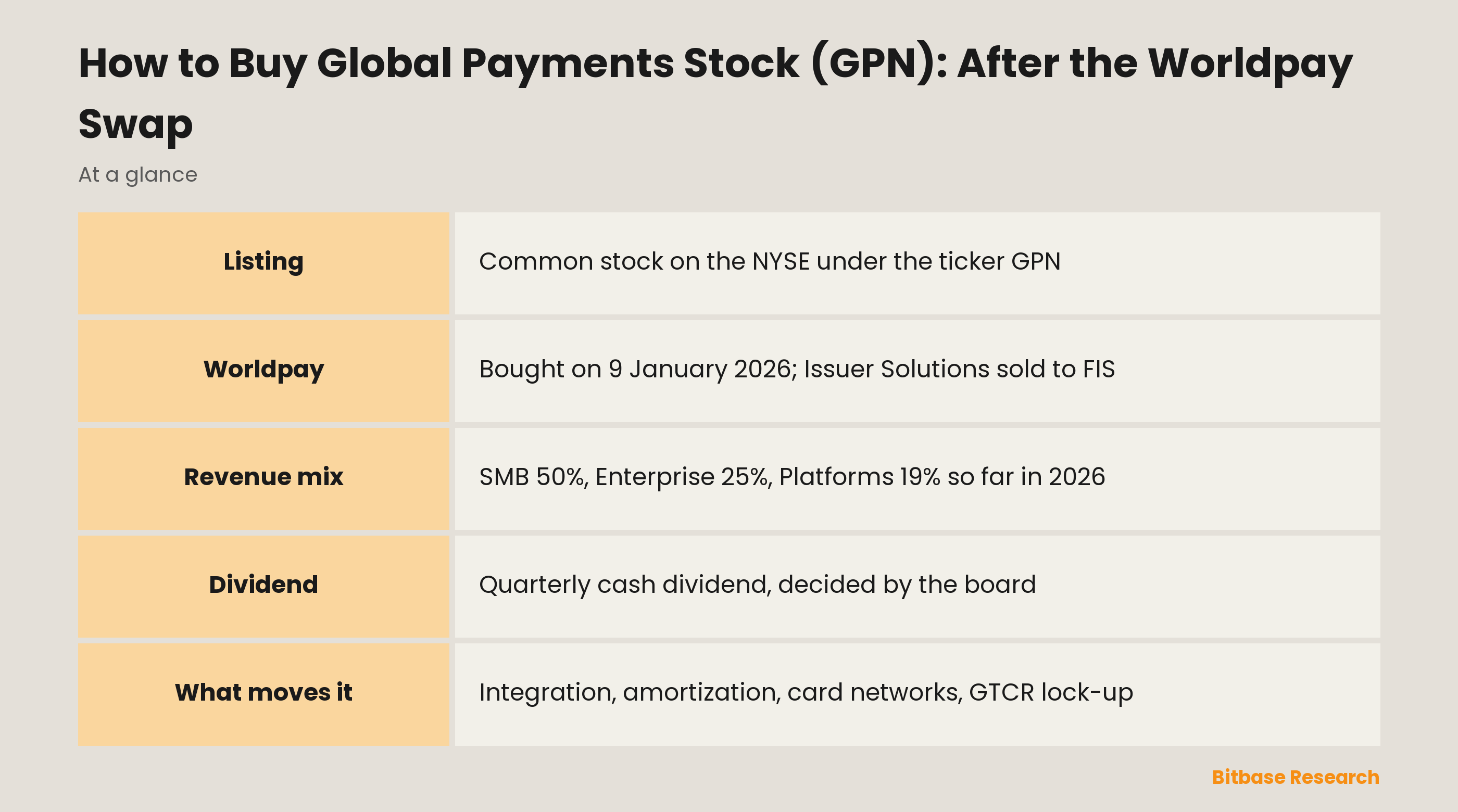
One ticker, GPN, is all you need: Global Payments common stock is listed on the New York Stock Exchange, so any broker with access to US shares can fill the order. The company you would be buying changed shape on 9 January 2026, when it took over the merchant processor Worldpay and handed its card-issuer processing business to FIS in the same closing. What follows covers the business as it now stands, the order itself, and the factors its filings point to, from integration and amortization to card network rules and a large shareholder's lock-up.
What Does Global Payments Do?
Global Payments describes itself as "a leading payments technology company delivering innovative software and services to our customers globally." In plain terms, it helps businesses accept card and digital payments. When a shopper taps a card, Global Payments captures the transaction, asks the card issuer for authorization through the card network, and arranges for the money to reach the merchant. Around that core it sells point-of-sale systems, business software and services such as chargeback handling, reconciliation and reporting.
The company began as a subsidiary of National Data Corporation. It was incorporated in Georgia on 1 September 2000, and on 31 January 2001 National Data distributed all of its shares to its own stockholders, leaving Global Payments an independent company with its stock registered on the NYSE. Acquisitions then built most of today's business: Heartland Payment Systems in April 2016, Total System Services (TSYS) in September 2019 and EVO Payments in March 2023.
The years since 2024 have been a reshaping. Global Payments sold AdvancedMD, its software for physician practices, in December 2024 and its Heartland payroll unit to Acrisure in September 2025. Then came the largest step. On 9 January 2026 it acquired 100% of Worldpay from FIS and affiliates of the private equity firm GTCR, paying GTCR in cash and newly issued shares, and at the same moment sold its Issuer Solutions business, which processed card accounts for banks and other issuers, to FIS. The 10-Q says the two deals "simplify our business model and position Global Payments as a leading pure play commerce solutions provider for merchants of all sizes."
Since the second quarter of 2026 the company has reported three segments:
1. Enterprise serves large and multinational merchants with in-store and online payment acceptance, plus what the 10-Q calls "emerging AI-driven commerce platforms."
2. Platforms reaches merchants indirectly, embedding payments in the software of partner vendors, payment facilitators and marketplaces.
3. SMB sells payments, point-of-sale technology and business software directly to small and medium-sized businesses. The 10-K says the company's point-of-sale businesses are being unified under one brand, Genius.
Global Payments processes the major international card brands, including Visa, Mastercard, American Express, Discover, JCB and UnionPay International, and some domestic debit networks such as Interac in Canada. In some markets it settles funds through sponsoring banks; in others it is a direct network member. At the end of 2025 it had about 26,000 team members in 37 countries, a count that still included Issuer Solutions, and subsidiaries holding payment institution licenses in Poland, Greece, Germany, Spain, Malta and the Czech Republic, with similar licenses in the United Kingdom.
The 10-K names its main US rivals in merchant acquiring as Fiserv, Chase Paymentech, Elavon, Bank of America Merchant Services, Wells Fargo Merchant Services, Toast, Stripe, Shopify and Block, and abroad Worldline, Nexi, Adyen, Block and Stripe, alongside local banks.
How Global Payments Makes Money
Most revenue comes from fees on payment volume, so the company earns more when its merchants sell more, whatever the card brand. The 10-K says "the majority of our revenue is generated by services priced as a percentage of transaction value or a specified fee per transaction," with software subscriptions, licenses and value-added services on top. Its own illustration shows the mechanics: on a card sale where the issuer keeps 1.5% as interchange and the merchant is charged a 2% discount rate, Global Payments passes the interchange through and keeps the 0.5% difference. Revenue therefore rises with transaction volume, while many costs stay fixed.
The new segments give the clearest picture of the combined company. For the first nine months of 2026, revenue split as follows:
| Segment | Share of revenue, first nine months of 2026 | Who the customers are |
|---|---|---|
| SMB | 50% | Small and medium-sized merchants, served directly |
| Enterprise | 25% | Large and multinational merchants |
| Platforms | 19% | Merchants reached through software partners, payment facilitators and marketplaces |
| Other | 6% | Noncore portfolios outside the go-forward strategy |
Shares are calculated from the segment note in the third-quarter 10-Q.
Growth in 2026 mostly reflects the deal. Revenue in the third quarter was about 64% higher than a year earlier, with Platforms up 122.5% and SMB up 21.4%, increases the 10-Q attributes "primarily" to the inclusion of Worldpay. On a normalized basis, a company measure that adds Worldpay's pre-acquisition results and removes divested businesses, adjusted net revenue rose more than 4% in the quarter.
Profits look different under GAAP. Acquired Worldpay intangible assets are amortized, so operating margins fell in all three segments; Enterprise's third-quarter margin was 23.3 percentage points lower than a year before. The company's adjusted figures exclude that amortization, which is why the earnings release and the financial statements can tell different stories.
The year before the deal is the last clean baseline for the old company. In 2025, with Issuer Solutions already reported as a discontinued operation, revenue from continuing operations slipped 0.4%. Integrated and Embedded Solutions provided 44%, Core Payments Solutions 39% and Point-of-Sale and Software Solutions 17%. By region, the Americas produced 80% of that revenue, Europe 17% and Asia Pacific 4%; the United States alone accounted for 73%.
GPN Stock at a Glance
| Feature | GPN |
|---|---|
| Exchange | New York Stock Exchange, listed since the 2001 spin-off |
| Ticker | GPN |
| Security | Common stock, no par value; the only share class registered under Section 12(b) |
| Other NYSE listing | 4.875% Senior Notes due 2031 (GPN31A), a debt security |
| Sector | Merchant payments technology and software |
| Index membership | S&P 500 |
| Headquarters | Atlanta, Georgia |
| Incorporated | Georgia, 2000 |
| Fiscal year | Calendar year, ending 31 December (until 2016 it ended on 31 May) |
| Dividends | Quarterly cash dividend; board decides each payment |
| SEC identifier | CIK 1123360 |
Prices, market value and trading volume move every session, so the table leaves them out; the Global Payments stock page on Bitbase shows them live.
How to Buy Global Payments Stock
Global Payments is a Georgia corporation and files a 10-K, so there is no depositary receipt layer: the NYSE shares are the common stock itself. A typical purchase runs as follows:
1. Find a broker that trades NYSE stocks. If you live outside the United States, check which entity holds your account and which regulator supervises it.
2. Get through onboarding. Expect identity checks; non-US individuals usually certify their status on IRS Form W-8BEN.
3. Fund the account. Depositing a currency other than dollars means a conversion, so the exchange rate matters as much as the commission.
4. Search for GPN and read the result. It should say Global Payments Inc. common stock on the NYSE. GPN31A, which also shows up on the NYSE, is a bond, not a share.
5. Choose the order type. FINRA says a market order "provides the most certainty that your order will be executed," while a limit order buys "at or better than a specified price."
6. Decide the amount. Some brokers sell fractional shares, so you can invest a set sum; ask how voting and dividends work on fractions.
7. Keep your records. Confirmations and statements show what you paid and what dividends you received.
Taxes outside the US. The IRS says that "most types of U.S. source income received by a foreign person are subject to U.S. tax of 30%," and that a lower rate may apply under a tax treaty between your country and the United States. GPN pays dividends, so this withholding applies to them; how a sale is taxed depends on where you live.
Holding it through a fund. GPN is an S&P 500 constituent. State Street's daily holdings file for its S&P 500 ETF, SPY, listed GLOBAL PAYMENTS INC under GPN on 10 November 2026, so funds tracking that index hold a small slice of the company.
What Moves GPN Stock
Integration of Worldpay. The 10-K lists integration as a principal risk: the company "may be unable to integrate the business of Worldpay successfully or realize the anticipated benefits." Transition services still run in both directions with FIS. In its November 2026 earnings release the company raised its annual run-rate target for Worldpay expense synergies, and the 10-Q says integration and transformation costs will continue through 2028.
Amortization and adjusted numbers. Because acquired intangibles are written down over time, GAAP earnings sit well below the adjusted earnings the company highlights. In the third quarter of 2026, GAAP diluted earnings per share were less than a third of adjusted EPS. Investors who compare the stock with peers need to know which measure each figure uses.
Small merchants and partners. Half of revenue in the first nine months of 2026 came from SMB, and Platforms depends on software partners and payment facilitators. The 10-K flags that "increased merchant, referral partner, ISO or payment facilitator attrition could cause our financial results to decline," and warns separately that large enterprise merchants could "direct significant transaction volume away" to other providers.
Card networks and regulation. Revenue depends on Visa and Mastercard registrations and bank sponsorship, and higher network fees can cost customers. In the United States, the Dodd-Frank Act caps debit interchange for large issuers and requires every debit card to work on at least two unaffiliated networks. Our guides to Visa and Mastercard explain how the networks earn their fees.
Debt and capital returns. Part of the Worldpay purchase was funded with new borrowing, and the 10-K warns that "our substantial indebtedness could adversely affect us and limit our business flexibility." At the same time the company keeps buying back shares through open-market purchases and accelerated programs, and repurchased about 17 million shares in the first nine months of 2026. The 10-Q ranks its capital allocation priorities in this order: dividends, buybacks, acquisitions, planned investment in the business, and payments on debt.
GTCR's stake. After closing, GTCR held about 15% of the common stock. Under its shareholders agreement, 35% of the shares it received are released from lock-up 12 months after closing, another 15% at 15 months and the rest at 18 months; GTCR also has registration rights. Future sales by a holder that size can weigh on supply.
What Could Go Wrong for a GPN Holder
Item 1A of the 10-K, which the 10-Q leaves unchanged, sets out these risks among others:
Competition. "The payments technology industry is highly competitive and highly innovative, and some of our competitors have greater financial and operational resources than we do."
Systems and partners. "Software and hardware defects, failures, undetected errors and development delays could affect our ability to deliver our services," and the company depends on third-party providers whose systems may also fail.
Losses from merchants. Global Payments carries chargeback losses when merchants "refuse or cannot reimburse us," and fraud by merchants or others can add to them.
Sponsorship and clearing. It relies on financial institutions for clearing in settlement; losing them without a replacement could hurt results.
Goodwill and ratings. The balance sheet "includes significant amounts of goodwill and other intangible assets," and a downgrade of its debt ratings "could restrict our ability to access the debt capital markets and increase our interest costs."
Payouts. The company "may not be able to, or we may decide not to, pay dividends or repurchase shares at a level anticipated by our shareholders."
The share price itself has been a risk. In the 10-K's performance graph, a holding in Global Payments made at the end of 2020 had a cumulative total return of about minus 62% by the end of 2025, against plus 96% for the S&P 500. A single stock can move far from the market for years.
How to Research GPN Yourself
All Global Payments filings sit on EDGAR under CIK 1123360: the annual 10-K, 10-Qs for the first three quarters and 8-Ks for material events. In 2026 the quarterly results came out on 18 February, 6 May, 5 August and 5 November. The 8-K of 12 January 2026 records the Worldpay closing and the shareholders agreement with GTCR. The company's investor relations site offers the same reports free.
Three things are worth checking. Compare years carefully: the 2025 10-K shows one Merchant Solutions segment, while 2026 filings use Enterprise, Platforms and SMB and recast earlier periods. Read the normalized figures in the earnings releases alongside GAAP numbers, since the two differ by design. And watch for 8-Ks on governance: in October 2026 the board amended the bylaws to make the Georgia State-wide Business Court the exclusive forum for internal claims and to require shareholders to own at least 1% to bring a derivative suit.
Live quotes are on the stock page linked above, and Bitbase keeps a list of US stock pages for other payments companies.
Global Payments Stock FAQ
Can I buy Global Payments stock with crypto?
Not directly. Brokers settle GPN in US dollars, so crypto must first be sold for cash, which may be a taxable event where you live, and the money moved to the brokerage account. A share carries dividend and voting rights in a registered company; stocks and crypto differ in ways worth knowing first.
Does Global Payments pay a dividend?
Yes, quarterly. The 10-K says the company expects "to continue paying quarterly cash dividends in the future," but that the amount and timing stay with the board. The latest declaration, in October 2026, is payable in December; check the newest release for size and dates.
Is GPN in the S&P 500?
Yes. The 10-K calls Global Payments "a member of the S&P 500," and SPY's holdings file listed it on 10 November 2026. It is not in the Nasdaq-100, since it trades on the NYSE.
Did Global Payments buy Worldpay and sell Issuer Solutions?
Yes, both closed on 9 January 2026. Global Payments bought all of Worldpay from FIS and GTCR, and FIS took Issuer Solutions in part exchange for its Worldpay interest plus cash. Issuer Solutions now appears only as a discontinued operation in past results.
Where is Global Payments based?
In Atlanta, Georgia, at 3550 Lenox Road. The company is incorporated in Georgia, and its October 2026 bylaw amendment points internal shareholder disputes to the Georgia State-wide Business Court.
Has Global Payments stock ever split?
Yes. A two-for-one stock split was paid as a stock dividend on 2 November 2015, and per-share figures in later filings are adjusted for it.
Conclusion
Global Payments is now almost entirely a merchant business, larger than before and more concentrated, since the bank-processing arm now belongs to FIS. The questions for 2026 and 2027 are whether Worldpay is folded in on schedule, how quickly amortization-heavy GAAP earnings converge with adjusted figures, and how GTCR handles its shares as the lock-up ends. Read the 10-K and the latest 10-Q side by side, follow the segment numbers each quarter, and decide what weight one payments processor deserves in your portfolio.
Related reading
Other Bitbase articles on this topic:
- How to Buy Bending Spoons Stock (BSP): Evernote, AOL and Vimeo
- How to Buy Cognizant Stock (CTSH): Banks, Health Care and India
- How to Buy Corpay Stock (CPAY): Fuel Cards to Cross-Border FX
- How to Buy Twilio Stock (TWLO): APIs, Carrier Fees and Buybacks
Disclaimer: This article is educational content from Bitbase Academy, provided for information only. It explains what a company or fund does and how the instruments referenced here differ from one another; it does not constitute investment, trading, tax, or financial advice, and it is neither a recommendation nor an endorsement of any security, token, or trading strategy. A tokenized stock is issued by a third party and is designed to give economic exposure to an underlying asset: it is not a share, it carries no shareholder rights, and it depends on the issuer's structure, eligibility rules, and redemption terms, which the issuer can change. Perpetual futures are leveraged derivatives that hold no underlying asset and can be liquidated, and trading hours, product availability, and eligibility differ by instrument and by jurisdiction and can change at any time. Written as of November 2026; verify everything yourself through company filings, the issuer's own documentation, and the product pages of the venue you trade on.
References
[1] Global Payments Form 10-K for 2025 (SEC EDGAR) www.sec.gov
[2] Global Payments 2025 Form 10-K, XBRL cover page (SEC EDGAR) www.sec.gov
[3] Global Payments 2025 Form 10-K, revenue by business and region (XBRL) www.sec.gov
[4] Global Payments 2025 Form 10-K, US share of revenue (XBRL) www.sec.gov
[5] Global Payments Form 10-Q for the third quarter of 2026 (SEC EDGAR) www.sec.gov
[6] Global Payments third-quarter 2026 results release (SEC EDGAR) www.sec.gov
[7] Global Payments Form 8-K on the Worldpay closing, January 2026 (SEC EDGAR) www.sec.gov
[8] Global Payments Form 8-K on the bylaw amendments, November 2026 (SEC EDGAR) www.sec.gov
[9] Global Payments annual report for fiscal 2001, on the spin-off (SEC EDGAR) www.sec.gov
[10] Global Payments Form 10-K for fiscal 2016 (SEC EDGAR) www.sec.gov
[11] State Street SPDR S&P 500 ETF Trust (SPY) fund page and daily holdings www.ssga.com
[12] FINRA: Order Types www.finra.org
[13] IRS: NRA Withholding www.irs.gov