
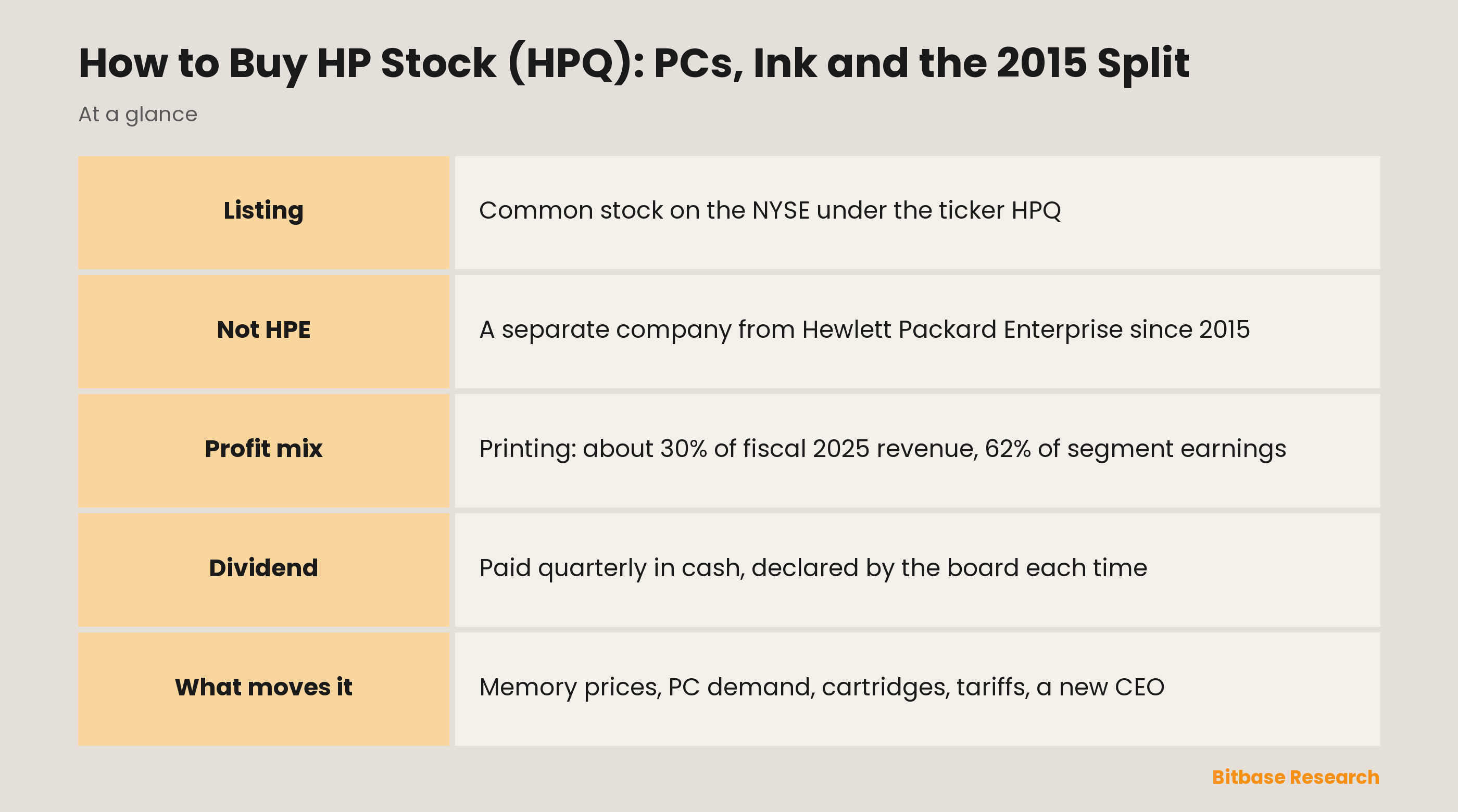
HP is listed on the New York Stock Exchange under the ticker HPQ, so a brokerage account that reaches US shares is all the order needs. This is the personal computer and printer half of the old Hewlett-Packard, not Hewlett Packard Enterprise, and its profits lean on the smaller half: in fiscal 2025 Printing brought in about 30% of revenue but about 62% of segment operating earnings. Below: the two businesses, the order, and what moves the stock, from memory prices to a new chief executive.
What Does HP Do?
HP Inc. sells personal computers, printers and the supplies printers consume, plus services and subscriptions around them. The 10-K says it operates in more than 170 countries with approximately 55,000 employees, and it reports three segments: Personal Systems, Printing and Corporate Investments.
The company is the original Hewlett-Packard Company under a new name. Its filings sum up the break-up in one sentence: "On November 1, 2015, Hewlett-Packard Company completed the separation of Hewlett Packard Enterprise, Hewlett-Packard Company's former enterprise technology infrastructure, software, services and financing businesses." Servers, storage and networking went to HPE, which has its own ticker and its own guide to buying HPE stock. The renamed parent kept PCs and printers, and the two still share the heritage name "through a joint brand holding structure."
Personal Systems covers desktops, notebooks and workstations, including the AI PCs HP now promotes, plus thin clients, point-of-sale systems, displays and support services. Most machines run Windows or Chrome OS on Intel and AMD processors, with NVIDIA graphics in heavier models. Commercial PS sells the Pro and Elite lines, Z workstations and Dragonfly to companies, schools and governments; Consumer PS sells Omni, Spectre, Envy and Pavilion PCs and the Omen and Victus gaming ranges.
Printing spans home and office printers, large-format and industrial presses, and 3D printing. HP reports it as Commercial Printing, Consumer Printing and Supplies: ink and laser cartridges, media and 3D materials sold for "recurring use" in printers already installed. Instant Ink, the HP All-In Plan and Managed Print Services add subscriptions on top. Corporate Investments holds incubation projects and lost money in fiscal 2025.
The 10-K names rivals. In PCs it lists Acer, Apple, ASUSTeK, Dell, Huawei, Lenovo, Logitech, Microsoft, Samsung and Toshiba, plus "white box" makers; in printing, Brother, Canon, Pantum, Seiko Epson, Ricoh and Xerox, plus sellers of imitation, refilled and remanufactured cartridges. Our Dell guide covers one of them.
How HP Makes Money
HP's fiscal year ends on 31 October. Fiscal 2025 revenue rose 3.2%, and the two main segments carried very different weight:
| Segment, fiscal 2025 | Share of revenue | Share of segment operating earnings | Operating margin |
|---|---|---|---|
| Personal Systems | about 70% | about 41% | 5.3% |
| Printing | about 30% | about 62% | 18.7% |
Earnings shares are calculated from the 10-K segment note and add up to more than 100% because Corporate Investments posted a loss; corporate costs, restructuring and amortization sit outside the segments.
Supplies made up about two-thirds of Printing revenue and about 20% of HP's total. That is the classic printer model: hardware goes into a large installed base, and the cartridges bought over the following years carry much of the profit. It also explains a slow leak: in fiscal 2025 Supplies revenue fell 3.4% "primarily due to decline in the installed base and usage," and printer units dropped 4.2%.
Personal Systems did the growing. Its revenue rose 6.5%, with units up 4.3% on what the 10-K calls "the Windows-based PC operating system refresh" and average selling prices up 3.1%; Commercial PS was about 71% of the segment. Higher commodity and tariff costs and the shift towards PCs still cut HP's overall gross margin by 1.5 percentage points.
About 65% of revenue comes from outside the United States, and "the majority of our overall revenue is made through channel resellers" rather than HP's own store.
HPQ Stock at a Glance
| Feature | HPQ |
|---|---|
| Company | HP Inc. (formerly Hewlett-Packard Company) |
| Exchange | New York Stock Exchange |
| Ticker | HPQ |
| Security | Common stock, the only class registered under Section 12(b) |
| Not to be confused with | Hewlett Packard Enterprise (HPE), separate since 1 November 2015 |
| Sector | Personal computers, printers and printing supplies |
| Index membership | S&P 500 (in SPY's holdings file on 10 November 2026) |
| Headquarters | Palo Alto, California |
| Incorporated | Delaware |
| Fiscal year | Ends 31 October |
| Dividend | Quarterly cash dividend, declared by the board each time |
| SEC identifier | CIK 47217 |
Quotes and market value change constantly; the live numbers are on the HP stock page on Bitbase.
How to Buy HP Stock
HP Inc. is a Delaware company listed in New York, so no depositary receipt is involved: investors anywhere buy the same common stock.
1. Find a broker that offers NYSE stocks to residents of your country, and check which entity holds your account and who regulates it.
2. Open the account and pass identity checks. Non-US individuals are normally asked for IRS Form W-8BEN, which the IRS says to submit "when requested by the withholding agent or payer."
3. Fund it. If your money is in won, euros or another currency, the conversion into dollars is part of the cost.
4. Search HPQ, then read the name. It should say HP Inc., common stock, NYSE. HPE is a different company with a similar name, and a hurried order can land on the wrong one.
5. Choose the order type. In FINRA's words, a market order "provides the most certainty that your order will be executed," while a limit order fills only "at or better than a specified price."
6. Decide the size. Some brokers sell fractions of a share, others limit them to "large-cap stocks or ETFs" or do not offer them, and FINRA notes a fractional holder "might not have shareholder voting rights."
7. Keep your records of purchase prices and dividends for tax.
Withholding on dividends. The IRS says "most types of U.S. source income received by a foreign person are subject to U.S. tax of 30%," unless a treaty lowers the rate, which is why brokers collect Form W-8BEN. Your home country may tax the dividend again.
Owning it indirectly. HPQ sits in the S&P 500, so index funds such as State Street's SPY hold a small slice of HP among about five hundred companies.
What Moves HPQ Stock
Memory prices and PC volumes. Memory and storage are bought-in parts, and in 2026 their prices rose sharply. In the third quarter of fiscal 2026, the three months to 31 July, Personal Systems revenue rose 18.5% while PC units fell 15.8%; average selling prices jumped 40.8%, mainly from pricing actions to offset higher commodity costs. The 10-Q says HP expects the "inflationary pressure in memory and storage costs and supply constraints" to continue.
Next year's PC market. On 21 September 2026 HP filed a planning assumption that industry-wide PC unit volumes will "decline roughly mid-single-digits in percentage terms in calendar year 2027," based on third-party forecasts and "subject to change." It gave no fiscal 2027 guidance then.
The supplies annuity. Printing earns most of the segment profit, and Supplies is most of Printing. A shrinking printer base, lower page volumes and cheaper non-original cartridges all reach that line. In the third quarter of fiscal 2026 Supplies revenue fell 3% and Printing 2%.
Tariffs and refunds. Since April 2025, the 10-K says, "new, substantial tariffs have been imposed on imports to the United States," and fiscal 2025 costs rose with them. On 20 February 2026 the US Supreme Court held that tariffs imposed under the International Emergency Economic Powers Act "were not authorized by statute." HP has applied for refunds and books each one "as a reduction of Products cost of net revenue when received," so they lift margins in the quarters they arrive, then stop.
Restructuring and leadership. In November 2025 the board approved a Fiscal 2026 Plan built on AI adoption, expected to run through fiscal 2028 and to cut approximately 4,000 to 6,000 jobs. Enrique Lores stepped down as chief executive on 2 February 2026, director Bruce Broussard became interim CEO the next day, and on 4 November 2026 the board named Emma Walmsley, formerly chief executive of GSK, as CEO effective 4 January 2027, with Broussard due to become chair that day.
Cartridges, Memory Chips and Other HP Risks
These passages from Item 1A of the fiscal 2025 10-K bear most directly on an HPQ holding:
Non-original supplies. Imitation and remanufactured cartridges "are often available at lower prices," and HP "may not be able to prevent the use of imitation print supplies with our printers using technological protection measures."
Suppliers. "We are heavily dependent on third-party suppliers and supply chain issues have adversely affected, and could adversely affect in the future, our financial results." HP relies on Canon for certain laser printer engines and toner cartridges, on Intel, AMD and NVIDIA for most PC processors, and on manufacturers in Taiwan for notebooks.
Trade policy. Tariffs and export controls "have and may continue to, materially adversely affect our supply chain."
Shared branding. Because both companies use the heritage name, "conduct or events adversely affecting the reputation of Hewlett Packard Enterprise could also adversely affect our reputation."
Printer firmware cases. HP's cartridge authentication, called Dynamic Security, has drawn lawsuits in the United States, Italy, Israel, the Netherlands, Australia and New Zealand. On 5 June 2026 the Dutch Supreme Court held that HP's use of it is not unlawful; an Illinois class action filed in January 2024 was still "in its early stages" in the latest 10-Q.
Two risks sit at the level of the share. One stock ties your outcome to one company's PC and printer cycle. And the payout is discretionary: HP says it is "not obligated to pay cash dividends or to repurchase a specified number or dollar value of shares," and at 31 October 2025 its balance sheet showed a total stockholders' deficit rather than positive book equity.
How to Research HPQ Yourself
HP's filings are on SEC EDGAR under CIK 47217 and on investor.hp.com. Start with the 10-K for the year to 31 October 2025, filed on 10 December 2025: Item 1 for products and competitors, Item 1A for risks, the MD&A for unit and price changes by business unit, and the segment note for revenue and earnings side by side.
Then read the 10-Qs and 8-Ks. In 2026 quarterly results came on 24 February, 27 May and 26 August, each with a release that breaks out Commercial and Consumer PS and Supplies. The fiscal 2026 10-K, which normally follows the fourth-quarter release, will replace the full-year figures used here.
Three checks keep the reading clean: confirm a document comes from HP Inc. at CIK 47217, not HPE; compare Supplies with printer hardware, since they can diverge; and separate one-off tariff refunds from underlying margins. For prices, use the HPQ page linked above or the list of US stock pages on Bitbase.
HP Stock FAQ
Can I buy HP stock with crypto?
Not directly. HPQ shares are bought through a brokerage account in US dollars, so crypto has to be sold for fiat and the money moved to the broker first, a sale that may be taxable where you live. Our guide on how to buy stocks with crypto walks through that route.
Is HP Inc. the same company as Hewlett Packard Enterprise?
No. They were one company until 1 November 2015, when Hewlett-Packard Company separated its enterprise businesses as Hewlett Packard Enterprise. The original company, renamed HP Inc., kept PCs and printers and trades as HPQ; HPE trades as HPE. Shares, filings and dividends are separate.
Does HP pay a dividend?
Yes, quarterly in cash. In November 2025 the board raised the planned quarterly amount from the first quarter of fiscal 2026, but each payment still has to be declared and the 10-K says HP is not obligated to pay. The latest earnings release gives the current amount.
Is HPQ in the S&P 500?
Yes. HP Inc. appeared in State Street's daily holdings file for SPY, an S&P 500 fund, on 10 November 2026, with HPE listed separately.
Who runs HP?
Bruce Broussard has been interim chief executive since 3 February 2026. Emma Walmsley, former CEO of GSK, is due to take over on 4 January 2027, when Broussard is set to become board chair, according to HP's 8-K of 4 November 2026.
Conclusion
HP is two businesses under one ticker. PCs bring in most of the sales and are being pushed around by memory prices and a market HP expects to shrink in 2027; printers and their cartridges earn most of the profit but shrink a few percent a year. With tariff refunds, restructuring and a new chief executive arriving in January 2027, read the next annual report with the latest quarterly release, check which business is doing the work, and decide how much one hardware company should weigh in your portfolio.
Related reading
Other Bitbase articles on this topic:
- How to Buy Celestica Stock (CLS): From IBM Unit to AI Racks
- How to Buy Ciena Stock (CIEN): Optics, Cloud Buyers, No Dividend
- How to Buy Ericsson Stock (ERIC): B Shares, ADS and 5G Gear
- How to Buy Ubiquiti Stock (UI): UniFi and Founder Control
Disclaimer: This article is educational content from Bitbase Academy, provided for information only. It explains what a company or fund does and how the instruments referenced here differ from one another; it does not constitute investment, trading, tax, or financial advice, and it is neither a recommendation nor an endorsement of any security, token, or trading strategy. A tokenized stock is issued by a third party and is designed to give economic exposure to an underlying asset: it is not a share, it carries no shareholder rights, and it depends on the issuer's structure, eligibility rules, and redemption terms, which the issuer can change. Perpetual futures are leveraged derivatives that hold no underlying asset and can be liquidated, and trading hours, product availability, and eligibility differ by instrument and by jurisdiction and can change at any time. Written as of November 2026; verify everything yourself through company filings, the issuer's own documentation, and the product pages of the venue you trade on.
References
[1] HP Inc. Form 10-K for fiscal 2025 (SEC EDGAR) www.sec.gov
[2] HP Inc. fiscal 2025 10-K, XBRL cover page (SEC EDGAR) www.sec.gov
[3] HP Inc. Form 10-Q for the quarter ended 31 July 2026 (SEC EDGAR) www.sec.gov
[4] HP Inc. fiscal 2026 third-quarter results release (SEC EDGAR) www.sec.gov
[5] HP Inc. Form 8-K, 25 November 2025: restructuring plan and dividend (SEC EDGAR) www.sec.gov
[6] HP Inc. Form 8-K, 21 September 2026: PC planning assumption (SEC EDGAR) www.sec.gov
[7] HP Inc. Form 8-K, 3 February 2026: interim CEO (SEC EDGAR) www.sec.gov
[8] HP Inc. Form 8-K, 4 November 2026: CEO appointment (SEC EDGAR) www.sec.gov
[9] State Street: SPY fund page and daily holdings www.ssga.com
[10] FINRA: Types of orders www.finra.org
[11] FINRA: Investing in fractional shares www.finra.org
[12] IRS: NRA withholding www.irs.gov
[13] IRS: About Form W-8 BEN www.irs.gov