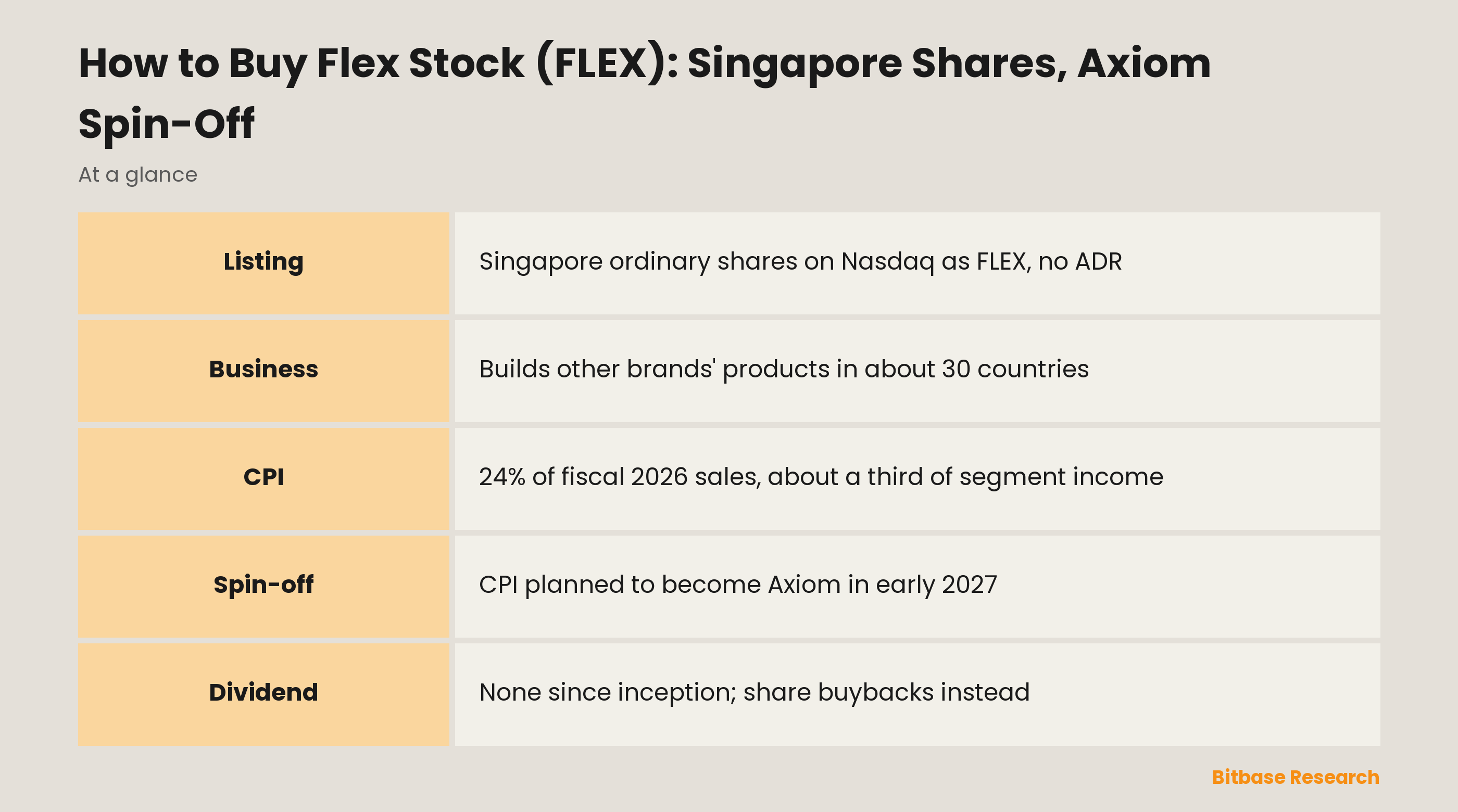
Despite its Singapore registration, Flex Ltd. has no depositary receipt: its ordinary shares trade on Nasdaq as FLEX, and any broker offering US equities can place the order. Flex builds other companies' products, and its data center power and cooling arm, 24% of fiscal 2026 sales but about a third of segment income, is planned to become a separate company, Axiom Solutions International, in early 2027. What follows covers the business, the order steps and the filings that track the separation.
What Does Flex Do?
Flex is a contract manufacturer. Its 10-K calls it "the advanced, end-to-end manufacturing partner of choice that helps a diverse customer base design, build, deliver and manage products that improve the world." The products mostly carry the customers' brands: Flex designs them, buys the components, assembles circuit boards and complete systems, ships them and later repairs or recycles them. The 10-K says manufacturing and systems assembly "generate the majority of our revenues."
The company was incorporated in Singapore in May 1990, and its registered office is still there, but its headquarters and principal executive offices are in Austin, Texas. EDGAR lists it under its former name, Flextronics International Ltd., until 2016. Flex runs more than 100 sites in about 30 countries on four continents, with roughly 150,000 people on its workforce at the end of March 2026.
Since fiscal 2026, which ended on 31 March 2026, Flex has reported three segments:
Integrated Technology Solutions (ITS) covers Communications (high-speed networking, enterprise and satellite communications systems) and Lifestyle (premium commercial, home and personal products). Regulated Manufacturing Solutions (RMS) covers Industrial, Automotive and Healthcare, markets where products must meet safety and regulatory standards. Cloud and Power Infrastructure (CPI) covers Cloud and Cooling (integrated compute systems and liquid cooling for dense server racks) and Power (rack, board, facility and utility-level electrical equipment).
The 10-K describes CPI as "focused on delivering integrated compute systems, power, and cooling technologies that support large-scale cloud, data center, and AI-enabled infrastructure deployments." Flex has been adding to it through acquisitions: Electrical Power Products closed on 1 May 2026, and EPC Power, which the 10-Q calls "a leading provider of intelligent power conversion solutions for data centers and grid applications," closed on 14 October 2026.
Flex has spun off a business before: on 2 January 2024 it handed its remaining stake in Nextracker to its shareholders pro rata, and Nextracker now appears in its accounts as discontinued operations.
How Flex Makes Money
Flex is paid to make things, so revenue tracks how much its customers build and margins stay thin. Segment income excludes amortization, stock-based pay, restructuring and other items listed in the 10-K, so it compares segments with each other, not with net income.
| Segment | Share of fiscal 2026 net sales | Share of fiscal 2026 segment income | Segment margin, fiscal 2026 | End markets |
|---|---|---|---|---|
| ITS | 40% | 33% | 5.4% | Communications, Lifestyle |
| RMS | 36% | 34% | 6.0% | Industrial, Automotive, Healthcare |
| CPI | 24% | 34% | 9.2% | Cloud and Cooling, Power |
The income percentages are worked out from the segment table in the 10-K: CPI brought in under a quarter of sales and about a third of segment income because its margin is higher.
Fiscal 2026 net sales rose 8%. ITS slipped 2% as Lifestyle fell 9% on weaker consumer demand, partly offset by a 6% gain in Communications. RMS grew 5%, led by a 13% rise in Industrial. CPI grew 38%, with Cloud and Cooling up 29% and Power up 61%. CPI's margin still fell from 10.2% to 9.2%, which the 10-K puts down to "costs to ramp the business and unfavorable mix in the Cloud and Cooling business."
The shift has continued into fiscal 2027. In the quarter to 25 September 2026, sales rose 25%: ITS by 22%, helped by Communications demand and higher memory pricing, RMS by 9% and CPI by 54%. CPI made up 30% of the quarter's sales and about 43% of its segment income, at a 10.7% margin.
Customers are spread out but not evenly. The ten largest accounted for 45% of fiscal 2026 net sales, and no single one passed 10%. In the September 2026 quarter, though, the ten largest made up about 50%, and the 10-Q reports that "a significant customer accounted for 14%" of the quarter's sales, mostly within CPI. It does not name the customer.
By where products were made, Mexico produced 25% of fiscal 2026 net sales, the United States 19%, China 16% and Malaysia 11%.
FLEX Stock at a Glance
| Feature | FLEX |
|---|---|
| Exchange | Nasdaq Global Select Market |
| Ticker | FLEX |
| Security | Ordinary shares with no par value; one registered class |
| Listing form | Shares of a Singapore company traded directly; no ADR |
| Sector | Contract manufacturing and supply chain services; data center power and cooling |
| Index membership | S&P 500 |
| Incorporated | Republic of Singapore, May 1990 |
| Headquarters | Austin, Texas |
| Fiscal year | Ends 31 March; 10-Qs cover the June, September and December quarters |
| SEC reports | 10-K, 10-Q and 8-K, like a US company |
| Dividend policy | No cash dividend paid since inception; share buybacks under a shareholder-approved mandate |
| SEC identifier | CIK 866374 |
The Flex share price, market value and trading volume change by the second. For live data, see the Flex stock page on Bitbase.
How to Buy Flex Stock
The 10-K cover registers one class, ordinary shares with no par value, and those shares are what change hands on Nasdaq. The steps match any US-listed stock:
1. Pick a broker that reaches Nasdaq. From abroad, either a domestic firm with US market access or a global broker works; find out which company actually holds your account and which authority supervises it.
2. Open and verify the account. Expect a request for IRS Form W-8BEN if you are not a US person; the IRS tells filers to "submit … when requested by the withholding agent or payer."
3. Fund it. Deposits in another currency are converted to US dollars, so the conversion rate is part of your cost.
4. Find the right line. Search FLEX and confirm the result reads Flex Ltd. ordinary shares on Nasdaq. Several other listed companies have "Flex" in their names, so check the company name, not only the word.
5. Choose the order type. In FINRA's words, a market order "provides the most certainty that your order will be executed because it's not tied to any restrictions," while a limit order fills only "at or better than a specified price."
6. Decide on the size. Fractional shares let you invest a fixed amount, but some firms limit them to "only large-cap stocks or ETFs," and FINRA warns that "as a fractional share owner, you might not have shareholder voting rights."
7. Keep the records. Confirmations and statements set your cost basis, and with a spin-off planned you may later need them to work out what the Flex and Axiom shares each cost you.
Taxes. Flex pays no dividend, so dividend withholding does not arise for now. The 10-K adds that Singapore "does not impose a withholding tax on dividends" and that there is no US–Singapore income tax treaty on withholding for dividends and capital gains. Gains are taxed under the rules where you live.
The spin-off as a holder. Flex says it intends the separation to be tax-free for US federal income tax purposes. If it goes ahead, shareholders on the record date would receive Axiom shares in proportion to their Flex holdings.
Index funds. FLEX is held by SPY, State Street's S&P 500 fund, so any S&P 500 tracker gives you a sliver of Flex alongside roughly 500 other companies.
What Moves FLEX Stock
Data center spending. The 10-K says demand for CPI is "significantly influenced by continued investment in AI, machine learning, and high-performance computing infrastructure by our customers, particularly hyperscale cloud providers," and that their spending cycles "can be volatile." CPI's growth of 38% in fiscal 2026 and 54% in the September 2026 quarter rode that wave, and the 10-K adds that "there can be no assurance that such trends will continue at current rates, or at all."
The separation itself. Shareholders approved the plan at an extraordinary general meeting on 2 November 2026: a bonus issue of one new Flex share for every share held, and a court-approved capital reduction to distribute between about 88% and 94% of Axiom's common stock to Flex shareholders. Completion, expected in the first quarter of 2027, still requires final board approval, the High Court of Singapore and an effective Form 10 registration with the SEC. Afterwards, Flex says it will remain "an advanced manufacturing and supply chain solutions business consisting of the ITS and RMS segments." Until then, a FLEX share is a claim on both businesses.
Customer concentration. A single customer at 14% of sales, mostly in CPI, is new for a company whose largest customer stayed below 10% in each of the last three fiscal years. Amazon holds a warrant issued in August 2025 that vests with its purchases from Flex; an October 2026 amendment replaces its part in the Axiom distribution with an Axiom warrant.
Trade policy and geography. With a quarter of sales made in Mexico and 16% in China, tariffs matter. The 10-K says that "throughout 2025 and into 2026, the U.S. administration imposed varying levels of tariffs on goods imported from China and other countries where we or our customers source materials and manufacture products."
Consumer and seasonal demand. Lifestyle sales fell 9% in fiscal 2026. Flex has "historically experienced stronger revenues in our second and third fiscal quarters," the July–December period that includes the holiday season, with the fourth fiscal quarter the weakest.
Spin-Off, Customer and Tariff Risks at Flex
Of the many risk factors in Item 1A of the 10-K, these matter most for someone holding FLEX:
The deal may slip. The spin-off "may not be completed on the terms or timeline currently contemplated, if at all, and involves significant costs and risks." The 10-Q adds that "there can be no assurance that any spin-off transaction will ultimately occur." Axiom has also sold convertible preferred stock to General Catalyst and other investors, which Axiom must redeem, with Flex as guarantor, if the spin-off is not completed by 31 December 2027.
Concentration. "A significant percentage of our sales come from a small number of customers," and "our principal customers have varied from year to year." Contracts "can generally be terminated on short notice."
Competition. "Our industry is highly competitive, and customers may in-source production or modify sourcing strategies." Rivals include "Asian-based competitors, including Taiwanese ODM suppliers."
Operations in war zones and trade disputes. On 21 August 2025 "a missile strike on our Mukachevo, Ukraine facility caused substantial physical damage and disrupted normal operations," and output moved to other sites.
Debt. Flex took on new term loans and a bridge loan in 2026 around the acquisitions, and the 10-K lists "our debt level may create limitations" among its risks.
The share itself. "The market price of our ordinary shares is volatile." There is no dividend to fall back on: Flex has never paid one and has "no plans to pay any cash dividends in fiscal year 2027." And a single stock ties your result to one company's execution.
How to Research FLEX Yourself
Flex files with the SEC under CIK 866374, on the same forms as a US company: a 10-K after each fiscal year ending 31 March, 10-Qs for the June, September and December quarters, and 8-Ks for events. In 2026 the quarterly results came out on 4 February, 5 May, 29 July and 28 October. The same documents are on investors.flex.com.
In the 10-K, Item 1 explains the segments, Item 1A the risks, Item 5 the dividend history and Singapore tax notes, and the MD&A sales and segment income by segment. For the separation, follow the 8-Ks: the 5 May 2026 announcement, the 15 September update that named Axiom, the 14 October filing on EPC Power and the 5 November vote results. Still to come: Axiom's Form 10 taking effect, the record date and the High Court decision.
Comparing Flex with other data center suppliers? Most of what Flex makes carries its customers' brands, while Eaton sells its own electrical equipment and Arista its own networking gear. For live prices, go back to the Flex stock page linked above; Bitbase's index of US stock pages leads to the rest.
Flex Stock FAQ
Can I buy Flex stock with crypto?
Not directly. A broker settles FLEX purchases in US dollars, so any crypto must first be converted to cash and transferred, and that conversion can trigger tax in your country. Once bought, the share carries a vote at Flex's general meetings, one of several ways a share differs from a crypto asset.
Does Flex pay a dividend?
No. The 10-K says Flex has not declared or paid a cash dividend on its ordinary shares since inception and has no plans to pay one in fiscal 2027. It buys back shares instead, under a mandate capped at 20% of issued shares.
Is Flex an American or a Singapore company?
Both, in part. Flex Ltd. is incorporated in Singapore, which is why the spin-off needs a Singapore court, but its headquarters are in Austin, Texas, and it files a 10-K like a US company.
What is the Axiom spin-off?
Axiom Solutions International is the planned new company that would hold Flex's Cloud and Power Infrastructure segment. Shareholders approved the steps on 2 November 2026, and Flex expects to complete the distribution in the first quarter of 2027, subject to the remaining approvals. Until then, a FLEX share covers all three segments.
Is FLEX in the S&P 500?
Yes. State Street's holdings list for SPY, its S&P 500 ETF, included Flex Ltd. on 10 November 2026. Index weights shift every day.
Conclusion
Flex is two companies in one share until the separation is finished: a broad contract manufacturer with margins of about 5% to 6%, and a faster-growing data center power and cooling business that already earns about a third of segment income. What a FLEX share is worth depends on how those two parts are valued once they trade apart, how long hyperscale spending lasts and whether the court, the SEC and the calendar cooperate. Read the next 10-Q, check for the Form 10 and record date, and decide how much one manufacturer should weigh in your portfolio.
Related reading
Other Bitbase articles on this topic:
- How to Buy Celestica Stock (CLS): From IBM Unit to AI Racks
- How to Buy Ciena Stock (CIEN): Optics, Cloud Buyers, No Dividend
- How to Buy Ericsson Stock (ERIC): B Shares, ADS and 5G Gear
- How to Buy Everpure Stock (P): Formerly Pure Storage, PSTG
Disclaimer: This article is educational content from Bitbase Academy, provided for information only. It explains what a company or fund does and how the instruments referenced here differ from one another; it does not constitute investment, trading, tax, or financial advice, and it is neither a recommendation nor an endorsement of any security, token, or trading strategy. A tokenized stock is issued by a third party and is designed to give economic exposure to an underlying asset: it is not a share, it carries no shareholder rights, and it depends on the issuer's structure, eligibility rules, and redemption terms, which the issuer can change. Perpetual futures are leveraged derivatives that hold no underlying asset and can be liquidated, and trading hours, product availability, and eligibility differ by instrument and by jurisdiction and can change at any time. Written as of November 2026; verify everything yourself through company filings, the issuer's own documentation, and the product pages of the venue you trade on.
References
[1] Flex Form 10-K for fiscal 2026 (SEC EDGAR) www.sec.gov
[2] Flex fiscal 2026 Form 10-K, XBRL cover page (SEC EDGAR) www.sec.gov
[3] Flex Form 10-Q for the quarter ended 25 September 2026 (SEC EDGAR) www.sec.gov
[4] Flex Form 8-K, November 2026: extraordinary general meeting results (SEC EDGAR) www.sec.gov
[5] Flex Form 8-K, September 2026: spin-off update naming Axiom (SEC EDGAR) www.sec.gov
[6] Flex Form 8-K, October 2026: EPC Power acquisition completed (SEC EDGAR) www.sec.gov
[7] Flex Form 8-K, October 2026: Axiom convertible preferred investment (SEC EDGAR) www.sec.gov
[8] Flex Form 8-K, October 2026: Amazon warrant amendment (SEC EDGAR) www.sec.gov
[9] SEC EDGAR: Flex Ltd. filer record, including former names www.sec.gov
[10] State Street SPDR S&P 500 ETF Trust (SPY): fund page and daily holdings www.ssga.com
[11] FINRA: Order Types www.finra.org
[12] FINRA: Investing in Fractional Shares www.finra.org
[13] IRS: About Form W-8 BEN www.irs.gov