
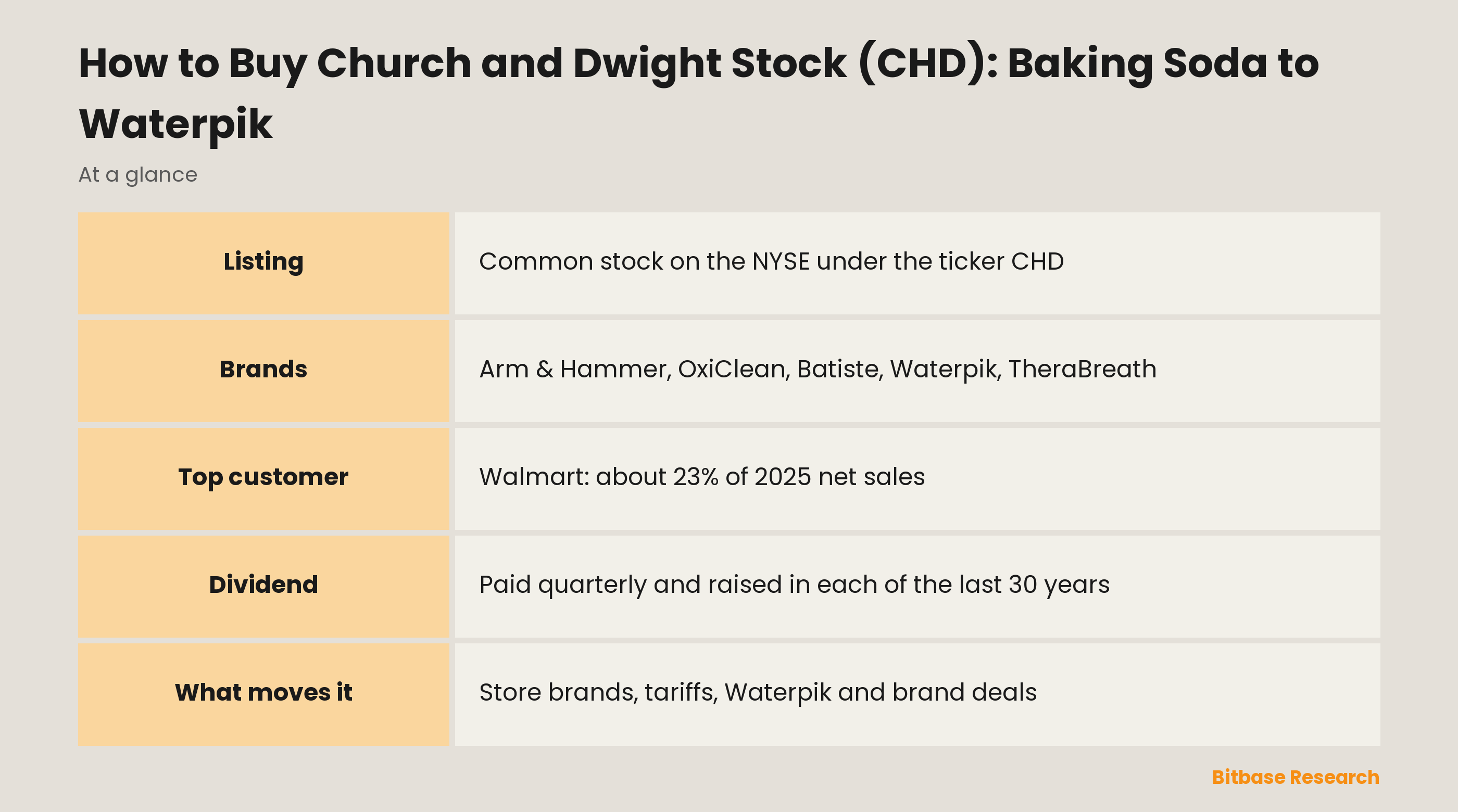
Its baking soda has been on sale since 1846, yet Church & Dwight stock is bought the ordinary way: through a broker that reaches the New York Stock Exchange, where the common shares trade as CHD. What sets the company apart is how much rides on a single retailer and a single country: in 2025 Walmart took about 23% of net sales, and customers in the United States about 82%. Below: the brands, the order itself, and what the filings flag, from store brands to a Waterpik trade name with a shrinking cushion.
What Does Church & Dwight Do?
Church & Dwight makes and markets household products, personal care products and specialty chemicals. Its annual report opens with the origin story in one line: "We were founded in 1846 and incorporated in Delaware in 1925." The founders first sold sodium bicarbonate for home baking, the Arm & Hammer trademark has been in use since 1867, and the head office is in Ewing, New Jersey.
Baking soda still runs through much of the business. It is made at plants in Green River, Wyoming, and Old Fort, Ohio, from soda ash supplied largely through a partnership with Tata Chemicals (Soda Ash) Partners that either side can end on two years' notice, and it reappears in Arm & Hammer detergent, cat litter, toothpaste and fridge deodorizers.
The modern company, though, is mostly a portfolio of acquired brands. The 10-K names seven "power brands": Arm & Hammer, OxiClean, Batiste, Waterpik, TheraBreath, Hero and Touchland. Together they "represent approximately 70% of our net sales and profits." Around them sit Trojan condoms, First Response pregnancy tests, Nair hair removal, Orajel oral pain relief, Xtra detergent and Zicam cold remedies. The filing calls Trojan "the number one condom brand in the U.S.," Batiste "the world's number one dry shampoo brand" and TheraBreath "the number one alcohol free mouthwash in the U.S.," with US rankings based on IRI retail sales data.
That list has been reshuffled lately. Church & Dwight bought Touchland, a hand sanitizer maker, on 16 July 2025. It left the Flawless, Spinbrush and Waterpik showerhead businesses by the end of 2025 and, on 31 December 2025, sold its VitaFusion and L'il Critters gummy vitamins to Piping Rock Health Products; those vitamin brands had made up less than 5% of 2025 net sales. On 28 May 2026 it added Miss Mouth's Messy Eater stain removers. Management says the exits let it "devote greater focus to our portfolio's faster growing value and premium product lines."
Named rivals include Procter & Gamble, Clorox, Colgate-Palmolive, S.C. Johnson, Haleon, Henkel, Reckitt, Kenvue and Unilever.
How Church & Dwight Makes Money
There are three reporting segments. Consumer Domestic sells household and personal care products in the United States. Consumer International sells mainly personal care products through subsidiaries in markets such as Canada, the United Kingdom, France, Germany, Australia, Mexico, Japan and China, and exports to more than 100 countries through distributors. The Specialty Products Division (SPD) sells to businesses: industrial sodium bicarbonate, feed additives for dairy cows and other livestock, and commercial cleaning products.
| Segment | Share of 2025 net sales | Share of 2025 segment operating income | Operating margin in 2025 |
|---|---|---|---|
| Consumer Domestic | 77% | 85% | 19% |
| Consumer International | 18% | 11% | 10% |
| Specialty Products | 5% | 4% | 14% |
Figures are calculated from the segment note in the 2025 10-K; the domestic margin is roughly double the international one.
Inside Consumer Domestic, household products made up about 41% of consolidated net sales in 2025 and personal care about 36%. One line stands above the rest: "Our laundry detergents constitute our largest consumer business, measured by net sales." The company deliberately keeps both premium and value brands, which accounted for 66% and 34% of 2025 worldwide consumer revenue, a mix it believes lets it "succeed in a range of economic environments."
A handful of buyers dominate distribution. Walmart and its affiliates accounted for about 23% of net sales in each of 2023, 2024 and 2025, and the four largest customers together for about 44% in 2025. Online is a rising share: global online sales were 21.4% of consumer sales in 2025 and 25.9% in the third quarter of 2026.
2025 itself was a slow year. Net sales grew 1.6% and organic sales, the company's measure that excludes acquisitions, divestitures and currency moves, grew 0.7%, held back by falling vitamin sales. Operating margin rose to 17.4% from 13.3%, mostly because 2024 had carried a large write-down of the vitamin brands. The third quarter of 2026 read differently: net sales up 1.0% after the portfolio changes, organic sales up 5.1% with volume up 4.6%, and gross margin at 46.8%. Chief executive Rick Dierker called it "our third consecutive quarter of industry-leading organic sales growth."
CHD Stock at a Glance
| Feature | CHD |
|---|---|
| Exchange | New York Stock Exchange |
| Ticker | CHD |
| Security | Common stock, the single class registered under Section 12(b) |
| Sector | Consumer staples: household and personal care products, plus specialty chemicals |
| Best-known brands | Arm & Hammer, OxiClean, Batiste, Waterpik, TheraBreath, Trojan |
| Index membership | S&P 500 |
| Headquarters | Ewing, New Jersey |
| Incorporated | Delaware, 1925 (founded 1846) |
| Fiscal year | Calendar year, ending 31 December |
| Dividend policy | Quarterly cash dividend, raised in each of the last 30 years |
| Stock splits | Two-for-one in 2011 and in 2016 |
| SEC identifier | CIK 313927 |
Quotes, market value and yield shift through every session, so none of them is printed here; for current figures, open the Church & Dwight stock page on Bitbase.
How to Buy Church & Dwight Stock
With one listed class of shares and no depositary receipt, a purchase runs through a broker in six steps:
1. Find a broker that trades NYSE stocks. Outside the United States this may be a local bank or broker with a US-equities service, or an international platform; check which legal entity holds your account and who supervises it.
2. Get the account approved. Non-US residents are generally asked for IRS Form W-8BEN, which the IRS says to submit "when requested by the withholding agent or payer."
3. Fund it. If your savings are not in US dollars, the broker converts them, and the exchange spread belongs in your cost estimate next to commissions.
4. Search for CHD. Check that the result reads Church & Dwight Co., Inc. on the NYSE before you place anything.
5. Choose market or limit. FINRA warns that with a market order "you might not get the price you saw or were originally quoted, especially in fast-moving markets"; a limit order caps the price you pay but may never fill.
6. Decide on whole or fractional shares. Many brokers sell slices of a share for a fixed amount of money. FINRA points to two catches: "At the moment, you can't transfer fractional shares to another brokerage firm," and fractional owners may not receive voting rights.
Dividends and tax abroad. Because CHD pays a quarterly dividend, holders outside the United States should expect US withholding. The IRS states that "most types of U.S. source income received by a foreign person are subject to U.S. tax of 30%," with a lower rate or exemption possible under a tax treaty, which is why brokers collect the W-8BEN. The country where you live may also tax the dividend.
Through funds. CHD is part of the S&P 500, so funds tracking that index own it; State Street's daily holdings file for SPY listed it on 10 November 2026. A fund gives you a sliver of CHD among hundreds of holdings rather than a direct stake.
What Moves CHD Stock
Big-box buyers and their own labels. With Walmart at about 23% of sales and four customers at about 44%, retailer decisions carry unusual weight. The 10-K says that in 2025 "some of our largest customers launched private label brands that compete with our products," and store-brand pressure has been sharpest in stain fighters, diagnostic kits and oral analgesics, the categories where OxiClean, First Response and Orajel compete.
Volume against price. After several years of price increases across most of its range, the company warns that further rises "may lead to declines in volume." Investors therefore watch how organic growth splits between the two: in the third quarter of 2026, volume supplied nearly all of the 5.1% organic gain.
Buying and selling brands. Batiste joined in 2011, Hero and Touchland more recently. Each deal shifts the mix, and a disappointing brand can bring a write-down, as the vitamins did in 2024 before their sale.
Tariffs and Waterpik. Waterpik is the brand most exposed to trade policy. Among its tariff responses, "most notably," it stopped importing "substantially all Waterpik flossers and certain other products from China into the U.S." After the US Supreme Court ruled on 20 February 2026 that tariffs imposed under the International Emergency Economic Powers Act were unlawful, refunds began arriving in the third quarter of 2026. Separately, the Waterpik trade name's fair value stood at 117% of its carrying value at the 2025 impairment test, down from 135% a year earlier, and further declines "could trigger an impairment charge."
Input costs. Surfactants, paper and resin-based packaging are the main raw materials. A second qualified supplier covers about 70% of direct-material spend, which eases shortages without fixing prices.
A long record against the market. The return chart in Item 5 shows that from the end of 2020 to the end of 2025, with dividends reinvested, CHD returned about 2%, against 96% for the S&P 500 and 9% for the household products index. A steady staples business is no guarantee of a rising share price.
Private Labels, One Big Customer and Other CHD Risks
From Item 1A of the 10-K, these are the risks closest to a CHD shareholder:
Competition. "We face intense competition in our markets," the section begins, citing store brands and newer online labels that, it says, Generation Z and Generation Alpha shoppers increasingly prefer.
Customer concentration. "Loss of any of our principal customers could significantly decrease our sales and profitability." Orders come one at a time rather than under long-term contracts, and most customers can leave on short notice.
Margins. "Volatility and increases in the price of raw and packaging materials or energy costs could erode our profit margins."
Mature markets. About 82% of sales come from the United States, where the filing describes consumer product markets as "considered mature," with high household penetration in laundry, cleaning and oral care.
Shrinking categories. The 10-K reports weaker demand "in recent years" for some products, "including condoms," and says inflation pushed Waterpik buyers toward "competitors' value-branded products." It also draws "a substantial percentage of our revenues" from laundry detergent.
Deals. Acquired businesses "may not be profitable," the filing warns, and the company has recorded intangible-asset impairments before.
Outside the business, one stock concentrates your money in one company, and dividends are set by the board quarter by quarter, so a 30-year run of increases is a record, not a commitment.
How to Research CHD Yourself
Filings sit on SEC EDGAR under CIK 313927. The 10-K for 2025, filed on 12 February 2026, is the core document: Item 1 lists brands, rankings, customers and raw materials; Item 1A holds the risks above; Item 5 has the five-year return chart and buyback activity; and Note 18 breaks out net sales and operating income by segment and by product line. Quarterly 10-Qs update tariffs and the Waterpik impairment test, and each earnings release is filed with an 8-K, most recently on 30 October 2026.
Two habits help. Compare reported and organic sales, because with brands entering and leaving the portfolio the reported figure alone can mislead. And whenever a release cites adjusted earnings, find the reconciliation to the reported number in the same document.
Competitors publish the same kinds of filings. Our guides to Procter & Gamble stock and Colgate-Palmolive stock cover two companies that appear both in Church & Dwight's list of rivals and in its benchmark index. For live quotes, use the CHD page linked above or browse all US stock pages on Bitbase.
Church & Dwight Stock FAQ
Can I buy Church & Dwight stock with crypto?
Not as such. CHD is bought with US dollars in a brokerage account, so crypto would first have to be sold for cash and the money transferred, and that sale can be taxable where you live. A share is a legal stake in a company with dividend and voting rights, one of the ways stocks and crypto assets differ.
Does Church & Dwight pay a dividend?
Yes, every quarter. In January 2026 the board raised the quarterly dividend by 4.2%; the company says that made 30 consecutive years of increases and 125 consecutive years of quarterly payments. Future amounts remain a board decision.
Is CHD in the S&P 500?
Yes. Church & Dwight appeared in State Street's SPY holdings file dated 10 November 2026, and the 10-K places it in the S&P 500 Household Products Index alongside Clorox, Colgate-Palmolive, Kimberly-Clark and Procter & Gamble.
Has Church & Dwight stock split?
Yes, twice in recent history, both times two-for-one: on 1 June 2011 and on 1 September 2016, each paid as a 100% stock dividend. Per-share figures in later filings are adjusted for both.
Who owns Arm & Hammer?
Church & Dwight does. Arm & Hammer, in use since 1867, is its oldest brand and covers baking soda, laundry detergent, cat litter and toothpaste; the animal nutrition unit also sells Arm & Hammer feed additives to dairy farms.
Conclusion
Church & Dwight is a set of category brands grown around a 19th-century baking soda business, and its results hinge less on any single product than on two relationships: with the retailers that stock it and with shoppers choosing between its labels and cheaper store brands. The vitamin sale, the Touchland and Miss Mouth's purchases and the Waterpik sourcing change are the threads to follow. Before buying, go through the latest annual and quarterly filings, set organic growth beside reported growth, and decide how much weight one household products company deserves in your portfolio.
Related reading
Other Bitbase articles on this topic:
- How to Buy ADM Stock (ADM): Grain, Biofuels and Dividends
- How to Buy Ambev Stock (ABEV): Skol, Brahma and AB InBev Control
- How to Buy Coca-Cola Europacific Partners Stock (CCEP): No ADR
- How to Buy FEMSA Stock (FMX): OXXO Stores and a 10-Unit ADS
Disclaimer: This article is educational content from Bitbase Academy, provided for information only. It explains what a company or fund does and how the instruments referenced here differ from one another; it does not constitute investment, trading, tax, or financial advice, and it is neither a recommendation nor an endorsement of any security, token, or trading strategy. A tokenized stock is issued by a third party and is designed to give economic exposure to an underlying asset: it is not a share, it carries no shareholder rights, and it depends on the issuer's structure, eligibility rules, and redemption terms, which the issuer can change. Perpetual futures are leveraged derivatives that hold no underlying asset and can be liquidated, and trading hours, product availability, and eligibility differ by instrument and by jurisdiction and can change at any time. Written as of November 2026; verify everything yourself through company filings, the issuer's own documentation, and the product pages of the venue you trade on.
References
[1] Church & Dwight Form 10-K for 2025 (SEC EDGAR) www.sec.gov
[2] Church & Dwight 2025 Form 10-K, XBRL cover page (SEC EDGAR) www.sec.gov
[3] Church & Dwight Form 10-Q for the third quarter of 2026 (SEC EDGAR) www.sec.gov
[4] Church & Dwight third-quarter 2026 earnings release, filed with Form 8-K (SEC EDGAR) www.sec.gov
[5] Church & Dwight fourth-quarter and full-year 2025 earnings release, filed with Form 8-K (SEC EDGAR) www.sec.gov
[6] Church & Dwight Form 10-K for 2016: 2016 stock split (SEC EDGAR) www.sec.gov
[7] Church & Dwight Form 10-K for 2011: 2011 stock split (SEC EDGAR) www.sec.gov
[8] State Street SPDR S&P 500 ETF Trust (SPY): fund page and daily holdings www.ssga.com
[9] FINRA: Order Types www.finra.org
[10] FINRA: Investing in Fractional Shares www.finra.org
[11] IRS: NRA Withholding www.irs.gov
[12] IRS: About Form W-8 BEN www.irs.gov