Satellite navigation is the foundation for building a spatiotemporal information system, and the BeiDou industry is entering a stage of large-scale application expansion. During the 2026 National Two Sessions, the National Development and Reform Commission stated that it will continue to implement the BeiDou large-scale application project and promote the BeiDou industry scale to exceed 1 trillion yuan within five years.
Recently, a semiconductor company that has been deeply engaged in this field for nearly two decades updated its IPO status.
According to Gelonghui, on November 26, Herun Electronic Technology (Jiaxing) Co., Ltd. (referred to as: Herun Electronics) disclosed its inquiry reply and updated its financial materials. The company's ChiNext IPO application was accepted on June 26, 2026, and the sponsor institution is China Securities Co., Ltd.
01 Has entered the supply chains of Chery, Desay SV, etc., with a valuation of approximately 3.1 billion yuan
Herun Electronics was established in September 2006 in Jiaxing, Zhejiang, and was converted into a joint-stock company in September 2022. Its headquarters is located in Nanhu District, Jiaxing City.
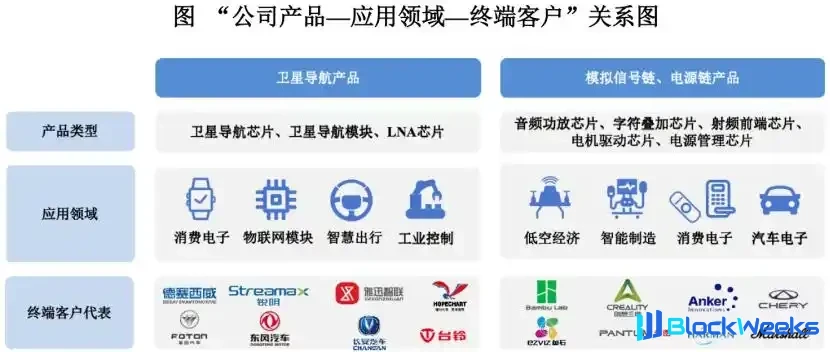
The company is an integrated circuit design enterprise deeply engaged in the fields of satellite navigation and positioning, analog signal chain, and power chain chips, adopting the Fabless model.
The company has built a product matrix centered on GNSS (Global Navigation Satellite System) chips and modules, with coordinated development of analog signal chain and power chain chips.
GNSS chips and modules are used to receive and process satellite navigation signals to achieve positioning, navigation, and timing functions;
Power chain chips mainly include motor driver chips and power management chips. The voltage of step-down products covers 5V to 120V, and the maximum current capability of step-up products reaches 30A;
Signal chain chips include audio power amplifier chips, character overlay chips, and RF front-end chips, which are used in scenarios such as audio, Bluetooth headsets, and drone image transmission.
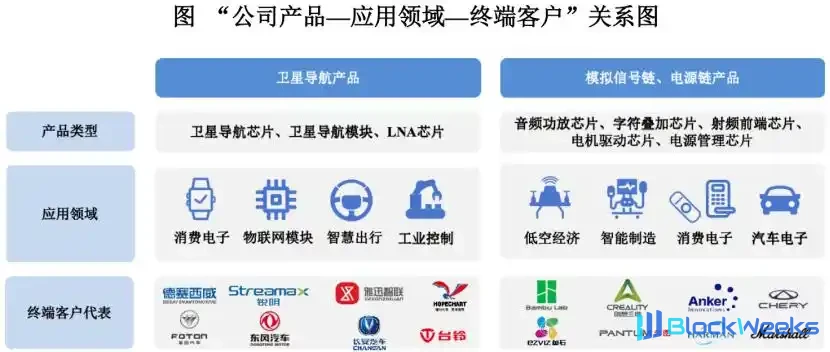
The company's main products, source: prospectus
From the perspective of revenue composition, from 2023 to the first half of 2026 (the reporting period), the revenue proportion of GNSS chips and modules decreased from 48.35% to 30.49%, and the revenue proportion of power chain chips decreased from 29.38% to 24.78%;
Correspondingly, the revenue proportion of signal chain chips increased from 22.27% to 44.73%, becoming the largest source of revenue in the first half of 2026.
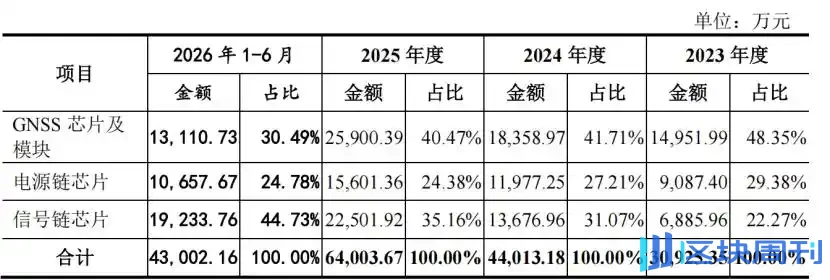
Main business revenue by product, source: prospectus
The company's upstream suppliers are mainly wafer foundries and packaging and testing plants. During the reporting period, the company's procurement amount from the top five suppliers accounted for more than 70%.
The prospectus states that due to the influence of various factors such as global trade policies, national industrial policies, and industry development cycles, the company's supply chain may face the risk of periodic tension.
On the downstream side, the company's GNSS chips and modules have entered the supply chains of manufacturers in the automotive vehicle, consumer electronics, industrial control, and communications fields, such as Yaxun Zhilian, Hongquan Technology, Streamax Technology, Desay SV, Quectel Communications, Youfang Technology, Jimi IoT, Foton Motor, Dongfeng Motor, Changan Automobile, Aima Electric Vehicles, Tailg Electric Vehicles, and State Grid.
In terms of analog signal chain and power chain products, the company has mass-produced and shipped to industry customers such as Bambu Lab, Creality, Anker Innovations, Chery Automobile, Ezviz Network, Pantum Electronics, Harman International, Marshall, Edifier, Laifen Technology, and Eastsoft Carrier.
It is worth noting that the company adopts a "non-direct sales + direct sales" sales model, and the revenue proportion of the non-direct sales distribution model has remained at around 80% in the past few years. The regulator has also raised inquiries about whether the company has the ability to independently develop customers.
02 Domestic substitution of GNSS chips accelerates, analog chip market dominated by European and American manufacturers
The industry in which the company operates can be divided into three levels: integrated circuits, GNSS chips and modules, and analog chips.
In terms of integrated circuits, the global integrated circuit market size in 2025 is approximately 4.68 trillion yuan, and the Chinese market is approximately 1.72 trillion yuan.
GNSS chip and module industry
GNSS refers to the Global Navigation Satellite System, which uses artificial satellites as spatial references to provide positioning, navigation, and timing services for various users.
At present, there are 6 GNSS systems with practical use significance in the world, among which China's BeiDou system, the US GPS, Russia's GLONASS, and Europe's Galileo are the four mainstream systems.
From the perspective of the industrial chain, the GNSS industrial chain is divided into the space segment, the ground segment, and the user segment. The space segment and the ground segment are mainly handled by national teams.
Herun Electronics is located in the user segment. The user segment industrial chain can be divided into upstream chips, boards, modules, and antennas, midstream terminals and software, and downstream various application scenarios. The company's products are precisely the upstream GNSS chips and modules.

GNSS industrial chain situation, source: prospectus
In terms of market size, in 2025, the market size of China's GNSS chips and modules is approximately 10.33 billion yuan, and it is expected to reach 20.19 billion yuan by 2030.
By application, passenger vehicles are the largest application market, with a market size of 3.77 billion yuan in 2025; the low-altitude economy has the fastest growth, with a market size of 1.08 billion yuan in 2025, and it is expected to reach 3.90 billion yuan by 2030.

Global and China GNSS chip and module market size, Source: Prospectus
Analog Chip Industry
Analog chips are the first gate for processing continuous external signals, and can be divided by function into power chain chips and signal chain chips. The company covers both product categories.
Analog chips are the bridge connecting the real world and the digital world, existing in almost all electronic products and devices, with applications everywhere.

Classification of analog chips, Source: Prospectus
In 2025, China's analog chip market size was 221.25 billion yuan, and is expected to reach 410.79 billion yuan by 2030.
By downstream segment, automotive is the most core growth engine. In 2025, China's automotive analog chip market size was 45.27 billion yuan, and is expected to reach 128.17 billion yuan by 2030; in addition, the low-altitude economy sector is also growing relatively fast.

China's analog chip market size (by application field), Source: Prospectus
In terms of competitive landscape, in the GNSS chip field, major foreign competitors include Qualcomm and u-blox (wholly acquired by onsemi in 2024), while major domestic players mainly include BDStar, Allystar, ComNav Technology, Techtotop, Mengxin Technology, etc.;
According to Frost & Sullivan data, from 2023 to 2025, the company's GNSS chip and module shipments ranked among the top two among relevant domestic manufacturers.
In the analog chip field, the top five manufacturers—Texas Instruments, Analog Devices, Infineon, STMicroelectronics, and NXP—together account for approximately 40% to 50% of the global market share, and domestic enterprises still lag behind.
The company selected Awinic, Southchip, JoulWatt, BPS, and Chipsea as comparable companies in the same industry.
In 2025, the average operating revenue of the eight comparable companies was 1.747 billion yuan, and the average net profit attributable to the parent company after deducting non-recurring gains and losses was -98.8037 million yuan; Herun Electronics' operating revenue in the same period was 640 million yuan, and its net profit attributable to the parent company after deducting non-recurring gains and losses was 142 million yuan.

Comparison of 2025 operating data of comparable companies in the same industry, Source: Prospectus
03 Revenue has grown somewhat, and R&D expenses have a certain gap compared with comparable companies in the same industry
In recent years, driven by factors such as growth in downstream demand, improvement in the localization rate, and the launch of new products, Herun Electronics' revenue has grown somewhat.
During the reporting period, the company's operating revenue was 309 million yuan, 440 million yuan, 640 million yuan, and 430 million yuan, respectively, and net profit was 28.7314 million yuan, 65.2343 million yuan, 128 million yuan, and 97.6615 million yuan, respectively.
During the reporting period, the company's gross profit margin of main business was 29.10%, 35.37%, 37.14%, and 37.65%, respectively.

Main financial data during the reporting period, Source: Prospectus
It is worth noting that the advanced nature of Herun Electronics' core technology was questioned by regulators, including whether the company's R&D expenses are sufficient to support the R&D iteration of related technologies:
During the reporting period, the company's R&D expenses were 43.2909 million yuan, 71.4629 million yuan, 88.1734 million yuan, and 42.2523 million yuan, respectively. Compared with comparable companies in the same industry, there is a certain gap in the scale of R&D investment;
In the same period, the R&D expense ratios were 14.00%, 16.24%, 13.78%, and 9.83%, respectively. The company stated that there is no major difference from comparable companies in the same industry.
As of the end of June 2026, the company had a total of 117 employees, including 63 R&D personnel, accounting for 53.85%.
In addition, there are two noteworthy aspects on the company's asset side. First, accounts receivable grew relatively fast. At the end of each reporting period, the company's accounts receivable balance was 51.6594 million yuan, 72.0584 million yuan, 119 million yuan, and 126 million yuan, respectively; the overdue proportion of accounts receivable was 30.86%, 34.09%, 29.99%, and 39.78%, respectively.
Second, the scale of inventory increased significantly. At the end of June 2026, the book balance of inventory was 264 million yuan, of which work in progress was 145 million yuan. The company carried out a certain amount of stockpiling to meet customer demand.
Affected by this, the company's net cash flow from operating activities decreased from 92.8099 million yuan in 2023 to 14.1215 million yuan in 2024 and 20.9980 million yuan in 2025, and was 26.1617 million yuan in the first half of 2026.
Before this issuance, Yin Ming, through direct and indirect means, controlled a total of 53.25% of the company's voting rights and is the actual controller.
Yin Ming was born in June 1965 and holds a master's degree. From 1989 to 2005, he successively held positions at the School of Management of Shanghai Jiao Tong University, the Shanghai Branch of Industrial Bank of Japan, Pudong New Area State-owned Assets Investment Management Co., Ltd., the Shanghai Branch of China Merchants Bank, and Shanghai Industrial Development Co., Ltd. Since September 2006, he has successively served as the company's executive president, director, chairman, and general manager, and currently serves as chairman and general manager.
In the equity transfer in May 2026, the company's overall valuation was approximately 3.1 billion yuan. The company's major institutional shareholders include Gaoxin Venture Capital, Yingfutek, Puhua Capital, Caitong Hengxin, and others.
In this IPO, Herun Electronics plans to raise 1.2 billion yuan, mainly for investment in three projects including the research and development and industrialization of low-orbit collaborative all-frequency-point high-precision secure and trustworthy GNSS chips, as well as 100 million yuan for supplementing working capital.
It is worth noting that during the reporting period, the company distributed cash dividends twice, distributing 5.7 million yuan for the 2024 fiscal year and 12.6 million yuan for the 2025 fiscal year.

Fundraising investment projects, source: prospectus
In the future, whether the company can continue to develop and iterate new products, seize the opportunities of the domestic substitution wave amid cyclical fluctuations in downstream industries, and achieve steady performance growth, Gelonghui will continue to pay attention.
This article is from the WeChat public account "Gelonghui New Stocks", author: Brother Fa Talks New Stocks