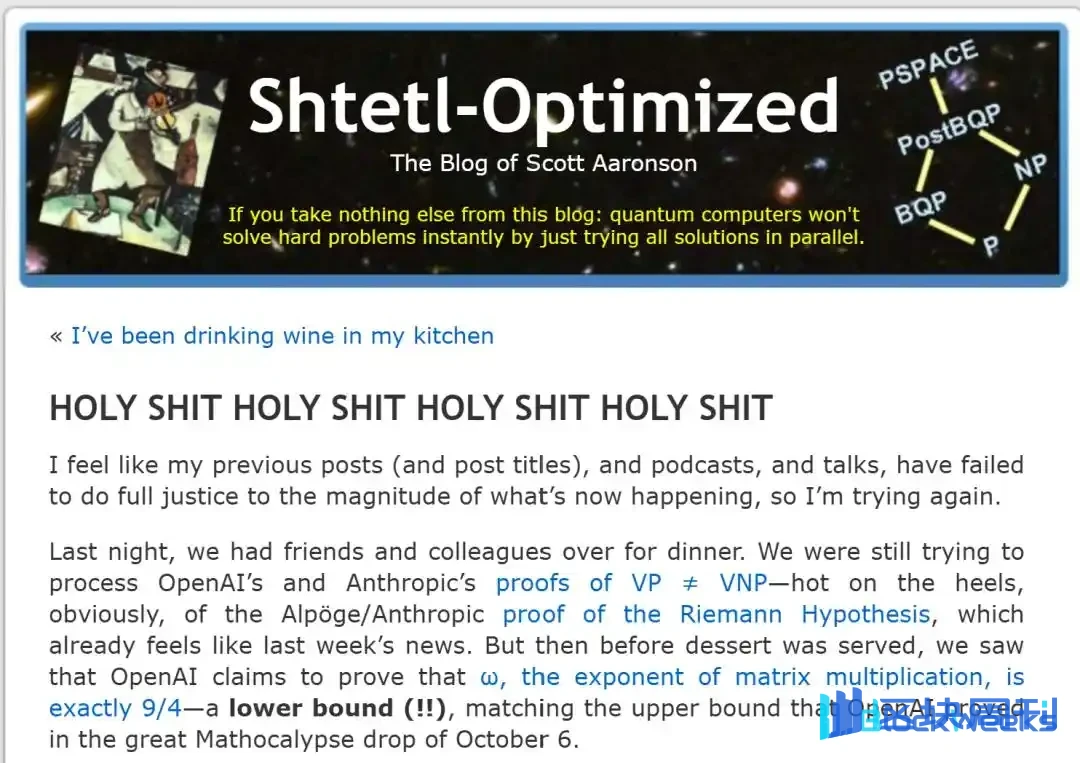
AI may have already found a way to crack existing cryptographic systems—it just hasn't been announced yet.
No way, how much stuff are OpenAI and Anthropic (A社) still hiding??
Just moments ago, both companies announced they had proven the algebraic version of P vs NP, VP≠VNP.
Right after that, Scott Aaronson, a big name in theoretical computer science, dropped an even more astonishing piece of news:
I've learned from multiple reliable sources that it's almost certain AI labs are still holding one or even several cryptography "blockbusters."
(The title is quite blunt too—HOLY SHITx4)
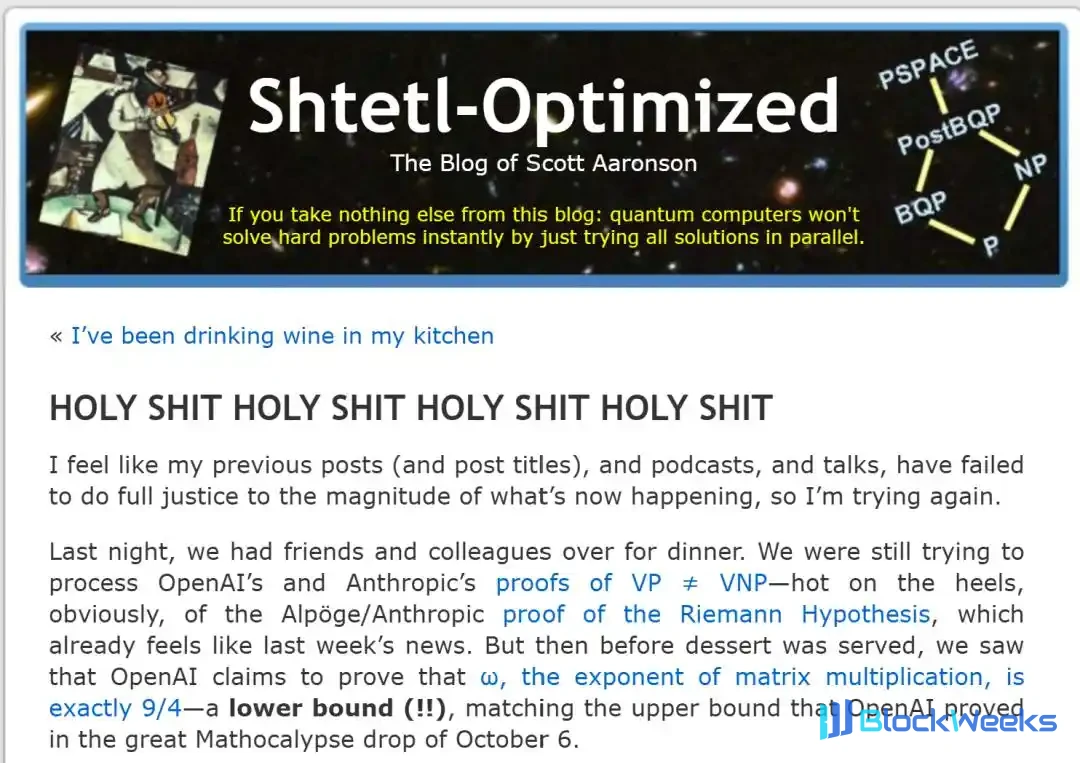
Honestly, if anyone else said this I might have doubts, but Scott is different.
He is a computer science professor at the University of Texas at Austin and a well-known figure in quantum computing and computational complexity theory.
Moreover, he has a rather intriguing identity—a former OpenAI researcher, where he specifically worked on AI safety issues.
With the right expertise and having worked at a major AI company, it's not surprising he gets to hear some gossip before the rest of us. (doge)
No wonder that as soon as Scott's revelation came out, people in math, AI, and cryptography circles instantly couldn't sit still...
After much speculation, everyone ultimately locked their eyes on one key question:
Could the large integer factorization problem that underpins the RSA encryption system have already been cracked by AI??
You know, if this really happens, it won't just affect the math world.
When we shop online, make payments, log into websites, and transmit confidential files, cryptography is behind it all—and RSA is one of the widely used public-key cryptographic algorithms.
This is such a big deal that even Nature caught wind of it and published a piece asking:
Has AI already cracked internet encryption?
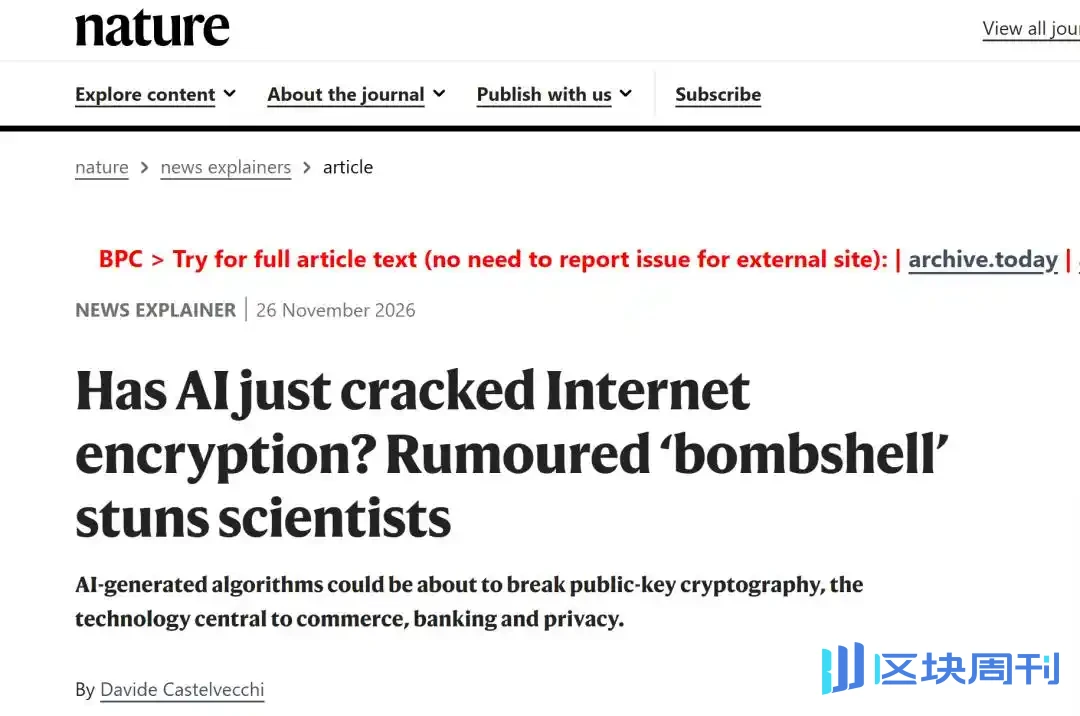
OpenAI and Anthropic may still have big moves up their sleeves
This all started with a dinner Scott had.
On the very day OpenAI and Anthropic both announced their proof of VP≠VNP, he was having dinner with several friends and colleagues.
Over the course of one meal, OpenAI went on to release math research results related to matrix multiplication and the fast Fourier transform.
At that speed, a whole table of theoretical computer science researchers was left utterly stunned.
While eating, everyone was frantically refreshing OpenAI and Anthropic's GitHub repositories on their phones and laptops.
After all, these two companies can't even be bothered to issue press releases now—who knows which math problem that has plagued humanity for decades will be solved on the next refresh...

And beyond the frantic refreshing, Scott, who once worked at OpenAI, couldn't help but worry—
The results already released are this astonishing—what about the ones that haven't been released yet?
In fact, as early as the comment section of his previous blog post, a netizen had asked him:
Have OpenAI or Anthropic already found a polynomial-time algorithm for integer factorization (Factoring in P)?
At the time, Scott revealed that he had heard many rumors claiming that at least one of OpenAI and Anthropic had already found such an algorithm.
I've now heard many, many rumors that one or both labs are sitting on Factoring in P.
However, as the matter spread further, Scott later added a strikethrough to that reply, reminding everyone not to treat rumors as confirmed facts.
And in his latest blog post, Scott simply clarified exactly how certain he could be:
I'm almost certain that AI labs are still holding major, undisclosed cryptographic breakthroughs. As for whether it's specifically integer factorization, it's hard to say at the moment.

No wait, why is everyone fixated on integer factorization?
Let's do a math problem.
What is 17×23?
391. Although we're past our peak intelligence, with a bit of time we can still work it out in our heads.
But if we reverse it and only tell you 391, asking you to find which two primes multiply to give it?
Obviously it takes a lot more effort.
Now replace those two primes with numbers that each have hundreds of digits. Multiplying them forward is still a breeze for a computer, but reversing the factorization makes the difficulty skyrocket.
The important security foundation of the RSA encryption algorithm is precisely this asymmetry in computational difficulty.

For the past few decades, mathematicians have been trying to find more efficient integer factorization algorithms.
If AI really finds a sufficiently practical polynomial-time algorithm, then the security foundation of RSA would be shaken.
And, don't dismiss it—AI has already started turning in homework in this direction.
On November 25, Google publicly released six math papers generated by the AI system Cogentic in one go.
Looking closely, two of them are precisely about integer factorization, and another involves another important mathematical hard problem in cryptography—the discrete logarithm.

Although the integer factorization algorithms Google has currently disclosed have not yet reached polynomial time, at least judging from these papers, AI has begun making progress on the mathematical hard problems that cryptography relies on.
And then, the question arises—
Google has already turned in homework in this direction, so what about the OA duo, who lately keep causing an "earthquake" in the math world at the drop of a hat?
And combined with Scott's tip-off...
Hiss, I dare not think too deeply...
Some Reddit users have even spotted an intriguing detail:
Previously, OpenAI released in one go research results involving 722 math problems, covering almost every field of mathematics, yet cryptography was nowhere to be seen.

It's just, really not right.
They used to rush to publish papers, now they might not dare to?
Anyway, since we can't sit still, why not "probe" OpenAI in reverse??
Just today, a user named Cassie Heart on X revealed that while researching
EC
C (Elliptic Curve Cryptography), they encountered something strange.
With the same research approach, previously GPT Astra 6 was willing to continue researching with them, but switching to Astra 6.2—well, it directly wouldn't let them talk about it.
This user immediately became alert:
Could it be that OpenAI has almost cracked ECC??
You should know,
EC
C, like the aforementioned RSA, is also a mainstream public-key cryptography technology today, widely used in HTTPS secure communication, digital signatures, and other scenarios.
To prevent OpenAI from suddenly dropping a paper someday and taking all the credit, this user simply posted the SHA-256 hash corresponding to their research approach online, leaving proof in advance.

Of course, the model refusing to continue the discussion alone doesn't prove that OpenAI has really made a breakthrough.
But this matter is quite subtle when you think about it.
A few days ago, the OA duo, in order to fight over who gets first authorship of VP≠VNP, were so eager that they wanted to pin down the time of the proof to the exact hour and minute.
But if someone really were the first to break RSA or
EC
C...
Would anyone still dare to take the lead?
After all, according to Dan Boneh, a renowned cryptographer at Stanford University, once AI finds a new method to break mainstream public-key cryptosystems, the entire internet could be affected.
More critically, this doesn't even have to wait until the P vs NP problem is solved.
When AI Weekly reported on this matter, it specifically pointed out that the mathematical hard problems that RSA and
EC
C rely on have never been proven to be NP-complete problems.
That is to say, AI doesn't even need to conquer the century-old problem of P vs NP to potentially break existing cryptosystems.

Thinking of this, looking back at the recent atmosphere in the math world, it feels a bit surreal.
As AI successively cracked mathematical problems, a wave of "finding fault" with AI has also surged online.
Some questioned the correctness of the proofs, some questioned whether AI truly has original capability, and others simply had AI refute the proofs given by AI.
For a time, mathematical proofs and "refutations" targeting the proofs were flying everywhere.
In response, Scott also quoted a comment from a friend in his blog to express his attitude:
After years of absurd "solutions" claiming that the Millennium Prize Problems had been solved, now that we have real solutions, absurd "refutations" have appeared claiming that the Millennium Prize Problems have not been solved. In a sense, this is simply a brilliant irony.

Anyway, it's hard to argue this matter to a conclusion in a short time.
But considering the risks AI may bring, the financial sector, which is deeply tied to cryptography, has already started to act.
On November 26 local time, the Bank of England released its latest Financial Stability Report.
The report specifically mentioned the cybersecurity risks that frontier AI may bring, while also urging financial institutions to accelerate their migration to post-quantum cryptography technology.

Speaking of which, for so many years, humanity has been preparing for the cryptographic threats that quantum computers may bring.
New cryptographic algorithms have been researched, and countries have gradually begun deployment.
Who would have thought?
Before the quantum computer arrived, the AI next door that does math problems every day might come and snatch the job first...
Moreover, post-quantum cryptographic algorithms also have their own mathematical security assumptions; being able to defend against known attack algorithms of quantum computers does not mean they can defend against entirely new solutions found by AI.
The most heartbreaking part is that, at the current pace, a major breakthrough by AI in mathematics might happen in the time it takes Scott to eat dinner.
But for banks, enterprises, and government agencies around the world to replace all their cryptographic systems...
That's not something that can be solved by just eating a few more meals.
One More Thing
After witnessing a series of recent AI mathematical breakthroughs, Scott felt for the first time, genuinely, that "the proof of P≠NP may not be far away."
He even lamented that what happened in the past week was very similar to what he had imagined the arrival of the AI singularity would look like.
He only hopes that this singularity will be confined to their small world of researching mathematical problems.
But now it seems that this is already a bit difficult...
This article is from the WeChat public account "Quantum位", author: Focus on Frontier Technology