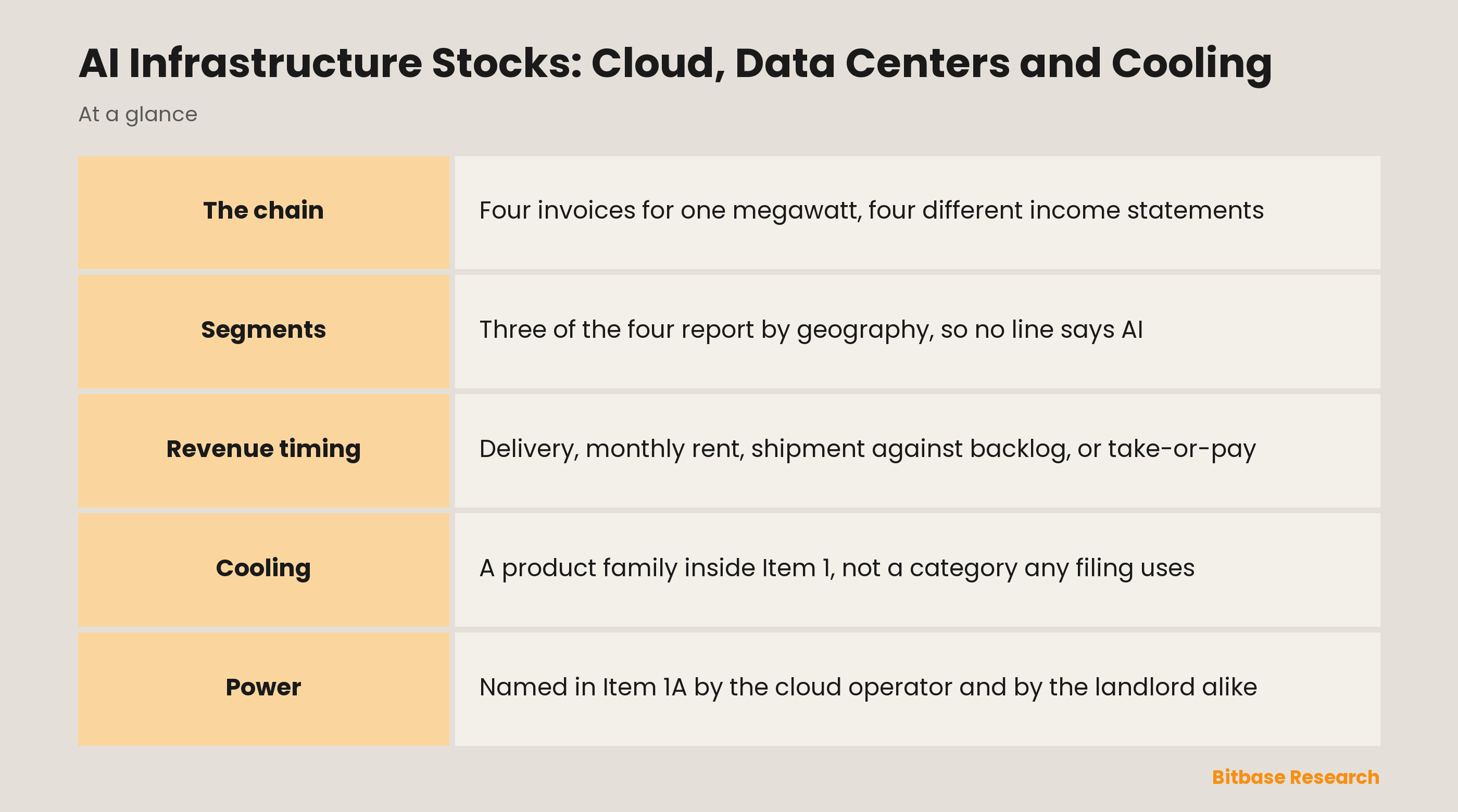
A single megawatt of AI capacity is invoiced four times before a model ever runs on it: once for the power and cooling gear, once for the room, once for the servers, once for the compute. Four listed companies collect those four invoices, and each books the money on a different line. This page reads what the four of them file, because the label they share is the part that says least.
The Same Megawatt, Billed Four Times
Start at the wall socket and work inwards.
Vertiv Holdings Co is a Delaware company whose Class A common stock is registered under Section 12(b) and trades on the New York Stock Exchange as VRT. Item 1 calls it a global leader in "critical digital infrastructure for applications in data centers, communication networks, and commercial and industrial environments." What it sells is equipment: power management, thermal management, switchgear and busbar, racks, uninterruptible power supplies, plus a separate services and spares line.
Equinix, Inc. lists its common stock on Nasdaq as EQIX and describes itself as "the world's digital infrastructure company." It owns the rooms, sells infrastructure and interconnection inside them, and operates as a REIT for federal income tax purposes — a tax structure rather than a business description, but one that governs what it does with cash.
Dell Technologies Inc. registers Class C Common Stock on the New York Stock Exchange as DELL and opens Item 1 as "a leader in the global technology industry" building for the data and artificial intelligence era. It ships hardware into those rooms.
CoreWeave, Inc. registers Class A common stock on Nasdaq as CRWV and calls itself "The Essential Cloud for AI." It rents the finished capacity out by the contract; its share classes and the routes to the ticker are covered in how to buy CoreWeave.
Two of the four call themselves a leader in their own Item 1, and a third calls itself the world's digital infrastructure company. Those are self-descriptions, not measurements, and nothing later in the document turns them into measurements.
Where the Money Lands, and When
| Company | What the invoice is for | When it turns into revenue | How the filing divides it |
|---|---|---|---|
| Vertiv (VRT) | Power and thermal equipment, service and spares | On delivery, then continuously on the service line | Three geographic segments |
| Equinix (EQIX) | Space, power and interconnection in its own buildings | Monthly recurring, with some non-recurring | Three geographic segments |
| Dell (DELL) | Servers, storage and networking shipped to a buyer | On fulfilment, drawn from a backlog | Two business units |
| CoreWeave (CRWV) | Contracted capacity on a cloud it runs itself | Across multi-year take-or-pay contracts | Three service lines |
The vocabulary gives the shape away. Equinix reports "monthly recurring revenue" and separates what is non-recurring, which is how a landlord counts. Dell says product backlog "represents the value of unfulfilled manufacturing orders," which is how a manufacturer counts. CoreWeave writes that customers "purchase a specified amount of capacity on a take-or-pay basis over the contract term" under multi-year committed contracts, which is money promised before the capacity is delivered and owed whether or not it is used.
So the question is not which of them is most exposed to AI. It is what has to happen next for each of them to be paid again. Vertiv needs another order, Dell another shipment against the backlog, Equinix a tenant that renews. CoreWeave has been promised the money already and needs to deliver with the counterparty still standing. The other infrastructure bucket covered here, the stablecoin one, has an interest rate at the top of the income statement; nothing in these four works that way.
No Segment Here Is Called AI
Vertiv reports three segments and cuts them by geography: Americas, Asia Pacific, and Europe, Middle East and Africa. Equinix reports three and cuts them the same way. Neither has a segment for data centers, so gear and space sold into an AI build sit in the same bucket as gear and space sold into a telecoms network.
Dell reports two business units, and AI-optimized servers is a product category inside Infrastructure Solutions, next to traditional servers and networking and next to storage. Dell does say plainly that demand for AI-optimized servers kept driving backlog growth across its last two fiscal years, but that is a sentence in the discussion rather than a column in the statements, and the same filing notes that demand for the traditional server and networking line outpaced supply as well.
CoreWeave is the exception, because all three of its delivery names describe one business.
For three of the four, how much of this is AI cannot be read off the financials at all. Any figure that answers the question was estimated outside the filing. What to check in a segment note first is not the numbers but whether the question being asked can be answered there.
Cooling Is a Product Category, Not a Theme
Vertiv's Item 1 product list is where cooling stops being a talking point and becomes a line of goods: thermal management, air and liquid cooled thermal systems, integrated modular solutions, and the rack power distribution beside them. Air and liquid are both on the list because both are ways of moving heat out of a rack. Next to them sits a services and spares line naming preventative maintenance, acceptance testing, engineering and consulting, remote monitoring and spare parts.
That second line is the one to notice. Equipment is sold once per deployment, while maintenance and spares recur for as long as the installed base runs, so an order book and an installed base are two different assets inside one company. It also puts the phrase "data center cooling stock" in its place: not a category any of these filings uses, but one product family, inside one geographic segment, inside one company.
The Constraints They Name Themselves
Risk factor headings are the most disciplined part of a filing, because a company writes them about itself and has to keep them current.
Power is named by the tenant and the landlord in almost the same words. CoreWeave files a risk factor about not being able to access sufficient power, about increased costs to procure it, and about "prolonged power outages, shortages, or capacity constraints." That phrase appears in the Equinix annual report for the same year. Two companies at different layers of one stack describe a single physical constraint in matching language.
Vertiv's first risk factor is about its customers rather than itself. It relies, it says, on "the continued growth of our customers' critical infrastructure systems, in particular data center and communication infrastructure" to grow its business, operations and revenue. What it is exposed to is their capital budgets.
Dell discloses that it will use "a single source or a limited number of sources of supply" where it judges that advantageous. CoreWeave files separate headings on substantial indebtedness and on continuing capital expenditure: the equipment is bought before it earns anything, and that bridge is priced in credit markets rather than in AI ones.
Customer concentration is a heading in CoreWeave's filing, and the heading is where this page stops. Naming the customers or repeating a concentration figure would outlive the document it came from.
What the Ticker Resolves To
A last layer stands between a reader and any of these companies: the short code on a crypto venue is not always that company's share. On the Vertiv price page, VRT is a tokenized stock created by an outside issuer, which delivers economic exposure while leaving behind the rights that come with a share. Coverage is uneven: some names have a tokenized market and others do not, so the tokenized stock listings settle it. Check who issued the instrument before assuming a page is about the company, because the same short code sometimes belongs to an unrelated crypto project.
The Bottom Line
The four filings answer four different questions and the shared label answers none of them. Vertiv sells hardware and then services it. Equinix leases space under a tax structure that governs its cash. Dell ships boxes against an order book. CoreWeave sells capacity forward and borrows to build what it has promised. Read the cover page for what is actually registered, Item 1 for how the business is divided, the risk factor headings for the constraints the company admits to, and the discussion for the contract language before deciding which of the four exposures is being taken. The label will still be here next year; the constraints are what move.
Related reading
Other Bitbase articles on this topic:
- What Is POND? Marlin, Oyster, and Asset Boundaries
- What Is Venice AI?
- What Is Wayfinder?
- DePIN Network Types
- Auto Compounding vs Manual Staking: What the Difference Is Worth
Disclaimer: This article is educational content from Bitbase Academy, provided for information only. It explains what a company or fund does and how the instruments referenced here differ from one another; it does not constitute investment, trading, tax, or financial advice, and it is neither a recommendation nor an endorsement of any security, token, or trading strategy. A tokenized stock is issued by a third party and is designed to give economic exposure to an underlying asset: it is not a share, it carries no shareholder rights, and it depends on the issuer's structure, eligibility rules, and redemption terms, which the issuer can change. Perpetual futures are leveraged derivatives that hold no underlying asset and can be liquidated, and trading hours, product availability, and eligibility differ by instrument and by jurisdiction and can change at any time. Written as of September 2026; verify everything yourself through company filings, the issuer's own documentation, and the product pages of the venue you trade on.
References
[1] Vertiv FY2025 Form 10-K: self-description, geographic segments, product lines, risk factors www.sec.gov
[2] Equinix FY2025 Form 10-K: REIT status, geographic segments, recurring revenue, power risk www.sec.gov
[3] Dell FY2026 Form 10-K: ISG and CSG, AI-optimized servers, backlog, supply sourcing www.sec.gov
[4] CoreWeave FY2025 Form 10-K: service lines, take-or-pay contracts, power and debt risks www.sec.gov