When a tokenized stock and the share it references print different prices on the same afternoon, nothing has necessarily broken. The token is not the share, and what it actually is depends on which issuer created it. What follows is a checklist, not a warning: five places where risk lives, and the question that settles each one.
Issuer Risk Is Not One Risk
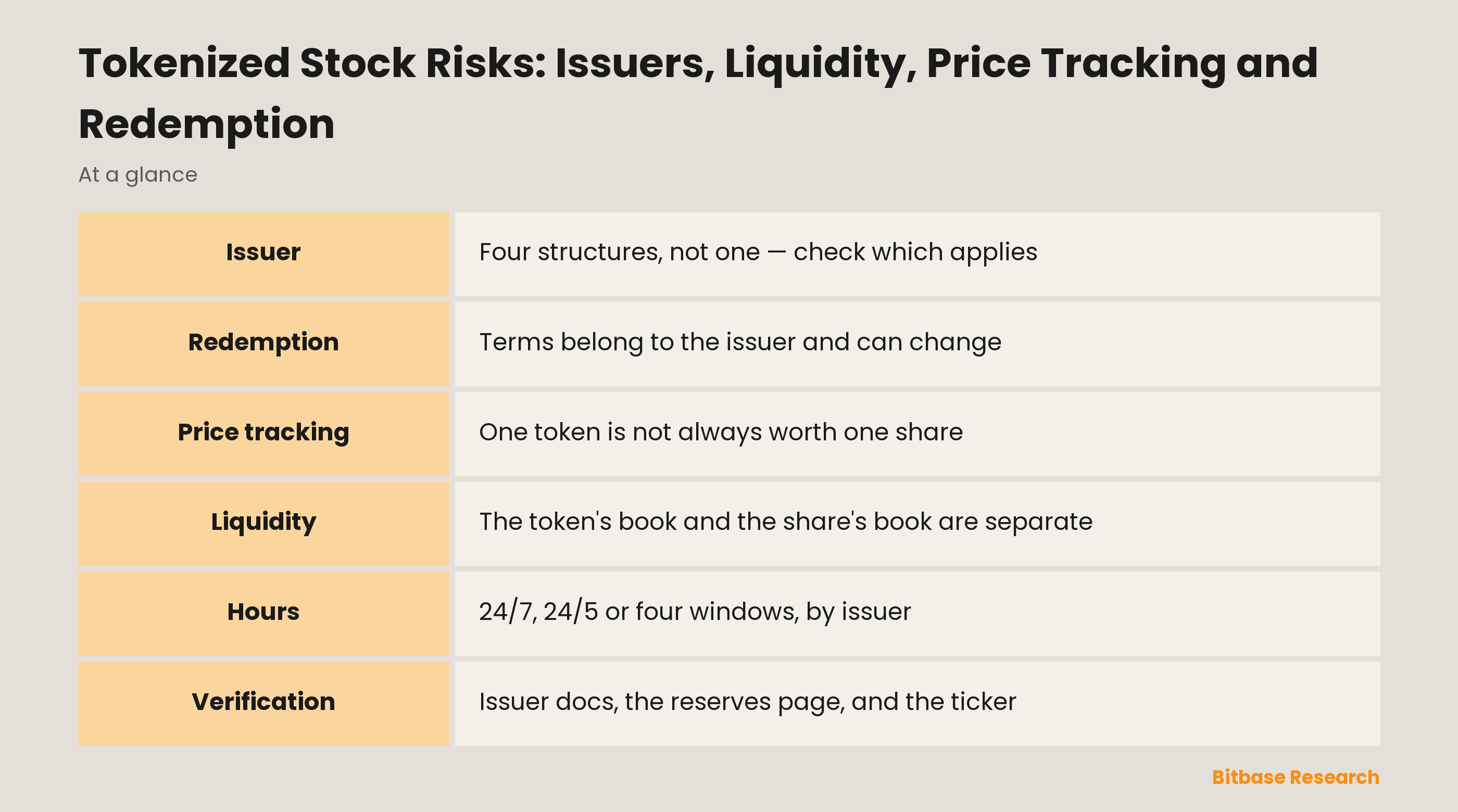
Begin with the issuer, because tokenized stocks are not one product with one risk profile. Four widely circulated issuers build them in structurally different ways, and the differences land where risk is measured.
| Issuer | What the token is | Backing | Trading hours |
|---|---|---|---|
| Ondo | Tokenized stock, built as a total return tracker | Not one token per share | 24/5, some tokens off-hours |
| xStocks, from Backed Assets (JE) Limited | Tokenized security from a Jersey company | 1:1, underlying in regulated custody | 24/7 on-chain |
| Robinhood Europe, UAB | A derivative contract with Robinhood | Underlying owned by Robinhood | Monday 02:00 to Saturday 02:00 CET |
| Dinari | dShare, minted after a broker order fills via Alpaca | 1:1 with the security | Four windows, some tickers 24/7 |
One row differs in kind from the other three. Robinhood's Classic Stock Tokens are derivative contracts between you and Robinhood, priced at the prices of the underlying securities without granting rights to them, and those underlying assets are owned by Robinhood and held with a US-licensed institution. The exposure is therefore a counterparty exposure: what settles it is what happens to the contract if the issuer does not perform, not where shares sit. Robinhood Europe, UAB is supervised by the Bank of Lithuania. But a regulated issuer is not the same thing as a risk-free product, and the two get conflated constantly.
The other three put the weight on custody and redemption. xStocks are described by their issuer as tokenized representations of specific US equities and ETFs, each backed 1:1 by the underlying asset in regulated custody. A dShare is backed 1:1 by a security, and Dinari mints or burns one only once the matching broker order fills through Alpaca. Ondo is the outlier: Ondo states plainly that one token does not necessarily represent the value of one share, because its tokens are total return trackers that reinvest dividends, net of withholding tax, instead of paying them out.
Dividends alone show how little carries across. Ondo reinvests them. Robinhood passes a corresponding amount to eligible holders in cash. Dinari distributes once the underlying cash arrives, paying direct holders in USD+ and depositing dShares into wrapped positions. For xStocks the treatment was not verified, so it is not described here.
Shareholder rights fragment the same way. Ondo states that holders receive no voting rights, statutory information rights or other shareholder rights. Robinhood states its tokens grant no rights to the underlying shares or ETPs. Backed describes an xStock as a claim on the value of the collateral rather than on the rights attached to it, which is a different sentence. Dinari's documentation, in the pages read here, does not address it. There is no general rule about shareholder rights — there are four positions, and one is silence.
Redemption Runs on Terms the Issuer Can Change
A tokenized stock is designed to give economic exposure to an underlying asset, and it depends on the issuer's structure, eligibility rules and redemption terms, which the issuer can change. That is structural, not cautionary: redemption is a policy of the company that issued the token, and policies get rewritten.
Redemption is also where public statements stop agreeing. For xStocks, the issuer's site and its news pages describe the form differently: one reads as cash value or the underlying itself, the other as cash against the underlying's market price but not the asset. Because they conflict, the accurate statement is the narrow one: the token is redeemable with the issuer, in whatever form current terms specify.
Rates, minimums and processing times are deliberately absent here: a stale redemption fee is worse than no figure at all. Eligibility behaves the same way. Ondo describes its tokens as generally available to non-US investors subject to jurisdictional and other restrictions, and xStocks states it is not available in the United States or to US persons. At least one issuer's documentation points both ways on a jurisdiction question, which is itself the argument for reading issuer pages rather than summaries.
Tracking Risk Is Not a Depeg
Ondo carries the clearest published statement of the tracking problem: one token does not necessarily represent the value of one share, and the price of one token will not always match the price of the underlying asset. That describes the instrument; it is not a defect notice.
The crypto word for a price that leaves its reference is depeg, and borrowing it hides three mechanisms. A stablecoin depeg and a tracking gap are not the same event. A stablecoin depeg is a deviation from a fixed target, and that target is the entire product. A tokenized stock has no fixed target: it references a moving price, and a gap can come from the structure itself, from the reference market being closed, or from nobody standing on the other side of the book.
The price a token trades at and the reference price a venue calculates for it are two more separate things. Which sources feed that reference, how they are smoothed, and what it does when the underlying has produced no fresh prints are venue-specific parameters, and only the platform's contract rules page is authoritative. An oracle reading a closed market reads the last price it saw, however old.
Two Order Books, Not One
The token and the share trade in different places, to different people, at different times, so depth in one says nothing about depth in the other. A share can be among the world's most liquid instruments while its tokenized version sits on a book thin enough that an ordinary order moves it. That is two order books, not one, the most common surprise for holders arriving from equities.
Liquidity matters most on the way out. Redemption with the issuer is no substitute for a bid, because it runs on the issuer's terms and timetable rather than on demand. Fragmentation compounds it: the same token can exist across several chains and venues, its depth split among them rather than pooled.
Dinari publishes a concrete version. Outside regular market hours, market orders are converted into marketable limit orders, which may fill completely, partially or not at all. Its Open window is on-chain only, covers a limited set of tickers, and carries lower liquidity. That is not a flaw peculiar to one issuer; it is what a thin book does, written down.
The Calendar Under the Token
The four issuers do not share a clock. xStocks are described as tradable 24/7 on-chain. Ondo trades 24/5, with a smaller set available off-hours, and suspends around corporate actions and risk events. Robinhood runs Monday 02:00 to Saturday 02:00 CET. Dinari splits the day into a regular session, pre-market and after-hours windows taking limit orders only, an overnight window, and an Open window covering the weekend for some tickers.
Underneath all four sits the same reference market, which closes each weekday evening, all weekend and on holidays. The token keeps pricing while the reference market is shut. News arriving after the close is absorbed by the token first and by the share only when its exchange reopens, so the two can be far apart at the bell, and the holder meets that distance as a gap rather than a trend.
How to Check One Before You Hold It
Three pages settle most of it, and none is a chart.
Start at the issuer's documentation, identified by name rather than by the venue listing the token. All four structures above are disclosed by their issuers, in their own words and briefly: what the token legally is, what stands behind it, how dividends are handled, what the redemption terms say.
Then read the reserves page. Proof of reserves shows what is held at the moment the report was produced. It does not tell you what you can redeem, from whom or how quickly, and it is not an audit.
Finally, confirm the ticker refers to the company at all. A ticker is not an identifier across markets: the same short string routinely belongs to an unrelated crypto project. ES resolves to Eclipse, CME to Commodity Market Exchange, ICE to Ice Open Network and VIX to a meme coin, none of them the equity or index those letters suggest. Checking the name behind the ticker is cheap, and it catches the most expensive mistake here.
The Bottom Line
Tokenized stock risk does not generalise, and the four issuers are the proof: one sells a derivative contract, one a tracker explicitly not worth one share per token, and two sell tokens backed one for one but redeemable on their own terms. The mechanism is shared; the issuer is not. The primary sources here are the issuers' own documentation pages, listed below; for anything venue-specific the platform's contract rules page supersedes any guide.
Related reading
Other Bitbase articles on this topic:
- How to Buy SCHD: Dividend Exposure, Costs and Comparison with QQQ
- How to Buy Snowflake (SNOW) Stock: Trading Methods, Costs and Risks
- How to Buy SoFi (SOFI) Stock: Trading Methods, Costs and Risks
- VTI ETF Explained: A Sample of the Whole US Stock Market
- What Is a Timestamp in Blockchain? Why It's Approximate
Disclaimer: This article is educational content from Bitbase Academy, provided for information only. It explains what a company or fund does and how the instruments referenced here differ from one another; it does not constitute investment, trading, tax, or financial advice, and it is neither a recommendation nor an endorsement of any security, token, or trading strategy. A tokenized stock is issued by a third party and is designed to give economic exposure to an underlying asset: it is not a share, it carries no shareholder rights, and it depends on the issuer's structure, eligibility rules, and redemption terms, which the issuer can change. Perpetual futures are leveraged derivatives that hold no underlying asset and can be liquidated, and trading hours, product availability, and eligibility differ by instrument and by jurisdiction and can change at any time. Written as of September 2026; verify everything yourself through company filings, the issuer's own documentation, and the product pages of the venue you trade on.
References
[1] Ondo tokenized stocks: total return trackers, not one token per share docs.ondo.finance
[2] xStocks official site: issued by Backed Assets (JE) Limited, backed 1:1 xstocks.com
[3] Robinhood EU: Classic Stock Tokens are derivative contracts, not shares robinhood.com
[4] Dinari: a dShare is 1:1 backed and minted via Alpaca docs.dinari.com
[5] Dinari trading hours: four windows and limit-only sessions docs.dinari.com
[6] Dinari dividends: USD+ for direct holders, dShares for wrapped docs.dinari.com