A stock perpetual holds nothing, never expires, and charges you for the direction you picked. That combination makes it behave unlike the share it tracks, unlike an option, and unlike the index futures it is often confused with. The thing that separates a stock perpetual from a crypto one is not leverage — it is that the market it references closes every night.
What a Stock Perpetual Actually Is
A perpetual futures contract on a stock is an agreement whose value tracks that stock's price. It holds no share, confers no shareholder rights, and has no settlement date. Positions are margined and settled in a stablecoin rather than in the currency the underlying trades in.
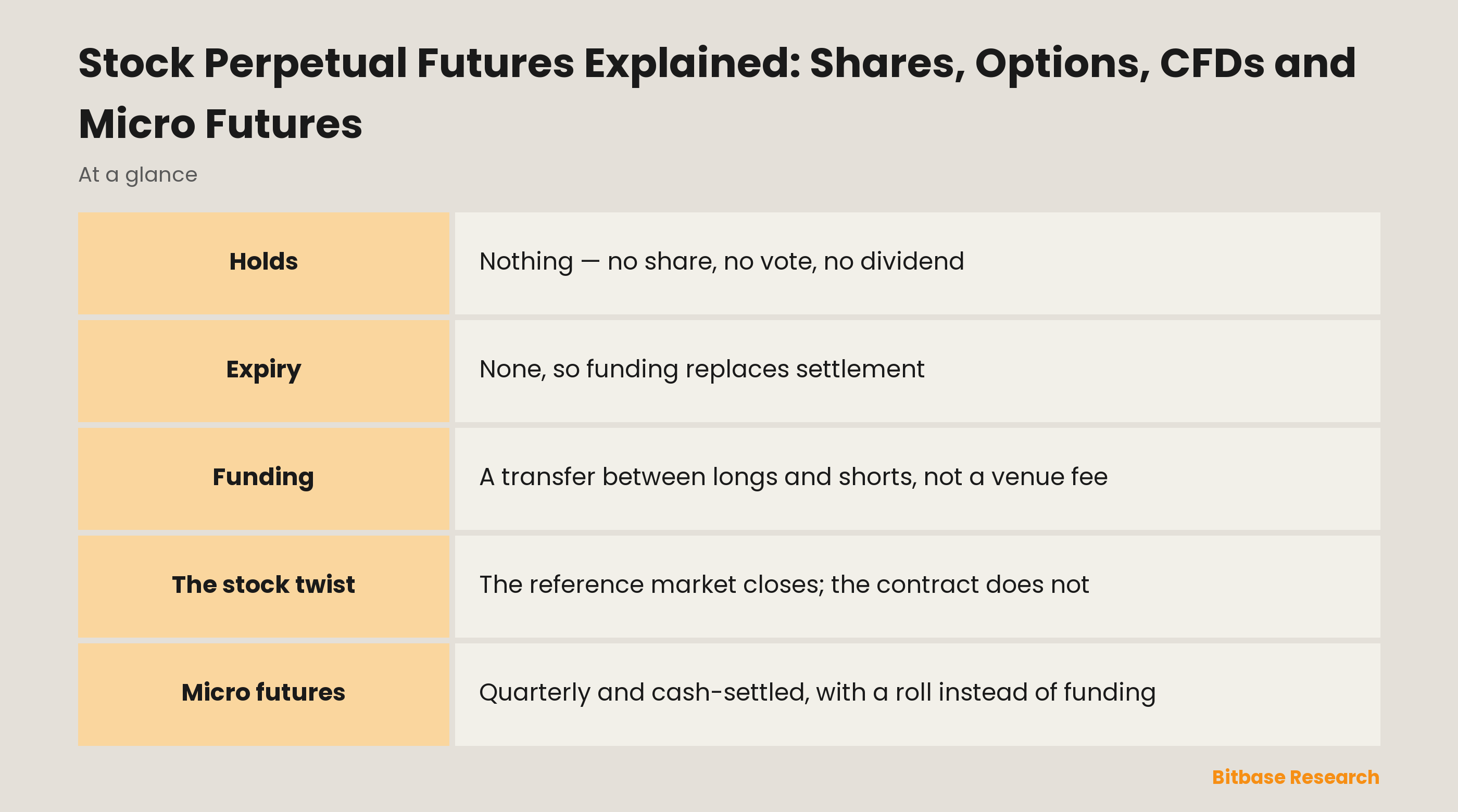
Three properties follow from that definition, and every practical question about the instrument comes back to one of them. There is no expiry, so a position can be held indefinitely and there is no roll. Nothing is held, so there is no dividend, no vote, and no claim on the company. And because nothing anchors the contract to the underlying by delivery, something else has to do the anchoring — which is where funding comes in.
Why Funding Exists at All
A futures contract with an expiry converges on the spot price because it settles against it. A perpetual has no such date, so it needs a continuous mechanism to keep its price near the reference. That mechanism is the funding rate: a periodic payment between the long and short sides, calculated on position notional rather than on margin posted.
The direction is the part worth internalising. When the perpetual trades above its reference, longs pay shorts, which makes holding a long more expensive and pulls the contract back down. When it trades below, shorts pay longs. Funding is therefore not a fee the venue collects — it is a transfer between traders, and the venue's own fee schedule sits on top of it separately.
The practical consequence is that time is a cost. A directional view that is right after six weeks can still lose money if funding ran against the position for six weeks. The mechanics of that arithmetic are worked through in what it costs to hold a perpetual; the point here is structural. Perpetuals price direction continuously rather than at a single settlement date, and continuous pricing means continuous cost.
The Part That Is Specific to Stocks
Everything above applies to a perpetual on any asset. What makes a stock perpetual different is the calendar underneath it.
A crypto perpetual references a spot market that never closes. There is always a fresh trade to build an index from, and the gap between one reference price and the next is measured in seconds. A stock perpetual references a market that shuts every weekday evening, stays shut all weekend, and closes for holidays. During those hours the underlying has no new prints at all.
That single fact produces most of the behaviour that surprises people:
The contract keeps trading while the reference does not. Price discovery during a closure happens entirely in the derivative, on whatever information arrives. Openings gap. News that lands after the close is absorbed by the perpetual first and by the share only when its market reopens, so the two can be far apart at the bell. And a position can be closed out overnight: liquidation runs on the mark price, which keeps moving whether or not the exchange the stock lists on is open.
How a given venue builds its mark price during a closure — which sources it uses, how it smooths them, whether funding accrues normally — is a venue-specific parameter. Read the contract rules page of the platform you trade on. It is the only authoritative answer, and it changes.
How It Compares With the Alternatives
| Instrument | What you hold | Expiry | Carrying cost | Hours |
|---|---|---|---|---|
| Share | Registered equity | None | None, unless financed | Exchange session |
| Tokenized stock | An issuer's structure, not equity | None | Per issuer terms | Set by the issuer |
| Stock perpetual | Nothing | None | Funding, paid both ways | Continuous |
| Micro index future | Nothing | Quarterly | Roll, not funding | Globex, with a daily break |
| Option | A right, not an obligation | Yes | Premium and time decay | Exchange session |
| CFD | A contract with a dealer | Usually none | Overnight financing | Dealer's schedule |
Two rows are worth reading slowly.
Micro index futures are the closest relative and still not the same thing. The CME Micro E-mini Nasdaq-100 is $2 times the Nasdaq-100 index, against $20 for the full-size E-mini; the Micro E-mini S&P 500 is $5 against $50. Both micros tick in the same 0.25 index points as their larger siblings, so the dollar value of a tick is a tenth. They trade on CME Globex from Sunday evening to Friday afternoon with a daily maintenance break, and they expire quarterly, cash-settled against a Special Opening Quotation on the third Friday of March, June, September and December. A perpetual has none of that structure: no quarterly date, no roll, no maintenance break — and in exchange, funding every period instead.
A note on naming, because it is a common error: NQ tracks the Nasdaq-100 index, and QQQ is an ETF that tracks the same index. They are different products with different mechanics. An index future is not "a futures contract on the ETF."
Options answer a different question. An option holder can be right about direction and still lose the premium to time. A perpetual holder can be right about direction and still lose to funding. The losses look similar in a statement and come from completely different places: one is the decay of a right that expires, the other is a transfer to the other side of an open contract.
Sizing, Not Leverage
The most common framing error is to treat leverage as the risk dial. It is not. Leverage determines how much margin a given position requires; position size determines how much a given price move costs.
A useful habit is to work backwards. Decide the amount the position is allowed to lose, find the price at which that loss occurs, and size so that the two agree — then check that the resulting liquidation level sits outside the range the stock plausibly moves overnight. On a stock perpetual that last check matters more than on a crypto one, precisely because an overnight gap is a normal event rather than a rare one.
Margin mode changes the shape of the risk rather than its size. Isolated and cross margin differ in what is available to absorb a loss: isolated ring-fences the position's own margin, cross lets the rest of the balance defend it and therefore puts the rest of the balance at risk.
Specific maintenance margin rates, tiers and maximum leverage are set per venue and per contract, and they are adjusted. They belong on the venue's rules page, not in a guide.
What to Check Before the First Position
Four things decide whether the instrument behaves as expected, and all four are venue-specific:
1. The funding schedule — how often it settles, and whether it settles at all while the underlying market is closed.
2. The mark price construction — what the index is built from, and what happens to it during a closure.
3. The margin tiers — maintenance rate at the size being traded, not at the smallest size.
4. Availability — products and eligibility differ by jurisdiction and change without notice.
None of these can be inferred from how a crypto perpetual behaves. The mechanism is shared; the parameters are not.
The Bottom Line
The primary source for the micro and E-mini figures above is the CME Group contract specification pages. The perpetual mechanics that a stock perpetual shares with any other perpetual carry their worked arithmetic in the articles linked from this page. For anything venue-specific — funding intervals, mark price construction, margin tiers, jurisdictional availability — the contract rules page of the platform being traded is the only authority, and it supersedes any guide.
Related reading
Other Bitbase articles on this topic:
- ES vs MES Futures: Contract Size, Margin, Trading Hours and Rollover
- FOMC and Equity Derivatives: Volatility, Execution and Position Risk
- NQ vs MNQ Futures: Contract Size, Margin, Trading Hours and Rollover
- ADX Indicator: How to Measure Trend Strength
- Moving Averages Explained for Crypto
Disclaimer: This article is educational content from Bitbase Academy, provided for information only. It explains what a company or fund does and how the instruments referenced here differ from one another; it does not constitute investment, trading, tax, or financial advice, and it is neither a recommendation nor an endorsement of any security, token, or trading strategy. A tokenized stock is issued by a third party and is designed to give economic exposure to an underlying asset: it is not a share, it carries no shareholder rights, and it depends on the issuer's structure, eligibility rules, and redemption terms, which the issuer can change. Perpetual futures are leveraged derivatives that hold no underlying asset and can be liquidated, and trading hours, product availability, and eligibility differ by instrument and by jurisdiction and can change at any time. Written as of September 2026; verify everything yourself through company filings, the issuer's own documentation, and the product pages of the venue you trade on.
References
[1] CME Micro E-mini Nasdaq-100 contract specifications: multiplier, tick, hours and settlement www.cmegroup.com
[2] CME Micro E-mini S&P 500: contract size and quarterly cash settlement against the SOQ www.cmegroup.com