You can take a position on one company in three ways, and only one of them writes your name into a share register. A tokenized stock and a stock perpetual both track a price without making you a shareholder, yet they are not two versions of one idea: a token comes from a named issuer with its own terms, while a perpetual holds nothing at all. Here is what each of the three gives you on ownership, dividends and voting.
The Ownership Ladder Has Three Rungs
Buying a share through a broker puts you on the issuing company's register, directly or through a nominee, and everything else here follows from that. Dividends, votes and statutory information rights attach to the register entry, not to the price chart. Hold the entry and they reach you by default; track the price without it and none of them arrives unless somebody has built a path.
A tokenized stock is an attempt at building that path, and it is not one product. At least four structures are sold under the label, and they answer the ownership question differently enough that a sentence true of one is false of the next. Which issuer stands behind a ticker is therefore the first thing to establish, and the symbol often gives it away, as the issuer behind a tokenized stock symbol sets out.
A stock perpetual sits at the far end. It holds nothing, references a price, and never settles into an asset.
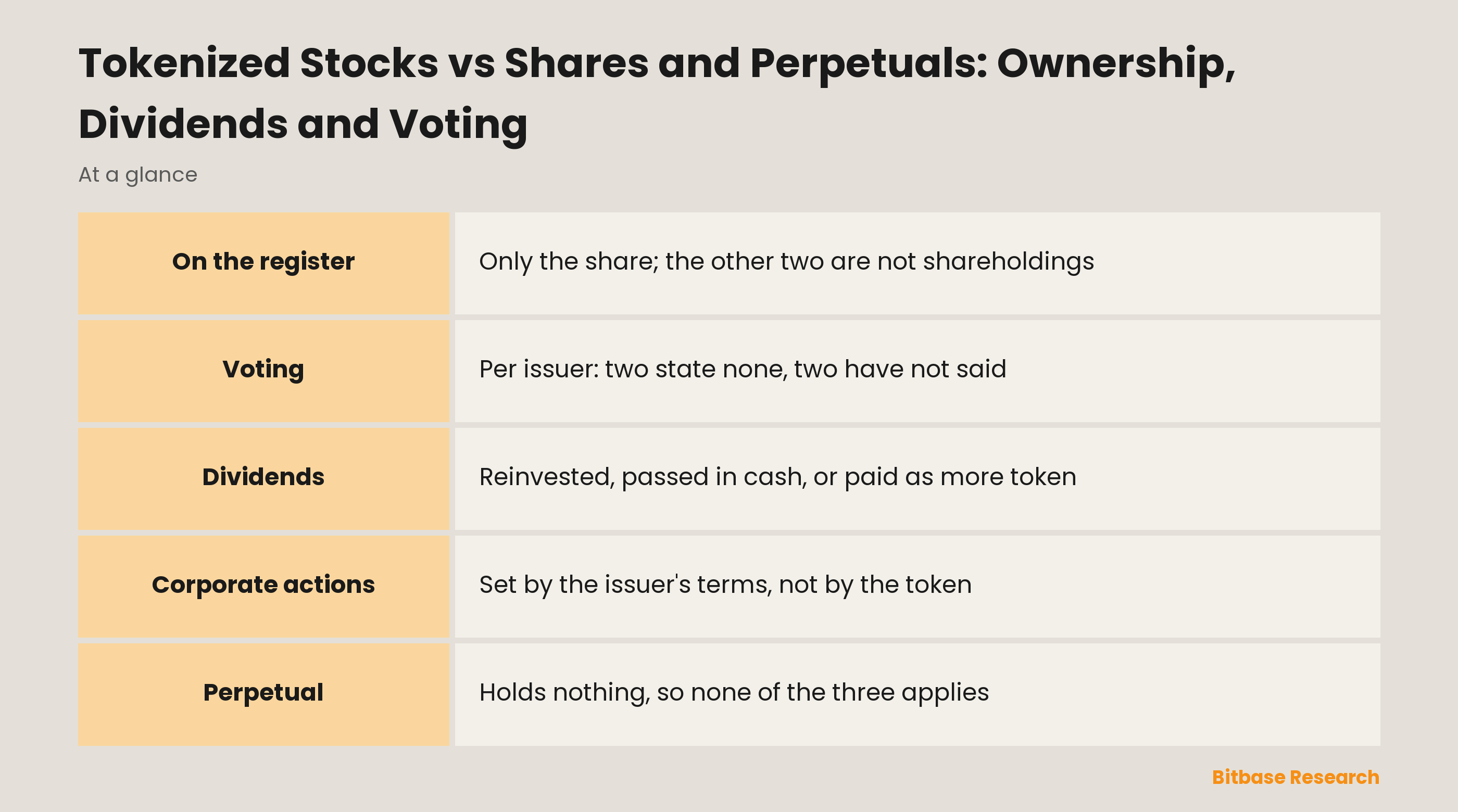
| What you hold | On the share register | Dividend | Vote |
|---|---|---|---|
| Share bought through a broker | Yes | Yes, as declared | Yes, by share class |
| Tokenized stock | No, an issuer's structure | Per the issuer's terms | Per the issuer's terms |
| Stock perpetual | No, nothing at all | No | No |
The middle row is where the work is. Per the issuer's terms is not a way of dodging the question; it is the answer.
Shareholder Rights Are a Per-Issuer Answer
There is a sentence that sounds safe and is not: tokenized stocks carry no shareholder rights. Two of the four issuers say something close to that about their own product. The other two have not, and saying it for them turns a silence in the record into a claim.
Ondo states it outright: holders do not receive shareholder voting rights, statutory information rights or other shareholder rights. That is a flat description rather than a hedge, and it fits a product built as a total return tracker rather than a claim on one share.
Robinhood reaches a similar place by a different road, because its product is not a tokenized share in legal form. Classic Stock Tokens are derivative contracts between you and Robinhood, priced at the prices of the underlying securities without granting rights to them, and Robinhood owns the underlying assets itself and holds them with a US-licensed institution. There are no rights to pass along, because the contract is with the broker rather than the company.
xStocks is where the public record stops short. Backed states that each xStock is backed 1:1 by the underlying asset held in regulated custody, and describes what the holder has as exposure to, and a claim on, the value of that collateral rather than the legal rights attached to it. That is a statement about collateral, not about voting, which the official site does not address.
Dinari leaves the same gap. Its documentation covers what a dShare is, how minting follows a filled brokerage order through Alpaca, and how dividends work, and none of it addresses shareholder rights. An absent statement is not a statement.
| Issuer | What the token is | Backing | On shareholder rights |
|---|---|---|---|
| Ondo | Tokenized stock, a total return tracker | Not one token to one share | Stated: none, including voting |
| Robinhood | A derivative contract with Robinhood | Underlying owned by Robinhood | Stated: no rights to the underlying |
| xStocks | Tokenized security from a Jersey company | 1:1, in regulated custody | Not addressed on the official site |
| Dinari | A dShare minted when a broker order fills | 1:1 with the security | Not addressed in its documentation |
The working rule is read the issuer before you read the ticker, and treat the two blank cells as blank rather than as a quiet no.
Dividends Travel Three Routes, and One Issuer Has Not Said
On an ordinary share a dividend is declared by the company and paid in cash to whoever holds it on the record date. None of that carries over to a token automatically.
Ondo does not pay one out at all. Dividends from the underlying are reinvested, net of withholding tax, into what the token tracks, so nothing lands in a wallet on the payment date. That is also why Ondo states that one token does not necessarily represent the value of one share and that the two prices will not always match.
Robinhood passes cash through. If the underlying stock or ETP pays a dividend, Robinhood passes a corresponding amount on to eligible holders in cash.
Dinari distributes once the underlying cash lands. Direct holders receive USD+, while holders of the wrapped version receive the underlying dShare deposited into their wrapped position, so the payout arrives as more of the token.
For xStocks the record is silent. Descriptions of a rebasing or multiplier mechanism circulate second hand, none is the issuer's own statement, and none belongs on a page that asks to be checked.
Three routes and one gap, for the same corporate event.
Splits and Corporate Actions Follow the Terms, Not the Token
A stock split changes the share count and the quoted price on the register side. What it does to a token is decided by the issuer's terms, and the documentation behind this page sets out no split policy for any of the four. One adjacent fact is on the record: Ondo says trading can be suspended around corporate actions and for risk controls, which establishes that a corporate action is something the structure reacts to.
Beyond that, anything written here would be invention, so the rule goes in place of a guess. Corporate-action handling is a term of the issuer's own documentation, and that documentation is the only place to read it. Terms can change, so the answer carries a date that matters as much as the answer itself.
Trading hours make the point briskly. Ondo describes its tokens as trading 24/5 rather than around the clock, while the xStocks site describes its tokens as tradeable 24/7 on chain. Two issuers, two structures, not one property of tokenization.
The Perpetual Column Answers by Removing the Question
A stock perpetual does not hold a weaker version of these rights; it has nowhere to put them. There is no register entry, no issuer holding an asset for you, and no payment date to design around. Nothing is held, so nothing can be passed on. Dividends, votes and corporate actions have no route into a contract whose entire content is a price reference.
What a perpetual carries instead of a settlement date is funding, a periodic payment between long and short that keeps it near its reference; the mechanism and its cost are worked through in the guide to stock perpetual futures. The two cannot be compared cell by cell: one question is about a structure, the other about a contract.
How to Answer These Three Questions for a Ticker
Start with the issuer rather than the company, whose name is the familiar part and the one that says nothing about what is held. Establish which structure stands behind the symbol, then open that issuer's own documentation instead of a summary of it, and read for three things in order: rights, dividends, corporate actions. Where a document is silent, record it as silent — that single habit keeps a gap from quietly turning into a fact.
Note the date of reading too, because eligibility rules, redemption terms and hours belong to the issuer and can change. Access routes also differ by jurisdiction, covered in how to buy US stocks with stablecoins and in the wider picture of how real-world assets get tokenized.
The Bottom Line
A share puts you on the register and the rights follow from the entry. A perpetual puts you in a contract that holds nothing, so the question never arises. A tokenized stock sits between them with no single answer, only four issuers' answers, two on the record about shareholder rights and two not. Every statement above traces to an issuer's own page, listed below; where those pages are silent this one stays silent, and current issuer documentation outranks any summary, including this one.
Related reading
Other Bitbase articles on this topic:
- How to Buy SoFi (SOFI) Stock: Trading Methods, Costs and Risks
- How to Buy SQQQ: Daily Inverse Exposure vs Shorting QQQ
- How to Buy TLT: Trading Hours, Costs and Bond ETF Risks
- XLK ETF Explained: Who Decides What the Fund Holds
- What Is Bitcoin Dominance?
Disclaimer: This article is educational content from Bitbase Academy, provided for information only. It explains what a company or fund does and how the instruments referenced here differ from one another; it does not constitute investment, trading, tax, or financial advice, and it is neither a recommendation nor an endorsement of any security, token, or trading strategy. A tokenized stock is issued by a third party and is designed to give economic exposure to an underlying asset: it is not a share, it carries no shareholder rights, and it depends on the issuer's structure, eligibility rules, and redemption terms, which the issuer can change. Perpetual futures are leveraged derivatives that hold no underlying asset and can be liquidated, and trading hours, product availability, and eligibility differ by instrument and by jurisdiction and can change at any time. Written as of September 2026; verify everything yourself through company filings, the issuer's own documentation, and the product pages of the venue you trade on.
References
[1] Ondo Finance, Ondo Tokenized Stocks documentation, Overview docs.ondo.finance
[2] xStocks, official site xstocks.com
[3] Robinhood Europe, UAB, Invest product pages for the European Union robinhood.com
[4] Dinari, documentation, What is a dShare docs.dinari.com
[5] Dinari, documentation, Dividend Payments docs.dinari.com