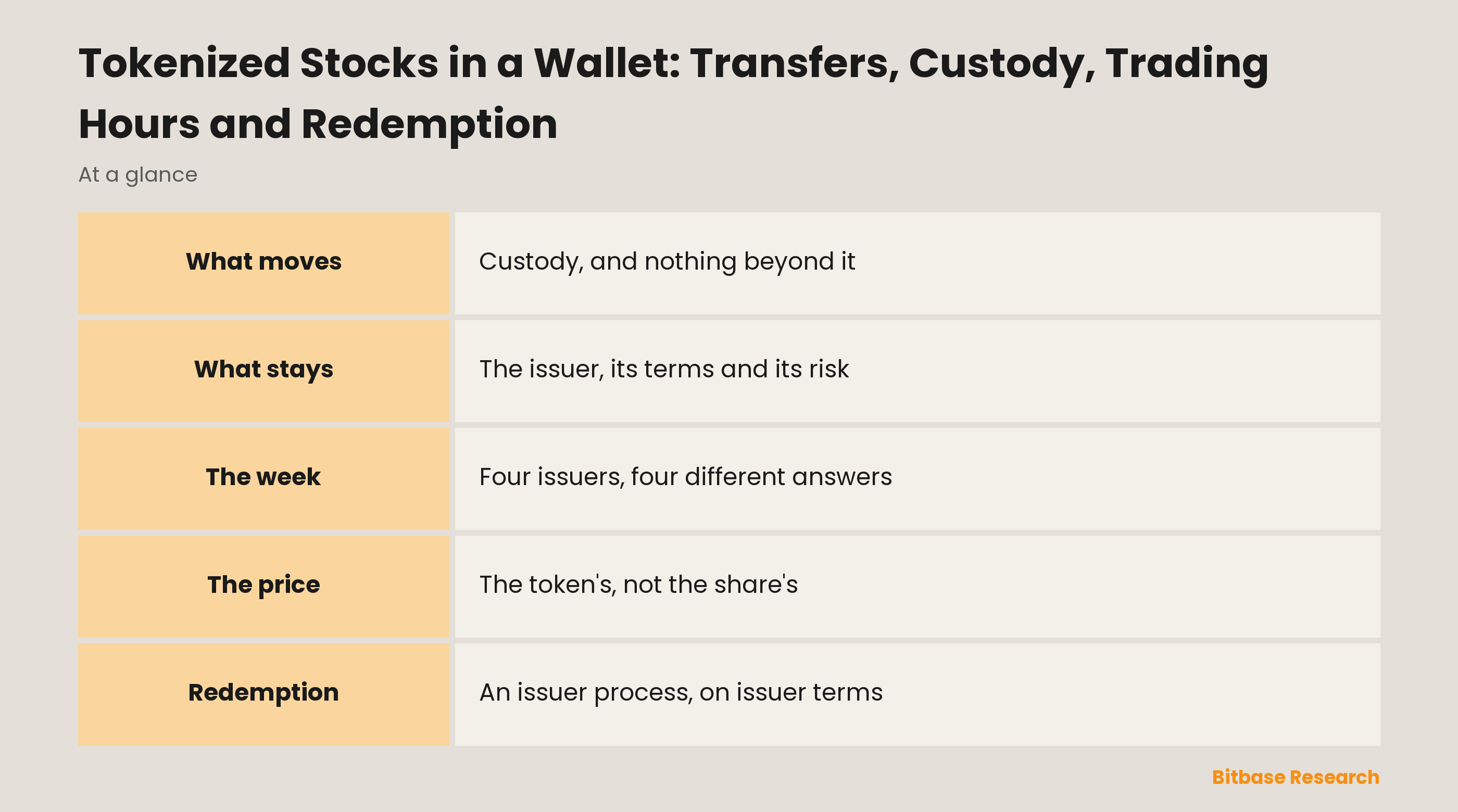
A transfer moves a tokenized stock out of a platform's custody and into your own, and custody is the only thing it moves. The issuer that wrote the token still decides what it is worth, when it trades, and whether it can ever be handed back. What changes is who carries the consequences when something goes wrong.
What a transfer actually changes
To transfer a tokenized stock to a wallet you control is to end one relationship and begin another. The platform stops holding the asset on your behalf; you begin holding it yourself. That is a change of custodian, which is why the difference between custodial and non-custodial holding is the right frame for the decision.
Everything upstream of the custodian stays where it was. The token was created by an issuer, under that issuer's structure and terms, and it still is. Its value still depends on that issuer operating, holding whatever its documentation says it holds, and honouring terms it remains free to change. An address on a public ledger sits between you and the platform, not between you and the issuer.
You changed the custodian, not the issuer. The move feels like removing an intermediary, and one is genuinely removed: the venue. The issuer was never an intermediary in that sense. It is the counterparty, and moving a token between wallets leaves it exactly where it stood.
The risk you drop and the risk you pick up
Tokenized stocks self custody is usually described as removing risk, and it does remove one. While a platform holds the asset for you, its solvency, its internal controls and its operational decisions all sit between you and the thing you bought. Move the token out and they no longer do.
What arrives instead has a very short chain of responsibility. A self-custodied token moves for whoever produces the signature and for nobody else: no account to freeze, no review between an instruction and its execution, nobody able to unwind a transfer afterwards. The difference between a private key and a seed phrase stops being a vocabulary question here.
Self-custody swaps a custodian's risk for your own and leaves the issuer's risk untouched. Choosing between a hardware wallet and a software wallet works on the middle term only. Nothing on that menu changes what happens if the issuer alters its terms or stops operating.
The chain runs all week; the token may not
A blockchain produces blocks on a Saturday. That says the network is available. It says nothing about whether there is a market for the token in your wallet, and reading the two as one statement is the commonest mistake in this area.
Tokenized stocks trading hours are set by the issuer, and the four issuers behind the tokens most people meet have settled on four different weeks.
| Issuer | The week as the issuer states it | What that leaves for a weekend |
|---|---|---|
| Ondo | 24/5, which corporate actions and risk controls can interrupt | The weekday week; some tickers additionally trade in off-hours sessions |
| xStocks (Backed) | Described by the issuer as tradeable 24/7 on-chain | Open, on the issuer's own description of the token |
| Robinhood | Monday 02:00 CET to Saturday 02:00 CET | Shut from Saturday morning until Monday morning, European time |
| Dinari | Pre-market, the regular US session, after-hours and an overnight window, everything outside the regular session limit-order only | An on-chain window running Friday evening to Sunday evening US Eastern, over part of the lineup, with thinner liquidity |
Tokenized stocks weekend trading has no general answer; it has four. The final column covers the range: one token is described as continuously tradeable, one week ends on Saturday morning, one is a weekday week with a narrow exception, and one has a thin on-chain channel over part of a lineup.
Holding your own keys does not create a market. The schedule belongs to the issuer and to whichever venue lists the token, and a wallet is neither. Self-custody lets you see the balance at any hour, which is not the same as being able to act on it.
What price tracking actually tracks
A portfolio line reads like a shareholding, and that is where the trouble starts. Tokenized stocks price tracking is two questions wearing one label: what is this token worth, and what is the share worth. Most of the week the two sit close enough to be mistaken for each other. They are still two numbers.
Ondo puts the caveat in writing: “One token does not necessarily represent the value of one share, and the price of one token will not always match the price of the underlying asset.” A tracker that fills the line with the ticker's last quote is showing you something adjacent to your holding rather than the holding itself.
While the underlying listing is closed, nothing holds the two numbers together. The share is not trading, so whatever information arrives has only the token side to land on, and it lands against whatever depth exists at that hour. When the listing reopens the share reprices in one move, and any distance that opened up gets resolved in public.
Redemption is a process, not a trade
Selling and redeeming are different operations, and the second is the one people assume. A sale finds a counterparty on a market. A redemption goes to the issuer, and only the issuer can say yes to it.
So how to redeem tokenized stocks is a question with an issuer's name attached rather than a general answer. Who may redeem, what has to be shown, by which route and on what schedule are written, published and changed by the issuer. No figures appear here for that reason: any number printed would be one issuer's terms on one day.
Custody is not eligibility. Holding the keys proves you control the token. It does not establish that you are someone the issuer will transact with. Ondo describes its tokenized stocks as generally available to non-US investors, subject to certain jurisdictional and other restrictions, which is a statement about who you are rather than about where the token is kept.
The mechanical layer, where issuers describe it, is quick. Ondo states that minting and burning are instant, and describes a purchase or a sale as arriving in a single atomic transaction. Dinari ties creation and destruction to a brokerage order filling through Alpaca, so nothing exists until a real order has been executed. For xStocks, redemption runs toward the issuer. Robinhood is a different shape again: its documentation describes Classic Stock Tokens as derivative contracts between you and Robinhood, priced at the prices of the underlying securities without granting rights to them, and a contract with a counterparty is not what the word redemption was built for.
Three things a wallet cannot tell you
A wallet shows a balance, an address and a history of transactions. Three of the questions above fall outside what it can answer.
The first is who issued the token. A ticker names a company, and the company decides none of the rows in the table above, so the structure behind a holding has to be read from which issuer built it rather than guessed from the letters. The second is when it trades, which a balance will never answer. The third is what the redemption terms say and whether they apply to you, which only the issuer's documentation settles.
A wallet is an excellent record of what you hold and a poor description of what it is. That gap is not a defect in the wallet. It follows from the token being a claim on an issuer rather than an object carrying its own terms around with it.
The Bottom Line
Moving a tokenized stock into self-custody decides one thing: who holds it. That is a real decision and it removes a real exposure, but it takes on a different one and changes nothing about the structure that gives the token its value.
The schedule stays the issuer's and varies by issuer instead of following the chain. The price stays the token's rather than the share's. Redemption stays a process the issuer runs, on terms the issuer sets and can change. Every issuer statement above comes from that issuer's own documentation, linked below, and that is the version that counts on the day you read it.
Related reading
Other Bitbase articles on this topic:
- How to Buy SCHD: Dividend Exposure, Costs and Comparison with QQQ
- How to Buy Snowflake (SNOW) Stock: Trading Methods, Costs and Risks
- How to Buy SoFi (SOFI) Stock: Trading Methods, Costs and Risks
- What Is Zebec? Streaming Payments On-Chain
- What Is Address Reuse in Crypto? Why to Avoid It
Disclaimer: This article is educational content from Bitbase Academy, provided for information only. It explains what a company or fund does and how the instruments referenced here differ from one another; it does not constitute investment, trading, tax, or financial advice, and it is neither a recommendation nor an endorsement of any security, token, or trading strategy. A tokenized stock is issued by a third party and is designed to give economic exposure to an underlying asset: it is not a share, it carries no shareholder rights, and it depends on the issuer's structure, eligibility rules, and redemption terms, which the issuer can change. Perpetual futures are leveraged derivatives that hold no underlying asset and can be liquidated, and trading hours, product availability, and eligibility differ by instrument and by jurisdiction and can change at any time. Written as of September 2026; verify everything yourself through company filings, the issuer's own documentation, and the product pages of the venue you trade on.
References
[1] Ondo tokenized stocks documentation: not one token per share, 24/5 trading, instant atomic minting and burning, eligibility docs.ondo.finance
[2] xStocks official site: 1:1 backing in regulated custody, issued by Backed Assets (JE) Limited, described as tradeable 24/7 on-chain xstocks.com
[3] Robinhood Europe: Classic Stock Tokens are derivative contracts granting no rights to the underlying, Monday 02:00 to Saturday 02:00 CET robinhood.com
[4] Dinari documentation: regular, pre-market, after-hours and overnight sessions, limit orders only outside the regular session, and an around-the-clock on-chain window on part of the lineup docs.dinari.com