Reading a list of tokenization infrastructure stocks means reading mostly about companies whose shares nobody can buy. Of the four issuers behind the tokenized stocks covered here, three are private and the fourth is a subsidiary of a listed parent. The listed names touch this work from the side, and their filings are far quieter about it than the label suggests.
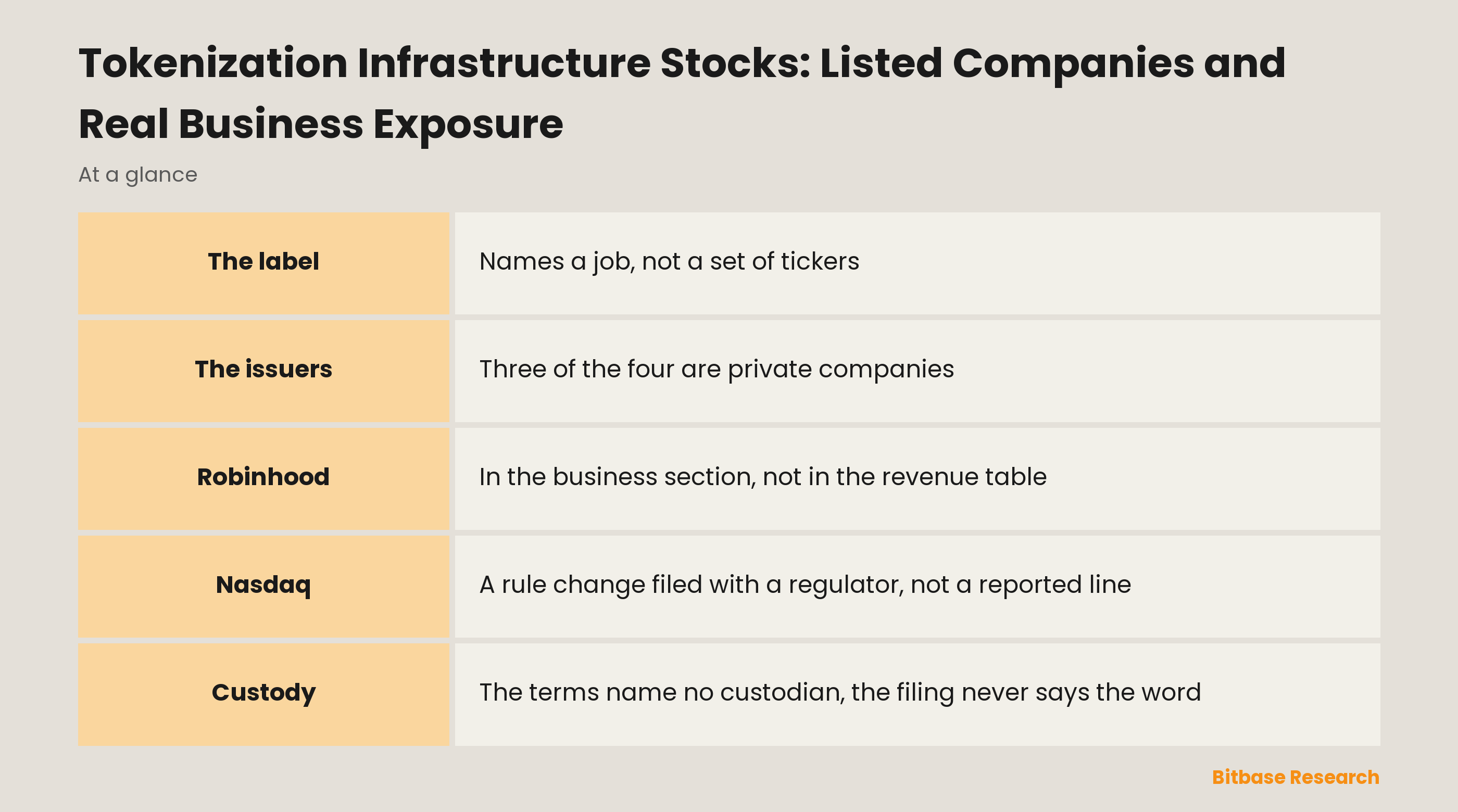
The Label Names Work, Not a List of Tickers
Tokenization is a stack of separate jobs: issuing the token, holding the underlying asset, running the venue where the instrument trades, and operating the chain it settles on. Nothing requires those four businesses to sit inside one company, or inside a listed one. The stack is described in RWA tokenization basics; this page is only about who owns which job.
Start from the products. The tokenized stocks a reader can actually hold are issued by Ondo, by Backed Assets (JE) Limited, the Jersey company behind xStocks, by Dinari, and by Robinhood Europe, UAB, supervised by the Bank of Lithuania. Three of those four are private companies. There is no ticker for them and no annual report to open.
That leaves two bad ways to build a list. From who does the work, it fills with unbuyable names. From who mentions tokenization, it fills with press language, the failure mode taken apart in crypto in the name does not make it a crypto stock. A third option remains: name the listed companies that describe this work in their own filings, and say how much those filings let you read.
Robinhood Markets: In the Business Section, Not in the Revenue Table
Robinhood Markets, Inc. is a Delaware corporation whose Class A common stock is registered under Section 12(b) and trades as HOOD on The Nasdaq Stock Market. Its annual report defines the product in one line: "A stock token is a derivative contract that tracks the price of a U.S. stock or ETP, giving eligible EU customers exposure to U.S. equities without owning the underlying shares." The issuing entity is the Lithuanian subsidiary, not the listed parent.
The risk factors name it too, under a heading on "the regulation, litigation, contractual, operational, and reputational risks associated with our introduction of products such as Robinhood Stock Tokens in the EEA."
Then the reading stops. Robinhood reports as one operating segment, and its revenue note splits transaction-based revenues into options, cryptocurrencies, equities and other, alongside net interest revenues and other revenues. No line in that table is a stock-token line. So the filing confirms the product exists and that the company considers it risky enough to name, while saying nothing about what it earns. Trading the listed share is a separate subject, handled in how to trade HOOD.
Nasdaq: A Filed Proposal Is Not a Reported Line
Nasdaq, Inc. is a Delaware corporation whose common stock trades as NDAQ on The Nasdaq Stock Market, and it reports three segments: Capital Access Platforms, Financial Technology, and Market Services. Discussing its technology, the filing says: "Moreover, in the third quarter of 2025, Nasdaq filed a proposed rule change with the SEC to enable the trading of tokenized equity securities and ETPs on its platform. The proposal represents a step toward integrating blockchain-based assets into the existing U.S. equities market infrastructure."
That is a fact about a regulatory process, stated by the company, and it is informative: a venue does not file a rule change for something it has no intention of carrying. It is not evidence about revenue, because none of the three segments separates this activity from everything else inside it.
Coinbase: The Revenue Table Answers a Different Question
Coinbase Global, Inc. is incorporated in Texas, and its Class A common stock trades as COIN on The Nasdaq Stock Market LLC. Its revenue is disaggregated by source into consumer, institutional and other transaction revenue, then into subscription and services revenue made of stablecoin revenue, blockchain rewards, interest and finance fee income, and other subscription and services revenue.
None of those categories is a tokenization line. Whatever the filing says about tokenized assets elsewhere, the money is reported in buckets built for other questions, so exposure of this kind arrives inside a line named for something else. The risk summary does carry the question underneath the whole label, whether a particular crypto asset, product or service counts as a security in a relevant jurisdiction, and that one belongs to the row rather than to a company. The share itself is covered in how to trade COIN.
The Custody Row Has No Ticker at Either End
Custody is where tokenization is supposed to meet the traditional system, and it is where the trail goes cold fastest. On the product side the terms describe the arrangement without naming the party: xStocks says each token is "backed 1:1 by the underlying asset held in regulated custody", and Robinhood says the underlying assets of its stock tokens "are owned by Robinhood and held with a US-licensed institution". Neither sentence leads from a product page to a ticker.
Coming the other way is no better. The Bank of New York Mellon Corporation, a Delaware corporation whose common stock trades as BK on the New York Stock Exchange, reports through Securities Services, Market and Wealth Services, and Investment and Wealth Management, with custody inside Asset Servicing. Search its annual report for the words tokenized or tokenization and they are not there; search for digital assets and they are. A word that never appears cannot be the business line you think you are buying.
What This Actually Leaves You With
| Layer of the work | What the product terms name | A listed company to check | What its filing lets you read |
|---|---|---|---|
| Issuing the token | The issuer, by legal name | Only where a listed parent owns it | A product definition and a named risk |
| Holding the underlying | Regulated custody, custodian unnamed | None the terms identify | Segment names; custody is one line among many |
| Listing and trading venue | Not part of the product terms | Yes | A rule change filed with a regulator |
| Chain and trading venue | Varies by product | Yes | Revenue by source, with no line for this |
The table is the finding: the work and the listings do not line up. In an ordinary sector they do, because the companies doing the thing are the companies you buy. Here the doing sits in private entities and foreign subsidiaries, and the listed names hold pieces of the perimeter.
So run the sequence in the direction that terminates. Open the product's terms, find the legal entity named there, then ask whether it has a listed parent. Starting from a ticker that mentions tokenization has no stopping rule, which is much of why any ranked version of these names goes out of date. What a token grants its holder is a separate question, answered in tokenized stocks versus shares.
The Bottom Line
The honest list is short, and short for a structural reason rather than because little is happening. One listed company defines the product and names it as a risk without reporting it as revenue. One has filed to trade the instruments. One runs rails they use and books income in categories built for other questions. One occupies the custody row without using the word. The rest of that row is private. Every claim here sits in a document that can be opened and tested again the next time it is published, which is what survives when a list does not.
Related reading
Other Bitbase articles on this topic:
- How to Buy SCHD: Dividend Exposure, Costs and Comparison with QQQ
- How to Buy Snowflake (SNOW) Stock: Trading Methods, Costs and Risks
- How to Buy SoFi (SOFI) Stock: Trading Methods, Costs and Risks
- Tokenized Stocks in a Wallet: Transfers, Custody, Trading Hours and Redemption
- Token Supply Mechanics
Disclaimer: This article is educational content from Bitbase Academy, provided for information only. It explains what a company or fund does and how the instruments referenced here differ from one another; it does not constitute investment, trading, tax, or financial advice, and it is neither a recommendation nor an endorsement of any security, token, or trading strategy. A tokenized stock is issued by a third party and is designed to give economic exposure to an underlying asset: it is not a share, it carries no shareholder rights, and it depends on the issuer's structure, eligibility rules, and redemption terms, which the issuer can change. Perpetual futures are leveraged derivatives that hold no underlying asset and can be liquidated, and trading hours, product availability, and eligibility differ by instrument and by jurisdiction and can change at any time. Written as of September 2026; verify everything yourself through company filings, the issuer's own documentation, and the product pages of the venue you trade on.
References
[1] Robinhood Markets, Inc. annual report on Form 10-K for the year ended December 31, 2025 www.sec.gov
[2] Nasdaq, Inc. annual report on Form 10-K for the year ended December 31, 2025 www.sec.gov
[3] Coinbase Global, Inc. annual report on Form 10-K for the year ended December 31, 2025 www.sec.gov
[4] The Bank of New York Mellon Corporation annual report on Form 10-K for 2025 www.sec.gov
[5] xStocks official site, backing and custody statement xstocks.com
[6] Robinhood EU product page, Classic Stock Tokens definition and custody robinhood.com