On a stock perpetual, the number that decides whether a position survives is almost never the number printed on the order book. Liquidation runs on a mark price, that mark is anchored to an index, and the index depends on a market that is shut for most of the hours in a week. Margin, sizing and the overnight gap all follow from that one arrangement.
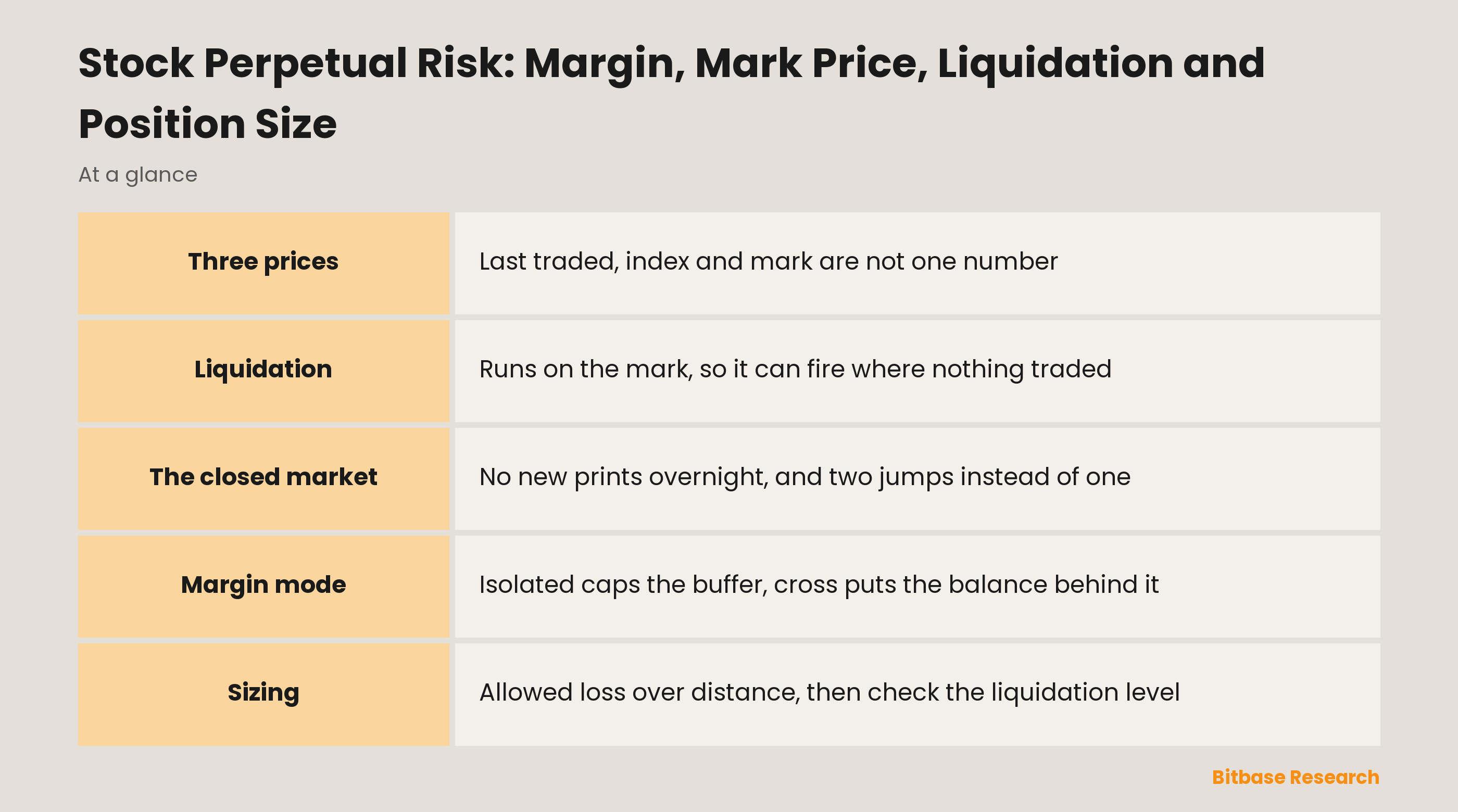
Three Prices, and Only One of Them Closes Positions
A stock perpetual carries three prices at once, and treating them as one number is an expensive habit.
The last traded price is a fact about a single fill: the most recent trade on the contract's own book. It is what the chart draws, and one determined order can move it.
The index price is the reference taken from the market the contract tracks, built from the underlying share as reported by the sources the venue selects.
The mark price is the valuation the venue applies to open positions. Unrealised profit and loss, the margin ratio and liquidation are all measured against it.
| Price | What it is | What it decides |
|---|---|---|
| Last traded | The most recent fill on the contract | The chart, and where a market order lands |
| Index | The reference taken from the underlying market | What the mark is anchored to |
| Mark | The venue's valuation of open positions | Profit and loss, margin ratio, liquidation |
Liquidation runs on the mark rather than on the last trade for a plain reason. A perpetual's own book is thinnest exactly when the underlying market is closed; if the last fill were the trigger, one aggressive order could set liquidations off, and each of them would send more orders into the same book. Anchoring the trigger outside the contract makes that loop far harder to start. The general mechanics are in mark price versus index price.
So a position can be closed at a level that never traded on the contract, and it can show a loss long before any of it has been realised.
What the Mark Does While the Stock Market Is Shut
A crypto perpetual references a spot market that never closes, so its index always has a fresh trade to work with. A stock perpetual references a market that shuts every weekday evening, all weekend and on holidays. For most of the hours in a week, the underlying produces no new prices at all.
What a venue does with its index and its mark during those hours, which sources it falls back on and whether funding keeps accruing, is a venue parameter rather than a property of the instrument. It lives on the contract rules page of the platform being traded.
Why the closure matters more here than it does to a shareholder needs no rules page. Companies release most of their price-moving information while their own market is closed. Earnings land after the bell or before the open by design, guidance and filings follow the same calendar, and macro releases arrive before trading starts. A share does much of its moving when nobody can trade it, so the first price of a session is a new price rather than a continuation of the last.
One closure therefore produces two jumps. The first happens in the contract: news arriving overnight is priced entirely in the derivative, on a thinner book than the session had. The second arrives when the underlying reopens and the index takes its first genuine print of the day, and the mark follows it there. A position can survive the first jump and be closed by the second.
Margin Is a Buffer, and Liquidation Is the Moment It Runs Out
Two requirements sit on every leveraged position. Initial margin is what has to be posted to open it; maintenance margin is the floor that must remain behind it for the venue to keep carrying it. Both are set per venue, per contract and usually per size band, both get adjusted, and no guide should quote either.
The mechanism is the same everywhere. The venue values the position at the mark, applies the margin posted, the funding debited and the fees charged, and compares what is left against the maintenance requirement. Liquidation is a bookkeeping event rather than a market event: it fires when that comparison fails, whether or not anybody wanted to trade there. The arithmetic is in liquidation price and leveraged profit and loss, and the requirement itself in margin requirements and the margin call.
Interfaces present that level as fixed. A liquidation price is an estimate that moves. It moves when margin is added or withdrawn, when funding is debited period after period, when fees accrue, and when a change in size moves the position into another band. Under cross margin it also moves when positions unrelated to this one start losing money.
Isolated and Cross Change the Shape of the Risk, Not Its Size
Isolated margin ring-fences a position: its assigned margin is the whole buffer, so liquidation arrives sooner and that margin is what is at stake. Cross margin lets the rest of the balance defend the position, so liquidation arrives later and the balance is what is at stake. Neither setting makes a position smaller, and neither changes what a price move costs. The full comparison is in cross margin versus isolated margin.
On a stock perpetual that choice also interacts with the calendar. Several stock positions held under cross margin do not merely share a balance; they usually share one closed window and one opening. Names that behaved independently through the session can be repriced by the same macro release at the same minute, because the markets they reference reopen together. Correlation that looked like diversification during the day becomes, at the open, one position drawing on one buffer.
Sizing Backwards, in Four Steps
The stock perpetual guide makes the structural case that size, not leverage, is the dial that changes outcomes. Turning that dial works backwards: the size is not chosen first and checked afterwards, it comes out last.
| Step | The question it answers | What comes out |
|---|---|---|
| One | How much may this position lose? | An amount, decided in advance |
| Two | At what price would the idea be wrong? | A level, taken from the thesis |
| Three | How far is that level from the entry, per unit? | A distance |
| Four | The allowed loss divided by that distance | The size |
Suppose the position is allowed to lose $100 and the level that would prove the idea wrong sits $4 away from the entry on each unit of exposure. Dividing the first by the second gives twenty-five units, and that is the whole calculation. Both figures are assumed here: the first is a decision, the second comes off the chart.
The step that gets skipped is the next one. A size is only finished once the liquidation level has been checked against it. Feed the size back into the margin the venue requires, find where liquidation would sit, and compare it with the level from step two. If liquidation sits nearer to the entry, the venue closes the position before the idea has been tested, and the size rather than the thesis decided the outcome.
Then comes the comparison the calendar forces. Measure the distance from entry to liquidation against the distance a share can travel between one close and the next open. If an ordinary overnight move reaches that level, the position has been sized for the session and not for the night, and it will spend most of its life in the night.
What the Rules Page Has to Answer
Four answers decide whether any of this behaves as expected, and not one can be inferred from a crypto perpetual: how the mark price is built and what becomes of it while the underlying market is closed; the maintenance requirement at the size actually being traded, not at the smallest band; whether funding accrues through a closure, since a cost that runs while the reference stands still changes what a weekend is worth; and what happens on a deficit, meaning whether a loss can exceed the margin posted.
The mechanism is shared with every other perpetual; the parameters are not.
The Bottom Line
Three prices, one buffer and one calendar explain most of what goes wrong on a stock perpetual. Liquidation runs on the mark, the mark follows an index that goes quiet every night, and the size of the position decides what that silence costs. Sizing backwards from an allowed loss, then checking the liquidation level against a realistic overnight move, is the part a trader controls. Everything else sits on the venue's contract rules page, which supersedes any guide, this one included.
Related reading
Other Bitbase articles on this topic:
- Stock Perpetual Funding Rates: Calculation, Direction and Holding Costs
- Crypto Futures Risk Mechanics: Insurance Funds and ADL
- What Are Crypto Options? Calls, Puts, Strikes and Expiry
- Bitcoin vs Ethereum: What's the Difference?
- Soulbound Tokens and On-Chain Reputation
Disclaimer: This article is educational content from Bitbase Academy, provided for information only. It explains what a company or fund does and how the instruments referenced here differ from one another; it does not constitute investment, trading, tax, or financial advice, and it is neither a recommendation nor an endorsement of any security, token, or trading strategy. A tokenized stock is issued by a third party and is designed to give economic exposure to an underlying asset: it is not a share, it carries no shareholder rights, and it depends on the issuer's structure, eligibility rules, and redemption terms, which the issuer can change. Perpetual futures are leveraged derivatives that hold no underlying asset and can be liquidated, and trading hours, product availability, and eligibility differ by instrument and by jurisdiction and can change at any time. Written as of September 2026; verify everything yourself through company filings, the issuer's own documentation, and the product pages of the venue you trade on.
References
[1] Investopedia, Mark to Market: how open positions are valued rather than settled investopedia.com
[2] Investopedia, Maintenance Margin: the floor a position has to stay above investopedia.com
[3] Investopedia, Margin Call: what happens when the buffer is exhausted investopedia.com