Nasdaq shuts every weekday evening and stays shut all weekend, while a perpetual tracking a share listed there keeps quoting straight through. Orders sent into that second market are the same four instructions as ever, but they reach a book with no fresh prints behind it for most of the week. What follows is what happens to each one on its way to a fill.
Two Books, Two Calendars
An order on a stock perpetual never reaches the exchange the share is listed on. It rests in the venue's own book for that contract and fills against other traders holding it. No share changes hands, which is why it can be accepted at an hour when the listing exchange is dark.
Two prices matter here and they are not the same one. The fill price is whatever the book gives the order. The mark price is the venue's own reference, and margin and liquidation are measured against it rather than against the last trade. An order can fill at one number while the position it opened is valued at another.
Limit and Market Orders When the Underlying Is Shut
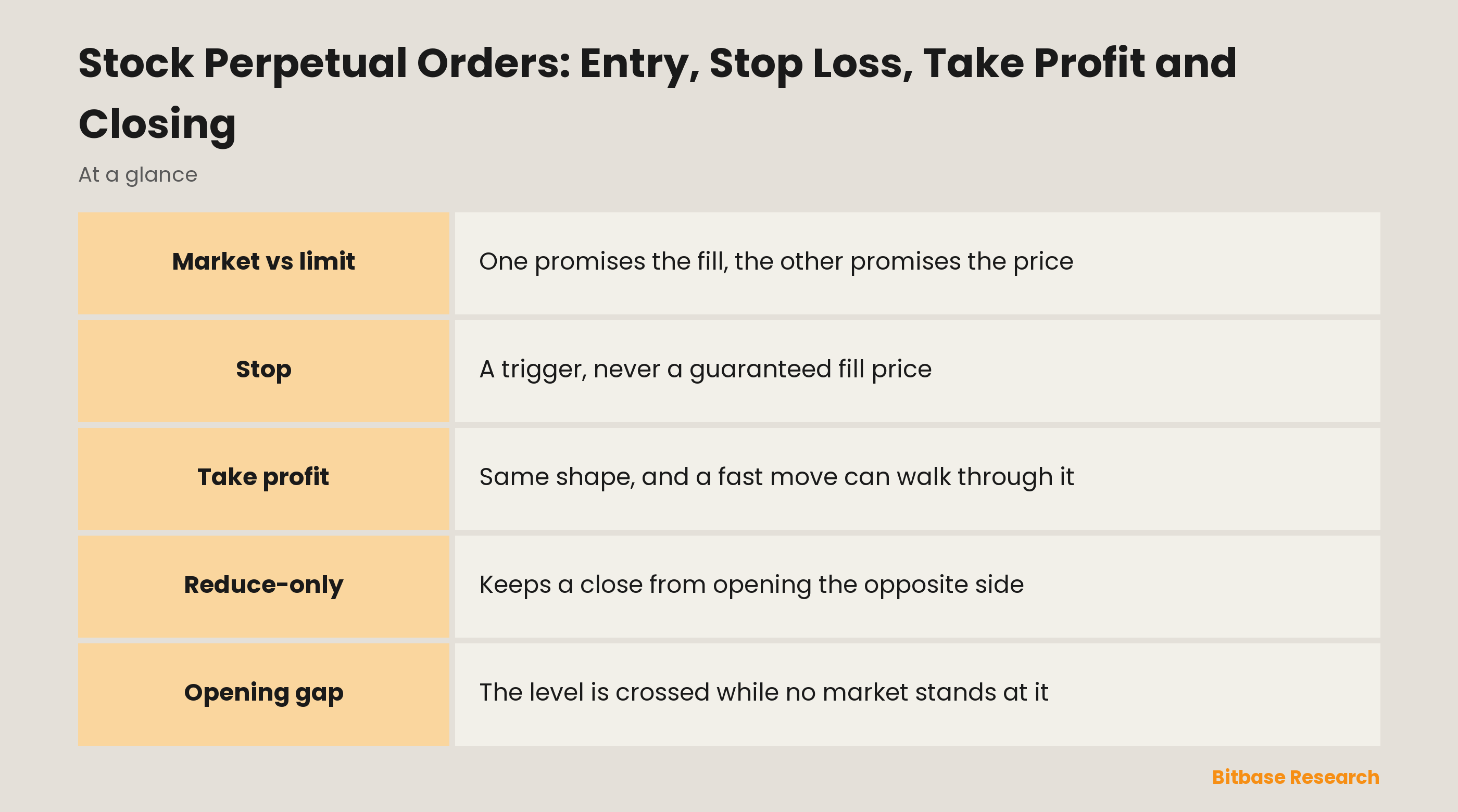
A market order is an instruction about certainty: take whatever is resting, now. A limit order is an instruction about price: fill at this number or better, and otherwise wait. A market order cannot promise a price, and a limit order cannot promise a fill.
The weight of that trade-off moves with the clock. Once the share stops printing, fewer makers will post a price they cannot hedge, the spread widens, and the size resting at each level thins out. An order that crossed one level in the afternoon can walk through several of them overnight. The distance between the price seen and the price received is slippage, and it belongs to the book rather than to the order type.
A limit order answers a thin book by naming the worst acceptable number in advance. It may fill in pieces, and it may not fill at all. Both are the order working correctly.
A Stop Is a Trigger, Not a Guaranteed Price
A stop carries two prices, and collapsing them into one is the most expensive misreading on this page. The trigger is the level that wakes the order up. The execution is whatever happens next, and it obeys the rules above.
A stop-market triggers and then takes the book, so it nearly always ends the position and never promises where. A stop-limit triggers and then posts a limit, so it promises a price and not an exit. Neither is the safe one; they fail in opposite directions.
Which reference the trigger watches, the last trade or the mark price, is a venue parameter rather than a property of stops. It decides whether one thin print in a quiet hour can wake the order. Read the contract rules page of the platform being traded.
Take Profit Has the Same Shape, Pointed the Other Way
A take profit is also a trigger plus an execution, with the trigger on the favourable side. A take-profit limit can be walked through in a fast move, leaving the position open past the price asked for. A take-profit market carries the same certainty, and the same indifference to price, as any market order.
The two are usually paired so that one cancels the other. Without that pairing, a filled take profit leaves the stop resting beneath a position that no longer exists, and a resting stop beneath no position is an opening order.
Reduce-Only, and the Accident It Prevents
Reduce-only is a flag on an order rather than a type of order. It tells the matching engine that this order may only make the position smaller. If filling it would carry the position through flat and out the other side, the engine trims it to the size that remains, or refuses it.
The accident it prevents is ordinary. A position gets closed by hand while a stop still rests beneath it; a close order is sized to the position held an hour ago; two exits fire on the same move. Each time, an instruction meant to end exposure manufactures the opposite one. Reduce-only and the neighbouring order controls exist because that mistake is mechanical rather than careless. Whether a venue trims such an order or rejects it is, once more, a venue parameter.
Four Ways Out, and What Each One Costs
| Way out | What it guarantees | What it costs | Where it fails |
|---|---|---|---|
| Market close | That the position ends | The spread, and every level it walks | Thin hours, when the walk is longest |
| Limit close | The price, if it fills at all | Time, and the risk of no fill | Fast moves that leave the order behind |
| Resting stop or take profit | A rule that acts without you | Trigger and fill are two numbers | Gaps that jump past the level |
| Closing in pieces | Partial control of both | More crossings, and a remainder to track | Losing track of the remainder |
Which shape fits depends on whether price or certainty is worth paying for at that moment. A fifth ending is not an order at all: when margin runs out the venue closes the position itself, at the mark price, on its own schedule, with the arithmetic worked through in liquidation price and leveraged profit and loss.
What the Opening Gap Does to Resting Orders
Here is the part with no equivalent in a crypto perpetual, whose spot market never closes. Assume a share last prints at $200 before the close, news lands overnight, and the exchange reopens with its first trade at $180. A stop whose trigger sits at $190 does not fill at $190. The level is crossed while no market stands at it, so the order wakes and takes the first price the book will offer. A stop-limit with its limit just under the same trigger does not fill at all, and the position stays open. Both orders did exactly what they were built to do.
The contract keeps trading through the closure, so the gap opens in the derivative at the hour the news lands, not at the opening bell. The bell is merely when the share catches up. A resting order is exposed to the news window rather than to the opening auction, and anything carried across that window keeps accruing the periodic charge described in funding rates on a perpetual.
The Bottom Line
Entry, stop, take profit and exit each promise exactly one of two things: a price, or a fill. A stop promises a trigger and never a fill price. Reduce-only is the one flag standing between a close and an accidental open. Everything that would make this concrete, from tick size and minimum order size to the price a trigger watches, is set by the venue and changes without notice; the contract rules page of the platform being traded is the only authority on it.
Related reading
Other Bitbase articles on this topic:
- Stock Perpetual Funding Rates: Calculation, Direction and Holding Costs
- Crypto Futures Risk Mechanics: Insurance Funds and ADL
- What Are Crypto Options? Calls, Puts, Strikes and Expiry
- How Crypto Social Sentiment Analysis Works
- Support and Resistance Levels in Crypto
Disclaimer: This article is educational content from Bitbase Academy, provided for information only. It explains what a company or fund does and how the instruments referenced here differ from one another; it does not constitute investment, trading, tax, or financial advice, and it is neither a recommendation nor an endorsement of any security, token, or trading strategy. A tokenized stock is issued by a third party and is designed to give economic exposure to an underlying asset: it is not a share, it carries no shareholder rights, and it depends on the issuer's structure, eligibility rules, and redemption terms, which the issuer can change. Perpetual futures are leveraged derivatives that hold no underlying asset and can be liquidated, and trading hours, product availability, and eligibility differ by instrument and by jurisdiction and can change at any time. Written as of September 2026; verify everything yourself through company filings, the issuer's own documentation, and the product pages of the venue you trade on.
References
[1] Investopedia on limit orders: filling at a set price or better investopedia.com
[2] Investopedia on stop-loss orders: the trigger level and what happens after it investopedia.com
[3] Investopedia on take-profit orders: a trigger on the favourable side investopedia.com
[4] Investopedia on slippage: the distance between the expected and the received price investopedia.com