Trading USDT-margined futures on Bitbase costs 0.0200% maker and 0.0600% taker at the base level, falling to 0.0050% maker and 0.0250% taker at VIP 7. But the schedule is only part of the bill: funding is charged separately, and the gap between maker and taker is three times wider here than on spot. This guide covers all three costs and works out what a round trip actually comes to.
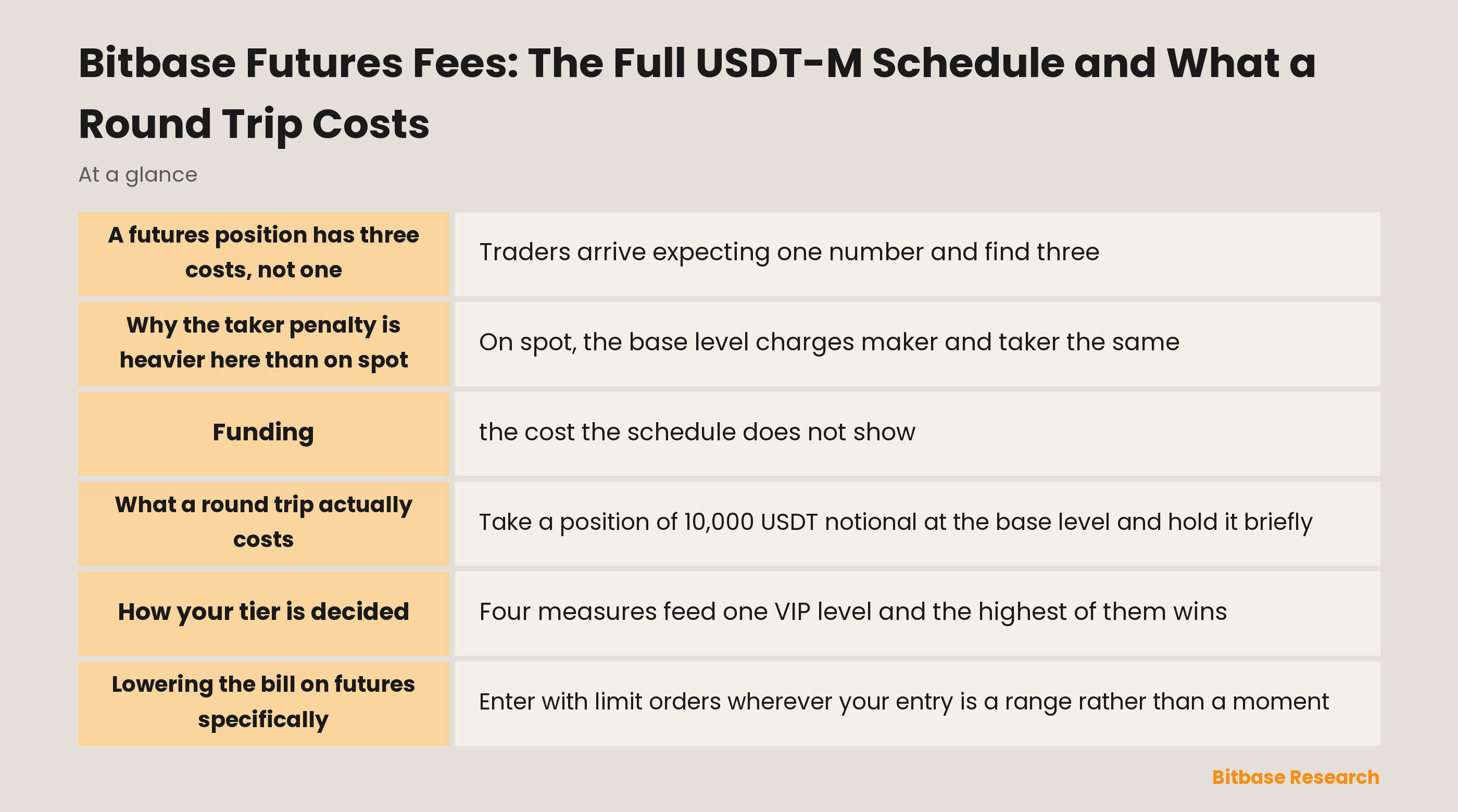
A futures position has three costs, not one
Traders arrive expecting one number and find three. The first is the trading fee, charged as a percentage of notional when you open and again when you close. The second is funding, a payment exchanged between long and short holders roughly every eight hours for as long as you hold. The third is slippage, which is not a fee at all but comes out of the same account.
Only the first of these appears in the fee schedule. The other two are why two traders on the same VIP level, holding the same position for the same move, can end the week with materially different results.
The ordering matters when you decide what to optimise. For a position held minutes, the trading fee dominates. For one held weeks, funding usually dwarfs it. Knowing which of the two you are running is the first step, and it is decided by your holding period rather than by your level.
The full USDT-M futures fee schedule
Every level below is published on the fee page and updated there in real time. These figures were read on 9 September 2026, so treat the table as a map and the fee page as the territory.
| VIP level | 30D futures volume (USDT) | Current balance (USDT) | 30D average balance (USDT) | Maker | Taker |
|---|---|---|---|---|---|
| VIP 0 | ≥0 | ≥0 | ≥0 | 0.0200% | 0.0600% |
| VIP 1 | ≥5,000,000 | ≥30,000 | ≥30,000 | 0.0180% | 0.0550% |
| VIP 2 | ≥10,000,000 | ≥50,000 | ≥50,000 | 0.0160% | 0.0500% |
| VIP 3 | ≥20,000,000 | ≥250,000 | ≥250,000 | 0.0140% | 0.0450% |
| VIP 4 | ≥50,000,000 | ≥750,000 | ≥750,000 | 0.0120% | 0.0400% |
| VIP 5 | ≥100,000,000 | ≥2,000,000 | ≥2,000,000 | 0.0100% | 0.0350% |
| VIP 6 | ≥300,000,000 | ≥5,000,000 | ≥5,000,000 | 0.0080% | 0.0300% |
| VIP 7 | ≥1,000,000,000 | ≥10,000,000 | ≥10,000,000 | 0.0050% | 0.0250% |
Two things stand out when you read it against the spot table. The volume thresholds are far higher here, five to ten times higher at the levels most traders occupy, so futures volume is an expensive way to climb. The balance thresholds, by contrast, are identical to the spot ones, which makes assets the cheap route on both sides at once.
Why the taker penalty is heavier here than on spot
On spot, the base level charges maker and taker the same. On futures it never does: the taker rate is three times the maker rate at the base level and five times at VIP 7. Proportionally, the penalty for crossing the spread grows as you climb rather than shrinking.
That has a practical consequence for how you enter. On spot, a beginner paying the taker rate loses nothing against a maker order at the base level. On futures the same beginner pays triple. Entering with a resting limit order is worth more here than it is on the spot book, and it is worth progressively more the higher your level goes.
The reason is structural rather than arbitrary. Perpetual order books depend on market makers quoting continuously through volatility, and the fee schedule is one of the instruments that pays them to do it.
Funding: the cost the schedule does not show
Funding keeps the perpetual price tethered to spot. When the contract trades above the index, longs pay shorts; when it trades below, shorts pay longs. It settles roughly every eight hours and only positions open at the settlement instant pay or receive it.
Two properties make it easy to underestimate. It is charged on notional rather than on margin, so at high leverage it is large relative to the capital you actually posted. And it is paid regardless of whether the trade is working, which means a position that is merely flat can still be bleeding.
For a position held over days or weeks in a persistently positive funding regime, the cumulative payment can exceed the entire trading fee by a wide margin. Neither the fee schedule nor your VIP level touches it, because it is a transfer between traders rather than a charge from the venue. The mechanics are covered in how to trade futures on Bitbase.
What a round trip actually costs
Take a position of 10,000 USDT notional at the base level and hold it briefly, so funding does not enter. Opening and closing as a taker costs 0.0600% twice, which is 0.1200% of notional in total, or 12 USDT. Opening and closing as a maker costs 0.0200% twice, which comes to 4 USDT.
The same trade therefore costs three times as much when you cross the spread on both legs as it does when you wait on both. That difference is available at every level and it is decided entirely by order type.
Two cautions on reading that figure. It is notional, not margin: at high leverage the same 12 USDT is a far larger share of what you put up. And it excludes funding entirely, which is the right way to price a scalp and the wrong way to price a swing.
How your tier is decided
Four measures feed one VIP level and the highest of them wins: 30-day spot volume, 30-day futures volume, current balance and 30-day average balance. You hold a single level, and the spot and futures tables each read their own rate off it.
Balance is measured by sampling rather than by one reading, with several snapshots at random moments each day across spot, USDT-M futures, USDC futures and Earn, converted to USDT and averaged. The 30-day average balance is built separately from one daily snapshot at 00:00 UTC. Levels refresh daily at 00:00 UTC, so today's activity reaches your rates tomorrow.
Because the balance thresholds are shared, assets held for a futures account also lower your spot rates, and the reverse holds too. The full mechanism, including the trial card and the risk-control clause, is in the Bitbase VIP fee guide, and the other half of the ladder is in the Bitbase spot fee schedule.
Lowering the bill on futures specifically
Enter with limit orders wherever your entry is a range rather than a moment, because the maker discount is proportionally larger here than anywhere else on the platform. This is the change that costs nothing and works on the next order.
Then match your holding period to the cost that dominates it. If you hold for hours, the trading fee is the bill and order type is the lever. If you hold for weeks, funding is the bill, and the lever is which side of the market you are on and whether the funding regime is paying you or charging you.
Leverage deserves a mention here even though it is not a fee. It does not change the percentage you pay, but it changes what that percentage is as a share of your own capital, because fees and funding are both charged on notional. Doubling leverage doubles the fee burden on the margin you posted while leaving the published rate untouched. Current contract specifications are on the futures product page.
The bottom line
Bitbase USDT-M futures start at 0.0200% maker and 0.0600% taker and fall to 0.0050% maker and 0.0250% taker at VIP 7, with one VIP level set by whichever of four measures places you highest and refreshed daily at 00:00 UTC.
Two things matter more than the level. The maker and taker gap is three to five times wide here rather than the flat rate spot charges at its base level, so order type is the single largest lever you control. And funding sits outside the schedule entirely, which means the longer you hold, the less your fee tier explains about what the position actually cost you. Rates change, so check the fee page before you rely on any number here. For more from Bitbase Academy, keep reading.
Related reading
Other Bitbase articles on this topic:
- What Is a Crypto Transaction Fee?
- Crypto Trading Fees Explained: The Costs You Actually Pay
- How Long Does a Crypto Transaction Take?
- Bitbase Review: The Facts, the Registration Numbers, and How to Check Them Yourself
- Institutional and Permissioned DeFi
Disclaimer: This article is educational content from Bitbase Academy, provided for information only. It does not constitute investment, trading, tax, or financial advice. Crypto assets are volatile; assess your own risk. Written as of September 2026; refer to the latest official information.
References
[1] Bitbase, Fee Schedule — VIP levels, spot and futures maker and taker rates www.bitbase.com