
Three separate things on Bitbase are called verification, and confusing them is what scammers rely on. Identity verification is the one-time check that raises your withdrawal limit. Security verification is the code you enter at the moment of withdrawal, every time. Channel verification is you checking that the site or account you are dealing with is genuinely Bitbase. This guide separates the three and shows what each one protects.
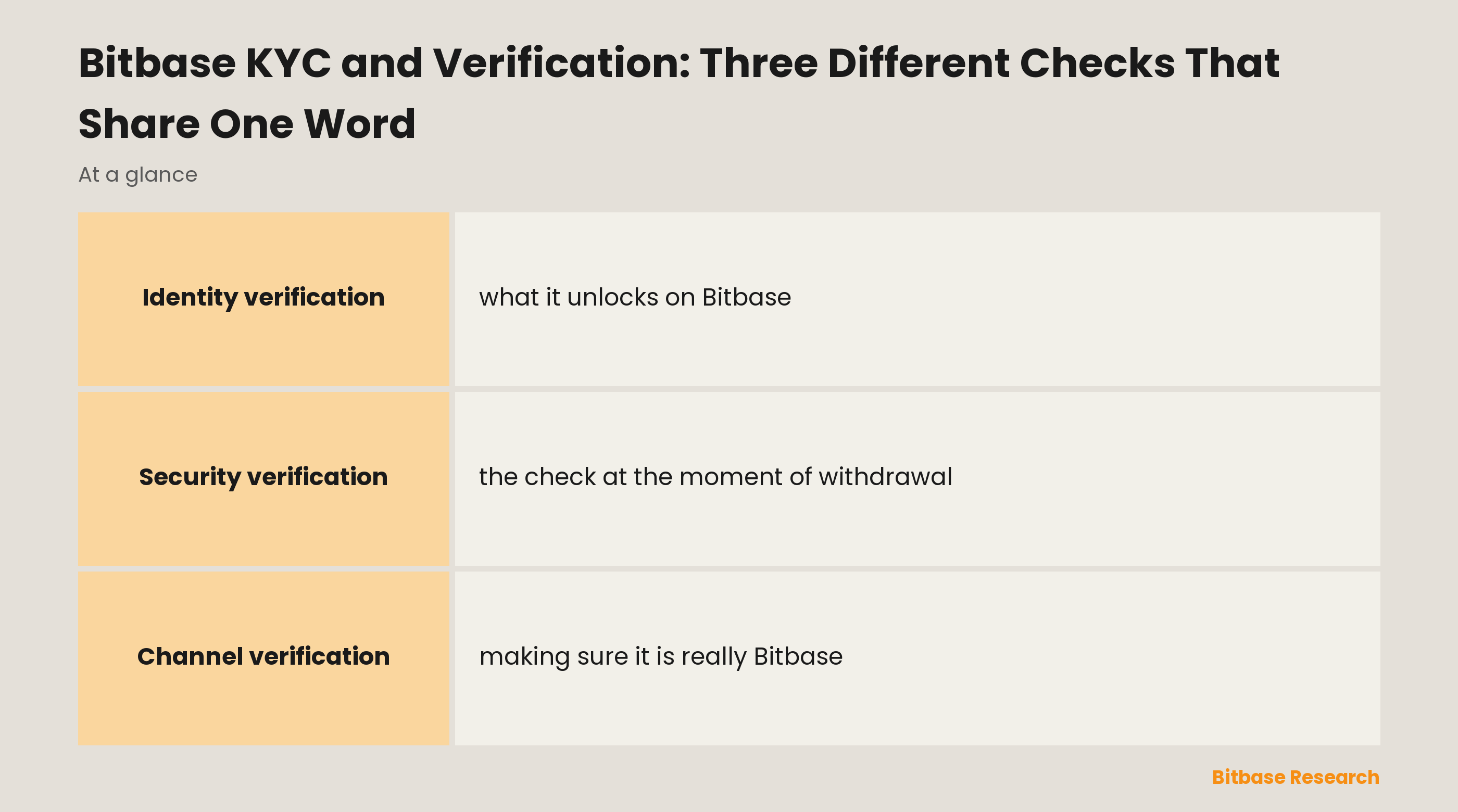
Three different things called verification
Ask three people what verification means on a crypto exchange and you get three answers, all of them right. One is thinking of the identity documents submitted once when an account is opened. One is thinking of the six-digit code that arrives when money is about to leave. One is thinking of whether the website in front of them is real.
They are unrelated mechanisms with unrelated failure modes, and the word they share is the reason the confusion is exploitable. An attacker who says "we just need to verify your account" is counting on you not asking which of the three they mean.
Separating them makes the rest simple. Identity verification is something you do once and it unlocks capability. Security verification happens on every sensitive action and it stops someone else acting as you. Channel verification happens before you trust anything at all, and it is the only one that protects the other two.
The three, side by side
| Check | When it happens | What it protects against |
|---|---|---|
| Identity verification | Once, before you need higher limits | An anonymous account that cannot be held to anything |
| Security verification | Every withdrawal and sensitive action | Someone with your password but not your devices |
| Channel verification | Before you trust a site, message or account | A convincing fake that never was Bitbase |
The order in the table is not the order of importance. Channel verification comes last in a typical user's awareness and first in an attacker's plan, which is why it sits in this guide alongside the other two rather than in a separate corner marked security.
Identity verification: what it unlocks on Bitbase
The concrete effect is on your withdrawal limits. Bitbase's own product tutorial states that completing identity verification raises the withdrawal limit to as much as 500,000 USDT per day, and limits are a function of that verification alongside your account tier.
That framing is worth keeping straight. Verification and VIP tier are two different levers on the same number: verification is a one-time process, while a tier is earned across thirty-day windows of volume or balance. If your limit is the thing blocking you today, verification is the faster of the two.
The requirements as they currently stand are shown in the product itself, and that is the place to read them rather than any article. What a verification flow asks for generally, and why each item is asked for, is covered in what is crypto account verification.
What the process generally involves
Across the industry the shape is consistent, and knowing it in advance removes most of the friction. An exchange establishes that you are a real person, that the person is you, and that the details match a document a government issued.
In practice that usually means a government-issued identity document and a live capture that ties your face to it. The live capture is the step that fails most often, and it fails for mundane reasons: glare, a cropped edge, an expired document, a name that differs from the account by a middle name or a transliteration. The common failure modes and how to get past them are set out in why selfie verification keeps failing.
One rule covers the whole process. Submit documents only inside the platform's own verification flow, reached by navigating there yourself. No legitimate verification has ever required you to email a passport scan to a support agent who contacted you first.
Security verification: the check at the moment of withdrawal
When you confirm a withdrawal, Bitbase asks for a security check, which may be two-factor authentication, an email code or an SMS code. It is placed at the end of the flow deliberately, because that is the point where an attacker who has your password but not your phone runs out of road.
This is also why that code is the single most valuable thing an attacker can get from you by asking. Anyone requesting it, through any channel and with any justification, is trying to complete an action you did not start. Bitbase's own guidance is unambiguous: never share verification codes or passwords, and Bitbase will never ask you for them.
Treat the arrival of an unexpected code as information rather than an inconvenience. It means someone reached the final step of an action on your account, and the correct response is to secure the account rather than to dismiss the message. The full withdrawal flow, including where this check sits, is in how to withdraw from Bitbase.
Channel verification: making sure it is really Bitbase
The third check is the one users perform on Bitbase rather than the other way round. Bitbase publishes an official channel checker where you can enter a website address, an email, a Telegram handle or a social account and find out whether it is genuinely an official channel.
Two statements from Bitbase's own official channel page are worth memorising, because they turn most scams into obvious ones. Official Bitbase channels will never contact you by direct message, and will never ask you for personal, financial or account information. They will also never ask you to transfer funds or digital assets to them or to any third party.
Any message that breaks one of those rules has identified itself, regardless of how well the logo is reproduced. How to run the check and what to do with the answer is covered in how to verify official Bitbase channels.
When verification fails or stalls
Most identity verification failures are document quality rather than eligibility, and they are fixed by resubmitting under better conditions: even lighting, all four corners in frame, an unexpired document, and a name entered exactly as it appears on it.
A security verification that never arrives is usually a delivery problem rather than an account problem. Check the alternate method if one is configured, and check that the contact details on the account are current before assuming something is wrong with the account itself.
If a withdrawal is blocked and verification is complete, the constraint is more likely a limit than a check. That is the point at which the question becomes which limit and what raises it, which is a different problem with a different answer.
The bottom line
Three checks share the word verification on Bitbase, and telling them apart is a security skill in itself. Identity verification is done once and raises your withdrawal limit to as much as 500,000 USDT per day. Security verification runs on every withdrawal and is the last barrier between an attacker and your balance. Channel verification is what you do to the other party, using Bitbase's official channel checker.
One rule survives all three. Nobody legitimate will ever ask you for a verification code or a password, and no official Bitbase channel will contact you by direct message or ask you to send funds anywhere. If a request breaks that rule, the request is the problem, not your account. For more from Bitbase Academy, keep reading.
Related reading
Other Bitbase articles on this topic:
- Where Is Bitbase Regulated? The Registrations, and What They Do Not Mean
- How to Check If a Crypto Exchange Is Safe: A Checklist You Can Actually Run
- How to Verify a Merkle Proof: Running the Check Yourself
- Dual Leaderboard Competition: What the Standings Say Four Days In
- Market Order Protection and Fat-Finger Limits
Disclaimer: This article is educational content from Bitbase Academy, provided for information only. It does not constitute investment, trading, tax, or financial advice. Crypto assets are volatile; assess your own risk. Written as of September 2026; refer to the latest official information.
References
[1] Bitbase, How to Deposit and Withdraw Crypto on Bitbase — Web (official product tutorial) www.bitbase.com