Bitbase holds two published regulatory registrations: a Money Services Business registration with FinCEN in the United States, and a Digital Currency Exchange registration with AUSTRAC in Australia. Both come with an entity name and a number you can quote. Neither is a licence, and neither means a regulator has approved the platform. That distinction is the whole subject of this article, because it is the one most exchange pages blur and the one that decides what protection you actually have.
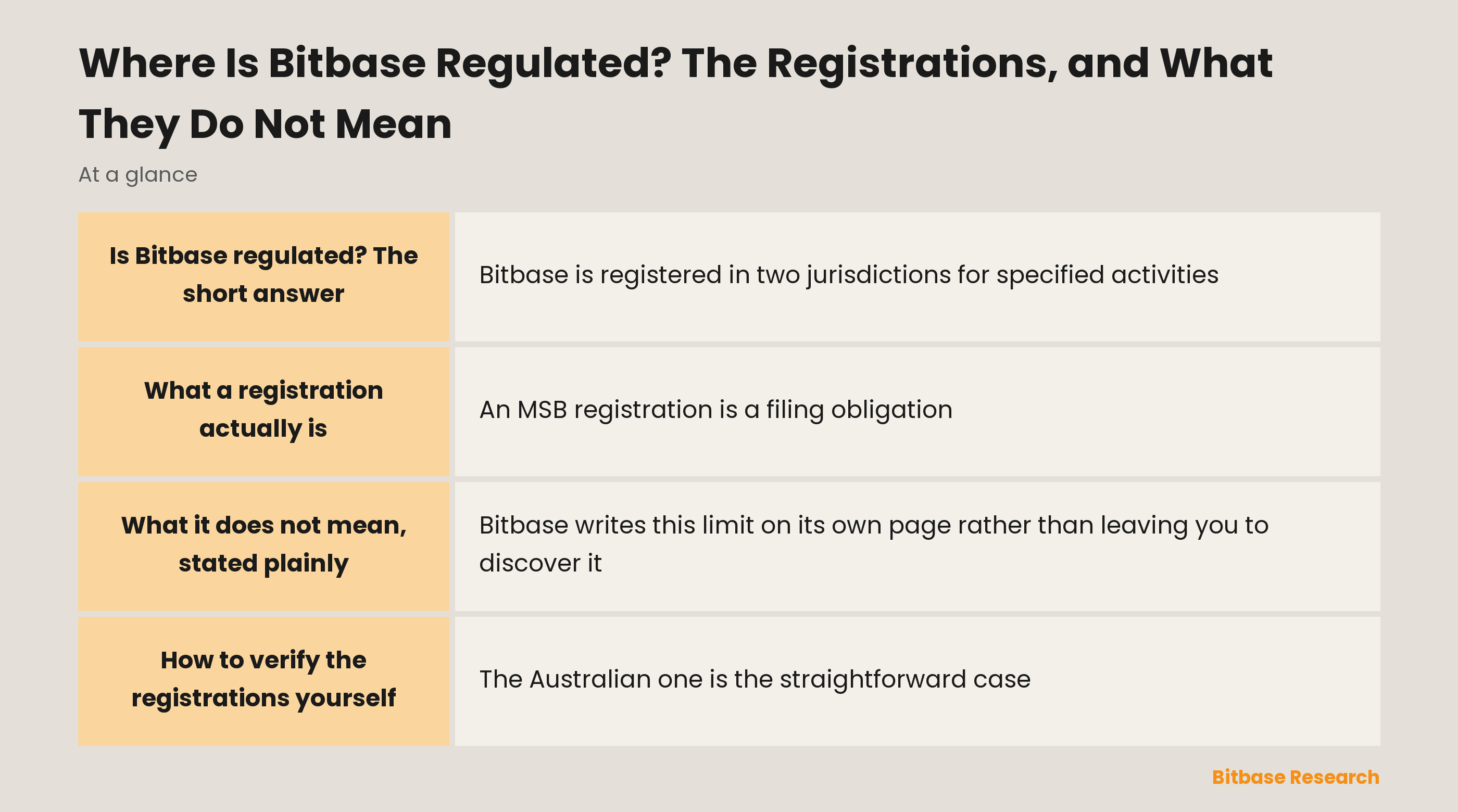
Is Bitbase regulated? The short answer
Bitbase is registered in two jurisdictions for specified activities. It is not licensed as a bank, a broker-dealer or an investment firm anywhere, and it does not claim to be.
That is a narrower statement than "regulated" usually implies in conversation, and stating it narrowly is the point. Registration and authorisation sit at different places on a ladder, and the gap between them is where most misunderstanding about crypto exchanges lives.
The two registrations, in full
| Jurisdiction | Registered entity | Registration type | Number | Regulator |
|---|---|---|---|---|
| United States | Bitbase Global Inc. (Panama) | Money Services Business under the Bank Secrecy Act | 31000331133865 | FinCEN, U.S. Department of the Treasury |
| Australia | BITBASE PTY LTD | Digital Currency Exchange / Virtual Asset Service Provider | ABN 19671902168 | AUSTRAC |
The US registration declares three activity types: dealer in foreign exchange, money transmitter, and seller of money orders. Its coverage extends to all US states and territories. The Australian registration sits under the anti-money-laundering and counter-terrorism-financing framework.
One of these is confirmable from outside without asking us. The Australian entity, BITBASE PTY LTD, appears on the Australian Business Register as an Australian private company, active from 4 October 2023. Full details are on the About Bitbase page.
What a registration actually is
An MSB registration is a filing obligation, not a permission. A business that handles money in the ways the Bank Secrecy Act defines must register with FinCEN, implement an anti-money-laundering programme, keep records and file reports. Registration confirms the filing was made for the declared activities.
The AUSTRAC side works on the same logic: a digital currency exchange operating in Australia must enrol on the register and meet AML/CTF obligations. Enrolment is the entry ticket to operating lawfully, not a grade awarded afterwards.
What both give you is real but specific. There is a named legal entity behind the platform, that entity has accepted a compliance obligation, and a regulator has a record of it. Those are the things an anonymous offshore operation cannot show you.
What it does not mean, stated plainly
Bitbase writes this limit on its own page rather than leaving you to discover it. The wording is worth reading rather than paraphrasing.
Registration means the relevant entity has completed statutory registration and compliance for specified activities in that jurisdiction. Each registration applies only to the registered entity and its declared activities, and does not extend to other entities, products or services. Registration does not imply regulatory endorsement or approval. Service availability varies by local law, and regional restrictions may apply.
Three consequences follow from that paragraph, and they are the ones to carry away.
First, no regulator has reviewed the platform's solvency, its custody arrangements or the fairness of its markets as a condition of the registration. Second, the registration attaches to one entity, so it does not automatically cover every product on the site. Third, being registered in the US does not mean the service is available to you if you live somewhere it is restricted.
Where registration sits relative to a licence
| What it establishes | What it does not | |
|---|---|---|
| Registration (MSB, DCE) | A named entity filed and accepted AML obligations | Any review of solvency, custody or conduct |
| Licence (bank, broker-dealer) | Prudential supervision, capital rules, ongoing examination | Still not a guarantee against failure |
| No registration at all | Nothing | Everything |
Most crypto exchanges globally sit in the first row. Reading the first row as though it were the second is the error that leaves people surprised, and it is worth being precise about because the distinction is doing real work: an AML registration says something about traceability and record-keeping, and says nothing about whether your balance is backed.
For the backing question there is a separate mechanism, which is proof of reserves, published monthly and verifiable by you rather than by a regulator. Reading the two together is what gives a full picture; reading either alone gives a partial one.
How to verify the registrations yourself
The Australian one is the straightforward case. The Australian Business Register is public and searchable by ABN, and looking up 19671902168 returns the entity name, its type and its active-from date. That takes a minute and requires trusting nobody.
For the US registration, FinCEN publishes an MSB registrant search. Search by name rather than by number, since the number formatting varies between sources, and confirm the entity name matches the one published above.
The habit worth building is this one: when any platform states a registration, ask which entity holds it and whether you can find that entity in the register yourself. A platform that names the entity and the number is inviting that check. One that says only "regulated" or "licensed" without either is not.
Frequently asked questions
Is Bitbase licensed? No. It holds registrations, which are a different instrument. See the table above for what each establishes.
Does the MSB registration mean Bitbase is approved by the US government? No. FinCEN registration is a filing requirement under the Bank Secrecy Act, and Bitbase states on its own page that registration does not imply endorsement or approval.
Can I use Bitbase from anywhere? No. Service availability varies by local law and some jurisdictions are excluded. Check the restrictions that apply where you live before opening an account.
Which entity would I be dealing with? That depends on your jurisdiction and the product. The two registered entities are Bitbase Global Inc. and BITBASE PTY LTD, and the registrations cover their declared activities rather than the whole platform.
The bottom line
Two registrations, two named entities, two numbers you can quote: MSB 31000331133865 with FinCEN, and ABN 19671902168 with AUSTRAC, the second confirmable on a public government register in about a minute.
What they establish is that a real, named company has taken on AML obligations under supervision. What they do not establish is regulatory approval, solvency or custody quality, and Bitbase says so on its own page. The checks that speak to those questions are in is Bitbase safe and the security mechanisms in Bitbase security. To keep learning the fundamentals, follow more from Bitbase Academy.
Related reading
Other Bitbase articles on this topic:
- Bitbase KYC and Verification: Three Different Checks That Share One Word
- How to Check If a Crypto Exchange Is Safe: A Checklist You Can Actually Run
- How to Verify a Merkle Proof: Running the Check Yourself
- FIFO vs LIFO for Crypto Cost Basis
- Memetic Premium: Why Memes Move Prices
Disclaimer: This article is educational content from Bitbase Academy, provided for information only. It does not constitute investment, trading, tax, or financial advice. Crypto assets are volatile; assess your own risk. Written as of September 2026; refer to the latest official information.
References
[1] Bitbase, About Bitbase — company overview and regulatory registrations www.bitbase.com
[2] Australian Business Register, ABN Lookup — ABN 19671902168, BITBASE PTY LTD abr.business.gov.au
[3] Bitbase, Proof of Reserves disclosure page and FAQ www.bitbase.com