This is Bitbase Academy writing about Bitbase, so treat it as a fact sheet rather than an independent review. What makes it useful is that every claim below is one you can check without taking our word for it: the registration numbers are searchable in public registries, the fee schedule is published live, and the reserve figures come with an open-source verifier. This page tells you what is on record and exactly where to look.
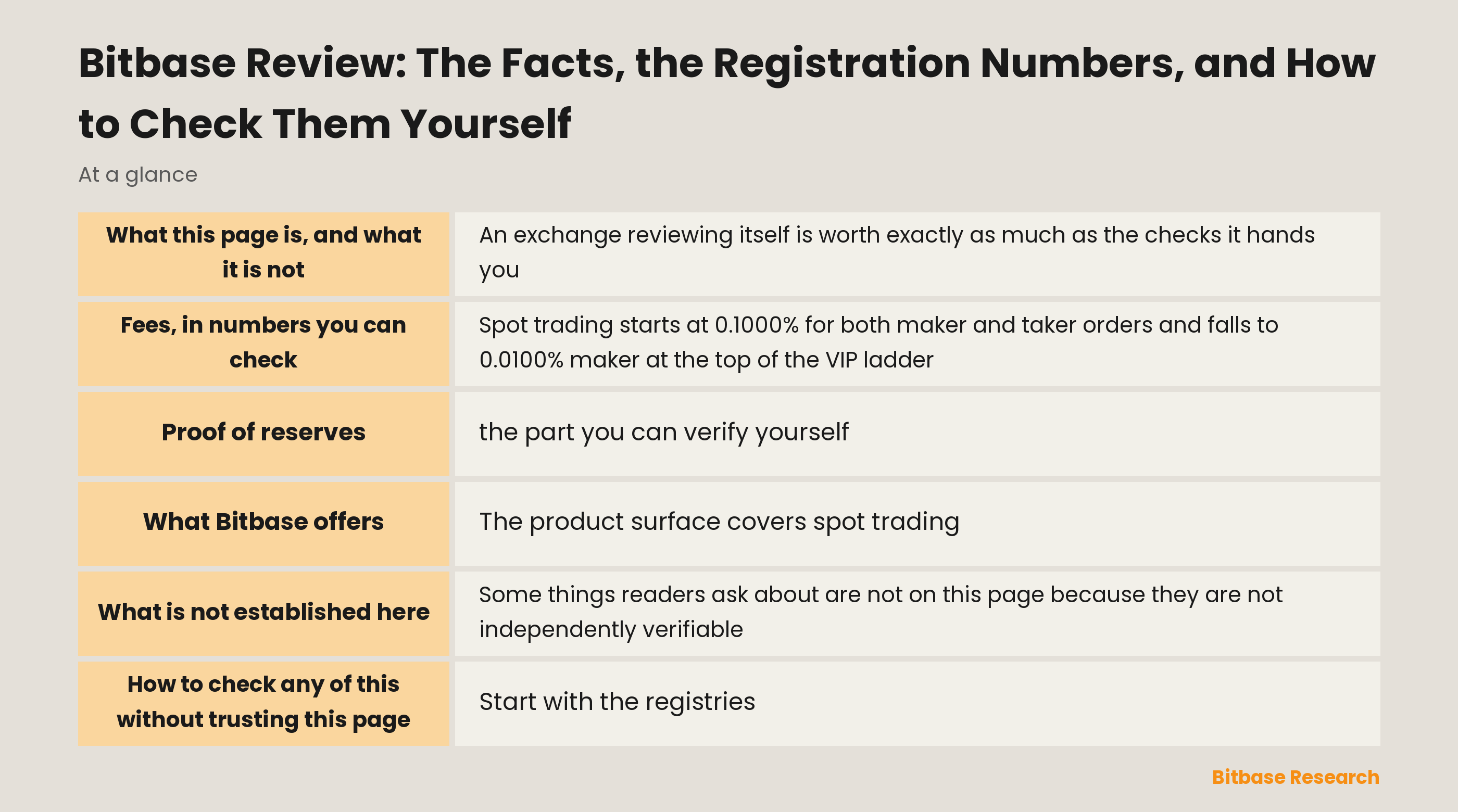
What this page is, and what it is not
An exchange reviewing itself is worth exactly as much as the checks it hands you. So this page does not rate Bitbase, score it, or compare it to anyone. It lists what is verifiable and points at the registry, page or tool where you can verify it.
That framing is deliberate. Anything not independently checkable has been left out, including the figures readers most often ask for and platforms most often supply without evidence. Where something is not established, this page says so rather than filling the gap.
Read it the way you would read a company filing: as a set of claims with addresses attached. The claims are only worth what the addresses turn out to hold.
The registrations, and exactly what they mean
| Registry | Number | Registered entity | Where you check it |
|---|---|---|---|
| FinCEN, United States | MSB 31000331133865 | Bitbase Global Inc. | FinCEN MSB Registrant Search |
| AUSTRAC, Australia | ABN 19671902168 | BITBASE PTY LTD | Australian Business Register lookup |
Both are registrations, not licences, and the distinction is the single most misread thing in this industry. Bitbase's own about page states it plainly: registration does not imply regulatory endorsement or approval. A registered business is one that has told a regulator it exists and what it does; it has not been vetted, blessed or insured by that regulator.
Read that way, the numbers are still worth having. A registered entity has a legal name, a jurisdiction and a public record, which is more than an anonymous platform offers and is the baseline any real check starts from. The company describes itself as founded in 2023, with headquarters in Panama City and teams in Hong Kong, Singapore and Dubai; the Australian record shows the entity active from October 2023, which lines up with that account.
Fees, in numbers you can check
Spot trading starts at 0.1000% for both maker and taker orders and falls to 0.0100% maker at the top of the VIP ladder. USDT-margined futures start at 0.0200% maker and 0.0600% taker and fall to 0.0050% maker. The full eight-level schedule with its qualifying thresholds sits on the fee page and updates there in real time.
Two structural features of that schedule are worth more than the headline rates. The balance thresholds are identical in the spot and futures tables, so assets you already hold lift both sides of the account at once; and the spot volume thresholds sit five to ten times below the futures ones. Both are checkable by reading the two tables side by side, which is what the Bitbase VIP fee guide does.
Rates move, so treat any figure in any article as an illustration and the fee page as the record.
Proof of reserves: the part you can verify yourself
Bitbase publishes proof of reserves monthly, covering BTC, ETH, USDT and USDC. The published data lets any user confirm that their own balance was included in the total that was attested, using a Merkle tree and an open-source verifier rather than a statement asking to be believed.
That distinction is the whole point of the exercise. A reserve claim you cannot check is a press release. A reserve claim with a per-user verification path is a claim that fails loudly if it is wrong, which is what makes it evidence rather than assertion. The mechanics and how to run the check on your own account are in how to verify Bitbase proof of reserves.
Note what proof of reserves does and does not establish. It shows assets held against user balances at the moment of the snapshot. It is not a financial audit and it says nothing about liabilities outside the covered assets, which is why nobody should read it as one.
What Bitbase offers
The product surface covers spot trading, USDT-margined perpetual futures, and TradFi, which brings stocks, indices, precious metals, forex and crude oil into the same account through on-chain price-tracking certificates. TradFi lists more than a hundred popular pairs with leverage up to 200x and keeps core assets tradable around the clock.
Alongside those sit an Earn product, a rewards hub, referral and affiliate programmes, and apps for iOS and Android. Everything settles into one balance and one VIP level, so activity anywhere in the account affects the rates everywhere in it.
There is also a piece of infrastructure worth naming separately, because most platforms do not publish one. Bitbase runs an official channel verification tool where you can enter a website address, an email, a Telegram handle or a social account and find out whether it is genuinely official. Given how much crypto fraud is impersonation, a first-party way to answer "is this really you" is a meaningful safety feature; how to use it is in how to verify official Bitbase channels.
What is not established here
Some things readers ask about are not on this page because they are not independently verifiable, and putting them here anyway would defeat the purpose. User counts, trading volumes, assets under custody and industry rankings are not published in a form anyone can check, so they are absent rather than estimated.
Bitbase holds registrations rather than licences, as set out above, and nothing here should be read as regulatory approval in any jurisdiction. Proof of reserves is not an audit. And no claim on this page is a superlative, because a superlative is a comparison and comparisons need evidence about other platforms that this page does not attempt to supply.
Saying all of that plainly costs nothing and is the reason the rest can be relied on. A page that claimed everything would be worth less than one that claims a smaller set and shows you the receipts.
How to check any of this without trusting this page
Start with the registries. Search the MSB number on FinCEN's registrant search and the ABN on the Australian Business Register; both are free, public and take about a minute each. The entity names should match the table above exactly.
Then check the live surfaces. The fee page carries the current schedule, the about page carries the company's own statements including the registration wording, and the proof of reserves page carries the latest attestation with the verification tooling.
Finally, verify the channel you arrived through. Fake sites are the most common way people lose money to an exchange they never actually used, and the official channel checker exists to settle that question in a few seconds. Background on the wider protections is in Bitbase security.
The bottom line
Bitbase is a crypto exchange founded in 2023, headquartered in Panama City, holding an MSB registration with FinCEN and an ABN registered with AUSTRAC, both of which you can look up yourself in public registries. It publishes a full eight-level fee schedule live, runs monthly proof of reserves with per-user verification through an open-source verifier, and operates a first-party tool for checking whether a channel is genuinely official.
Those are registrations rather than licences, and proof of reserves is not an audit. What they are is checkable, which is the property that matters when you are deciding whether to trust a platform with money. Verify the numbers above in the registries, read the fee page for current rates, and run the reserve check against your own balance rather than taking any page's word for it. For more from Bitbase Academy, keep reading.
Related reading
Other Bitbase articles on this topic:
- How to Download, Deposit and Withdraw Crypto on Bitbase - App
- How to Set Up the Bitbase VIP Bot (Telegram and Discord)
- How to Trade Crypto on the Bitbase App (Spot and Futures)
- How to Trade Crypto on Bitbase - Web (Spot and Futures)
- Solana Meme Launches and Token Risks
Disclaimer: This article is educational content from Bitbase Academy, provided for information only. It does not constitute investment, trading, tax, or financial advice. Crypto assets are volatile; assess your own risk. Written as of September 2026; refer to the latest official information.
References
[1] Bitbase, About Bitbase — company overview and regulatory registrations www.bitbase.com
[2] Bitbase, Fee Schedule — VIP levels, spot and futures maker and taker rates www.bitbase.com
[3] Bitbase, Proof of Reserves — monthly attestation and open-source verifier www.bitbase.com
[4] Bitbase, TradFi — product page and FAQ on tokenised traditional assets www.bitbase.com