Security on an exchange is not one feature. It is a stack: where the coins physically sit, who can authorise them to move, what watches the platform during a crash, and what you control on your own account. Bitbase publishes four architectural elements and gives users three controls. This is what each one does, which failure it is built against, and where the boundary between the platform's job and yours falls.
The split that decides everything
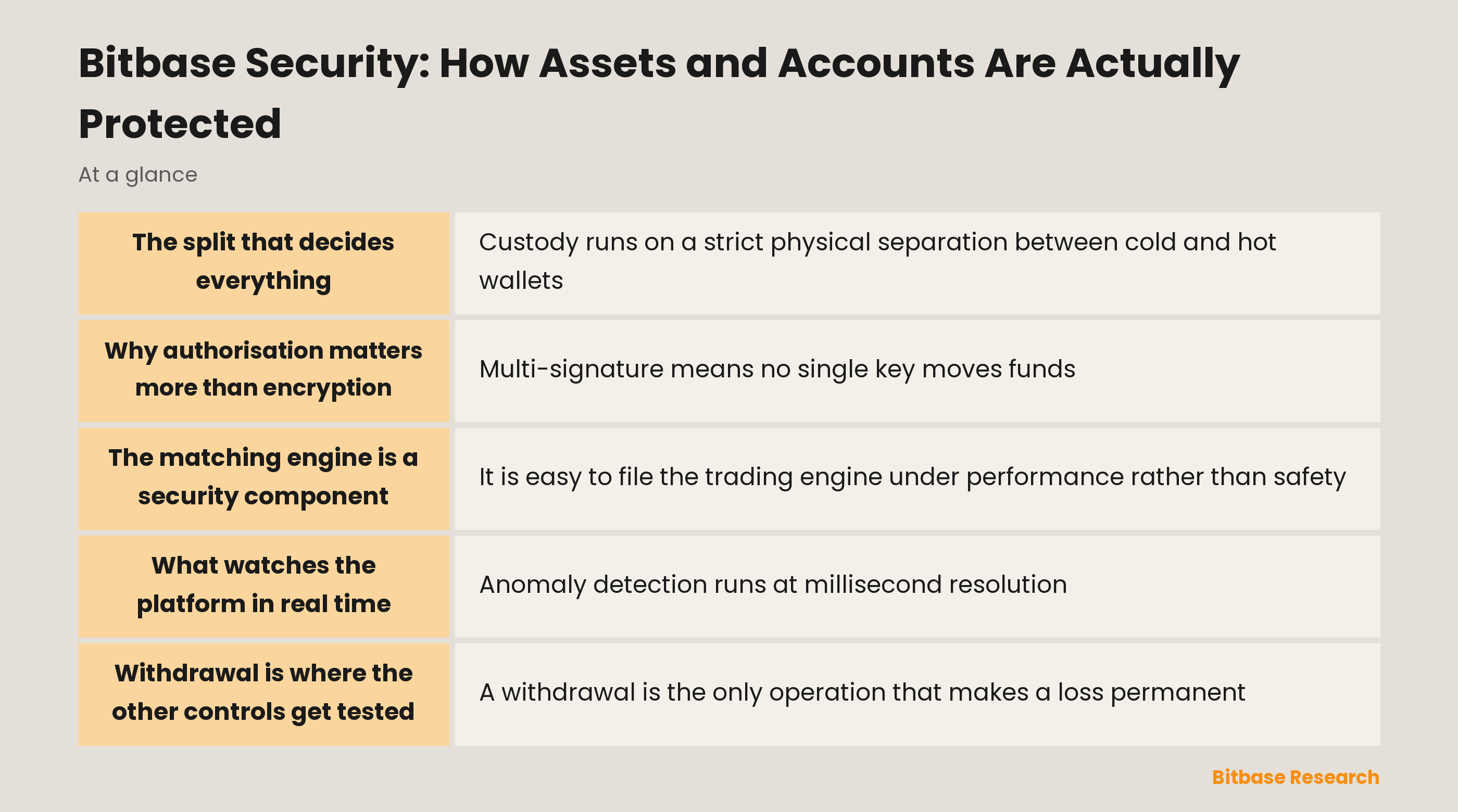
Custody runs on a strict physical separation between cold and hot wallets. Cold wallets are kept offline; hot wallets hold the working balance that funds withdrawals. Movement between them is governed by multi-signature authorisation and tiered access controls.
That sentence is easy to skim past, so it is worth stating what it is built against. Almost every large exchange loss in the history of this industry has been a hot wallet loss, because a hot wallet is by definition reachable from a network. The cold side is not defended by being harder to break into; it is defended by not being connected. The difference between the two is the single most consequential design decision a venue makes about your coins, and every other control sits downstream of it.
Why authorisation matters more than encryption
Multi-signature means no single key moves funds. A transaction requires several verified signatures before execution, so compromising one person, one machine or one credential does not produce a withdrawal.
Tiered access control is the companion to that. Not everyone with access has the same access, and the level required rises with what is being moved. Together the two convert the interesting question from "can an attacker steal a key" to "can an attacker steal several keys held under different controls at the same time", which is a much harder problem and, more usefully, one that leaves traces while it is being attempted.
The matching engine is a security component
It is easy to file the trading engine under performance rather than safety. On an exchange they are the same thing. The failure mode that costs users money in a violent move is not a slow page; it is orders that do not execute, liquidations that fire on a price no market printed, and a platform that stops responding at the moment positions need to be closed.
Bitbase built its engine in-house on a sharded architecture for millisecond-level order processing, with core engine modules scheduled for public release in 2026. The derivatives side pairs it with fair price marking, which sets the mark price against a weighted average of spot indices from major venues so that a liquidity gap on one platform cannot trigger liquidations the wider market does not justify.
What watches the platform in real time
Anomaly detection runs at millisecond resolution, with the stated purpose of keeping the platform reliable during extreme volatility. The reason that matters is timing: attacks and infrastructure failures cluster in exactly the windows when volume spikes, because that is when both are hardest to distinguish from normal load.
Monitoring is also the control that produces evidence. Prevention that works leaves nothing behind; detection is what tells you an attempt happened, and how far it got. An exchange with no detection layer does not have fewer incidents, it has fewer incidents it knows about, and the gap between those two states is where the expensive surprises live.
The same logic applies to load. A platform that degrades gracefully under ten times normal volume and one that falls over look identical on a quiet Tuesday. The difference only appears on the day it matters, which is why the architecture is worth reading before that day rather than after.
What you control on your own account
Platform architecture stops mattering at the point where an account is simply opened by its owner. Three controls do most of the work, and they are yours rather than ours.
| Control | What it stops | Where it fails |
|---|---|---|
| Two-factor authentication via an authenticator app | Password reuse and credential leaks | SMS codes, which are exposed to SIM swap |
| [Withdrawal address whitelist](https://www.bitbase.com/blog/what-is-a-crypto-withdrawal-whitelist) | Funds leaving to an attacker's address | Addresses you added yourself under pressure |
| [Identity verification](https://www.bitbase.com/blog/what-is-kyc-in-crypto) | Loss of account access with no recovery path | Nothing, but it raises limits as a side effect |
The whitelist is the one people skip and the one that matters most. It converts a stolen password from a total loss into an inconvenience, because funds can only leave to addresses approved in advance and adding a new one carries a delay. That delay is the entire point: it gives you a window to notice, and it removes the speed advantage an attacker needs.
Two-factor deserves one clarification. Any second factor beats none, but SMS is the weakest option because it depends on your mobile carrier rather than on your device, and SIM swap attacks target exactly that dependency. An authenticator app keeps the secret on hardware you hold.
Withdrawal is where the other controls get tested
A withdrawal is the only operation that makes a loss permanent. Everything else can be reversed, disputed or waited out; a confirmed on-chain transfer cannot.
That is why the controls stack specifically there: whitelist plus two-factor plus the platform's own risk checks, with the hot and cold split behind them limiting how much is reachable at all. It is also why the most common real-world attack does not try to defeat any of this. It asks you to do the withdrawal yourself, which is a social problem rather than a cryptographic one and is why the official-channel checker exists at all.
What can be verified and what is stated
| Independently checkable | Stated by the platform |
|---|---|
| Two registrations with numbers and regulators | Cold and hot wallet separation |
| Monthly reserve ratios and a Merkle root | Multi-signature authorisation |
| Whether your balance was in the snapshot | Tiered access controls |
| Whether a channel is official | Millisecond anomaly detection |
Both columns are worth having, and confusing them is the error to avoid. The right column is Bitbase's own description of its architecture, which is what any exchange can offer about internals no outsider can inspect. The left column is what someone outside can confirm, and the reason proof of reserves is worth the effort of checking yourself rather than reading.
The bottom line
The platform side rests on four elements: cold and hot separation, multi-signature authorisation with tiered access, an in-house sharded matching engine with fair price marking, and millisecond anomaly monitoring. Each is aimed at a specific failure rather than at a marketing bullet.
Your side rests on three: an authenticator app rather than SMS, a withdrawal whitelist set before you need it, and completed verification. The whitelist is the one to do today. What none of this settles is covered in is Bitbase safe, and the platform overview is in what is Bitbase. To keep learning the fundamentals, follow more from Bitbase Academy.
Related reading
Other Bitbase articles on this topic:
- Bitbase KYC and Verification: Three Different Checks That Share One Word
- Where Is Bitbase Regulated? The Registrations, and What They Do Not Mean
- How to Check If a Crypto Exchange Is Safe: A Checklist You Can Actually Run
- How to Trade Stocks on Bitbase: A Step-by-Step Guide for Crypto Traders
- Trends, Ranges, and Breakouts
Disclaimer: This article is educational content from Bitbase Academy, provided for information only. It does not constitute investment, trading, tax, or financial advice. Crypto assets are volatile; assess your own risk. Written as of September 2026; refer to the latest official information.
References
[1] Bitbase, About Bitbase — company overview and regulatory registrations www.bitbase.com
[2] Bitbase, Proof of Reserves disclosure page and FAQ www.bitbase.com
[3] Bitbase, Official Channel Verification www.bitbase.com