Spot trading on Bitbase costs 0.1000% for both maker and taker orders at the base level, and falls to 0.0100% maker and 0.0200% taker at the top of the ladder. This guide publishes the full schedule with its qualifying thresholds, explains how your tier is decided by four separate measures rather than by trading volume alone, and shows which of those measures you can actually move.
What you actually pay on a spot trade
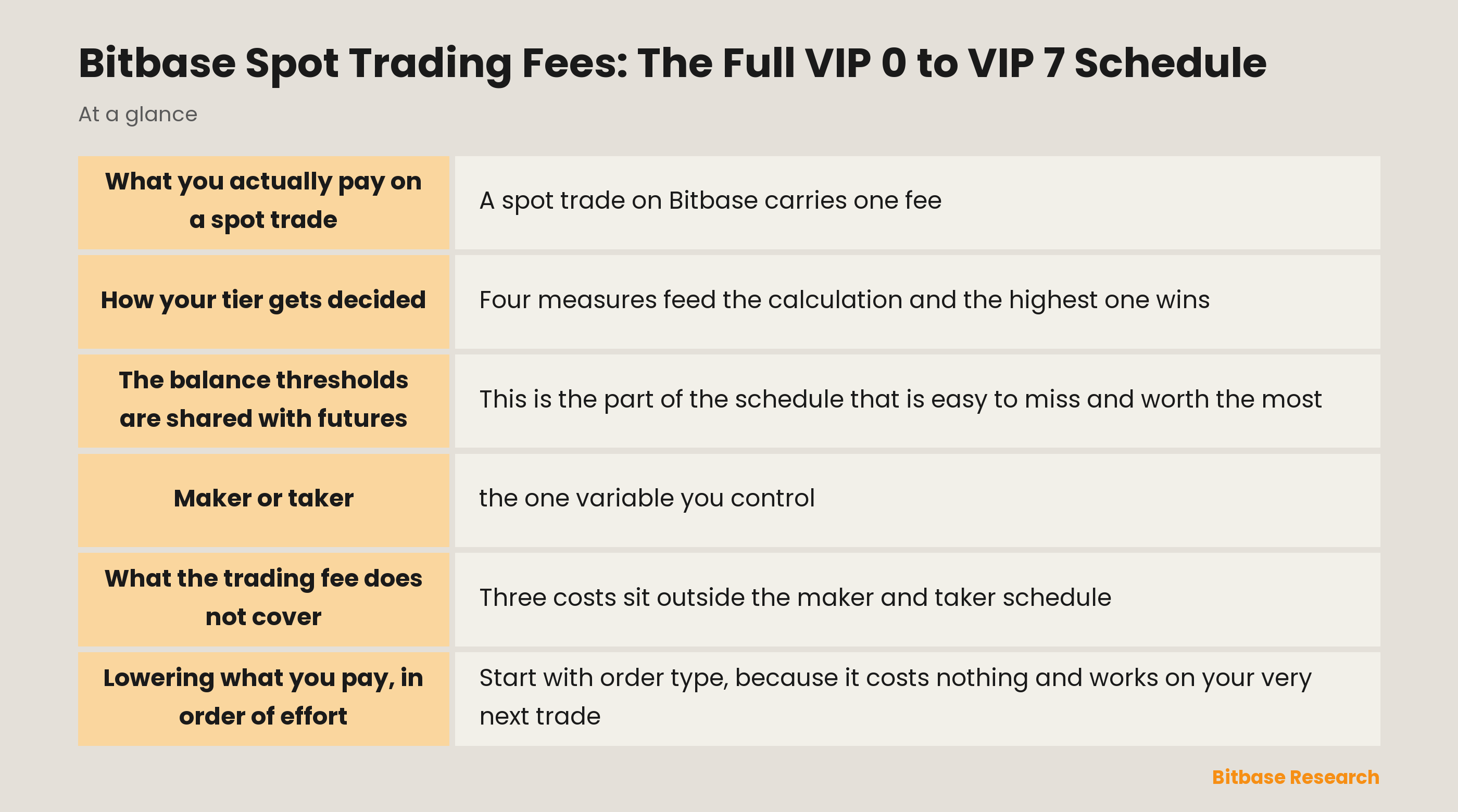
A spot trade on Bitbase carries one fee, charged as a percentage of the order value at the moment it executes. There is no separate charge for opening and closing, because a spot trade is not a position: you are exchanging one asset for another, and the fee comes out of the proceeds once.
The rate depends on two things. The first is your VIP level. The second is whether your order added liquidity to the order book or removed it. An order that rests on the book waiting for someone to trade against it is a maker order. An order that executes immediately against what is already resting there is a taker order. Venues price the two differently because the first improves the market and the second consumes it.
At the base level those two rates happen to be identical, which surprises people who have been told that maker orders are always cheaper. They separate from VIP 1 upward, and the gap widens all the way to the top.
The full spot fee schedule
Every level below is published on the fee page and updated there in real time. These figures were read on 9 September 2026, so treat the table as a map and the fee page as the territory.
| VIP level | 30D spot volume (USDT) | Current balance (USDT) | 30D average balance (USDT) | Maker | Taker |
|---|---|---|---|---|---|
| VIP 0 | ≥0 | ≥0 | ≥0 | 0.1000% | 0.1000% |
| VIP 1 | ≥500,000 | ≥30,000 | ≥30,000 | 0.0800% | 0.0900% |
| VIP 2 | ≥2,000,000 | ≥50,000 | ≥50,000 | 0.0700% | 0.0800% |
| VIP 3 | ≥8,000,000 | ≥250,000 | ≥250,000 | 0.0500% | 0.0600% |
| VIP 4 | ≥30,000,000 | ≥750,000 | ≥750,000 | 0.0400% | 0.0500% |
| VIP 5 | ≥50,000,000 | ≥2,000,000 | ≥2,000,000 | 0.0300% | 0.0400% |
| VIP 6 | ≥75,000,000 | ≥5,000,000 | ≥5,000,000 | 0.0200% | 0.0300% |
| VIP 7 | ≥100,000,000 | ≥10,000,000 | ≥10,000,000 | 0.0100% | 0.0200% |
Three columns qualify you and only one of them has to. The volume column counts your spot turnover over the trailing thirty days; the two balance columns count assets rather than activity. Whichever column places you highest is the one that sets your rate.
Read the last two columns downward and the shape of the ladder appears. Maker fees fall by ninety percent from base to top and taker fees by eighty percent, so the schedule rewards patience more than it rewards urgency.
How your tier gets decided
Four measures feed the calculation and the highest one wins. Two are visible in the table above: your 30-day spot volume and the two balance measures. The fourth sits in the futures schedule, because your 30-day futures volume counts toward the same single VIP level.
That last point is the one most often missed. You hold one VIP level, not a spot level and a futures level, and every market reads its own rate off it. Trading futures therefore lowers your spot fees, and holding a balance lowers both.
Balance is measured by sampling rather than by a single reading. Bitbase takes several snapshots at random moments each day across spot, USDT-M futures, USDC futures and Earn, converts everything to USDT and averages the samples. The 30-day average balance is built separately, from one snapshot per day at 00:00 UTC over the trailing thirty days. Levels themselves refresh daily at 00:00 UTC, so a change today reaches your rates tomorrow. The full mechanism, including the trial card and the risk-control clause, is set out in the Bitbase VIP fee guide.
The balance thresholds are shared with futures
This is the part of the schedule that is easy to miss and worth the most. The balance thresholds in the spot table are exactly the same figures as the balance thresholds in the futures table: 30,000 USDT, then 50,000 USDT, then 250,000 USDT, and onward by the same steps to the top.
One consequence follows immediately. A trader who reaches VIP 3 by holding 250,000 USDT gets VIP 3 pricing on spot and on futures at once, without trading a single dollar of volume on either side. You are not maintaining two ladders and you do not have to split your activity to keep both of them warm.
The volume thresholds, by contrast, are not symmetric at all, and the asymmetry favours spot. VIP 1 asks for 500,000 USDT of spot volume against 5,000,000 USDT of futures volume, which is ten times more on the futures side. At VIP 2 the gap is five times, at 2,000,000 USDT against 10,000,000 USDT. Someone who trades mostly spot climbs the same ladder considerably faster.
Maker or taker: the one variable you control
Your VIP level moves slowly, on a daily refresh and against thresholds measured in millions. The maker or taker split moves on every single order, which makes it the only part of the bill you can change today.
A limit order placed away from the current price rests on the book and pays the maker rate when it fills. A market order, or a limit order priced to execute immediately, pays the taker rate. At VIP 3 that is the difference between 0.0500% and 0.0600%, which is a sixth off the bill for accepting that the fill is not instant.
The trade-off is real rather than free. A resting order may never fill, and in a fast market the price you were waiting for can leave without you. The honest rule is that maker orders suit entries where your price is a range, and taker orders suit the ones where being filled matters more than the basis point.
What the trading fee does not cover
Three costs sit outside the maker and taker schedule, and all three get mistaken for it.
Deposits and withdrawals are priced separately, per coin and per chain, and their dominant component is the network fee rather than a platform charge. Futures carry a funding payment settled roughly every eight hours between long and short holders, which is a transfer between traders rather than a fee to the venue. And spread and slippage are not fees at all, though they come out of the same account: on a thin order book a market order can cost more in slippage than the entire trading fee.
That last one deserves measuring before you optimise anything else. Shaving a basis point off a fee tier while losing several times that to slippage on every entry is effort spent in the wrong place. Where to look first is liquidity, which is a property of the pair you chose rather than of the schedule.
Lowering what you pay, in order of effort
Start with order type, because it costs nothing and works on your very next trade. A limit order that rests rather than crosses moves you from the taker column to the maker column immediately, at every level above the base one.
Then look at where your assets sit. Because balance counts toward the level, and because the balance ladder is shared with futures, consolidating funds that are already yours can move a tier without any trading at all. This is the cheapest structural change available and the one most often overlooked.
Volume is the slowest lever and the one most often pulled for the wrong reason. Trading more in order to reach a cheaper tier only pays when the extra trades were worth making on their own account; otherwise the discount is bought with losses that dwarf it. If you are new to the market itself, how to buy crypto covers the mechanics, and what is Bitbase covers the platform around them.
The bottom line
Bitbase spot trading starts at 0.1000% for both maker and taker orders and falls to 0.0100% maker and 0.0200% taker at VIP 7. Your level is set by whichever of four measures places you highest, and it refreshes daily at 00:00 UTC.
Two features of the schedule matter more than the headline rate. The balance thresholds are shared with futures, so assets you already hold lift both sides of the account at once and cost nothing in trading to maintain. And the spot volume thresholds sit five to ten times below the futures ones, so spot activity climbs the ladder faster than futures activity does. Rates change, so check the fee page before you rely on any number here. For more from Bitbase Academy, keep reading.
Related reading
Other Bitbase articles on this topic:
- What Is a Crypto Transaction Fee?
- Crypto Trading Fees Explained: The Costs You Actually Pay
- How Long Does a Crypto Transaction Take?
- Is Crypto on the Stock Market? Three Places the Two Connect
- Wallet Address vs Public Key: Which One Do You Share?
Disclaimer: This article is educational content from Bitbase Academy, provided for information only. It does not constitute investment, trading, tax, or financial advice. Crypto assets are volatile; assess your own risk. Written as of September 2026; refer to the latest official information.
References
[1] Bitbase, Fee Schedule — VIP levels, spot and futures maker and taker rates www.bitbase.com