Your Bitbase fee tier is not decided by trading volume alone. Four separate measures feed the calculation, and whichever one places you highest is the one that counts. This guide gives the full VIP 0 to VIP 7 rate ladder for spot and futures side by side, explains how each measure is sampled and when levels refresh, and works out which of the four is actually worth moving.
What the VIP level actually changes
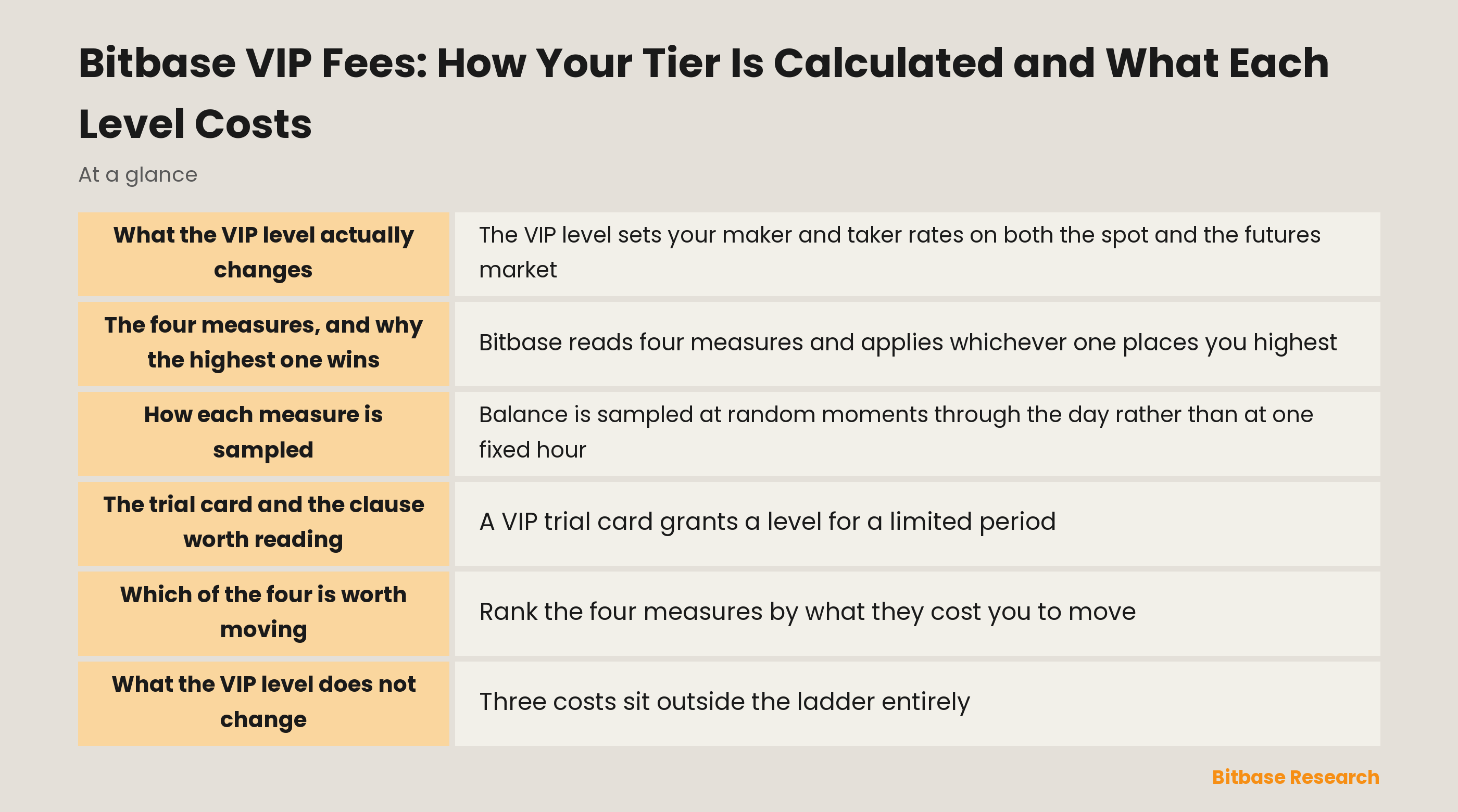
The VIP level sets your maker and taker rates on both the spot and the futures market, and it carries a small set of account benefits alongside them: higher withdrawal limits, priority access to round-the-clock support, and additional eligibility in platform activities. Nothing else about how the account works changes with the level.
It is one level, not two. There is no separate spot tier and futures tier to maintain in parallel; you hold a single VIP level and each market reads its own rate off that level. That structure is the reason the four measures below feed one calculation rather than two, and it is what makes a balance held on one side of the account useful to the other.
The four measures, and why the highest one wins
Bitbase reads four measures and applies whichever one places you highest. Two of them are activity measures: your 30-day spot trading volume and your 30-day futures trading volume, each counted against its own threshold. Two are asset measures: your current balance and your 30-day average balance, both counted as USDT equivalent across the account.
Qualifying on any single one of them is enough. If your spot volume puts you at VIP 1, your futures volume at VIP 2 and your balance at VIP 3, you are VIP 3 and you pay VIP 3 rates in both markets. Nothing is averaged and nothing is combined, which means there is no penalty for concentrating your activity in one place instead of spreading it.
The design has a specific consequence worth stating plainly. A trader who holds a meaningful balance but trades rarely pays the same rates as one who trades constantly at the same tier. Assets and activity are two roads to the same level rather than one road with a toll on it.
The full ladder, both markets
The rates below are published on the fee page and updated there in real time. These were read on 9 September 2026, so treat the table as a map and the fee page as the territory.
| VIP level | Spot maker | Spot taker | Futures maker | Futures taker |
|---|---|---|---|---|
| VIP 0 | 0.1000% | 0.1000% | 0.0200% | 0.0600% |
| VIP 1 | 0.0800% | 0.0900% | 0.0180% | 0.0550% |
| VIP 2 | 0.0700% | 0.0800% | 0.0160% | 0.0500% |
| VIP 3 | 0.0500% | 0.0600% | 0.0140% | 0.0450% |
| VIP 4 | 0.0400% | 0.0500% | 0.0120% | 0.0400% |
| VIP 5 | 0.0300% | 0.0400% | 0.0100% | 0.0350% |
| VIP 6 | 0.0200% | 0.0300% | 0.0080% | 0.0300% |
| VIP 7 | 0.0100% | 0.0200% | 0.0050% | 0.0250% |
Read down the columns and the shape of the ladder appears. Spot maker fees fall by ninety percent from the base level to the top and spot taker fees by eighty percent, while on futures the maker rate falls by three quarters and the taker rate by a little under sixty percent. In both markets the gap between maker and taker widens as you climb, so the higher your level, the more the choice between a resting order and an immediate one is worth to you.
One detail catches people out. At the base level the spot maker and taker rates are identical, and they only separate from VIP 1 upward. Advice that says maker orders are always cheaper is describing the ladder, not the ground floor.
The per-market schedules, with the qualifying thresholds that go with them, are set out in the Bitbase spot fee schedule and the Bitbase futures fee schedule.
How each measure is sampled
Balance is sampled at random moments through the day rather than at one fixed hour. Bitbase takes several snapshots across spot, USDT-M futures, USDC futures and Earn, converts each of them to USDT and averages the results, so the figure reflects what you actually hold rather than what you happen to hold at one predictable instant. The 30-day average balance is built differently again: one snapshot each day at 00:00 UTC, summed across thirty days and divided by thirty.
Volume is simpler. Both volume measures count the trailing thirty days in USDT equivalent, with spot and futures tallied separately against their own columns rather than added together.
Levels themselves refresh once a day, at 00:00 UTC. A change in your volume or your balance therefore reaches your rates the following day rather than the moment it happens, which is worth knowing if you are watching a threshold.
The trial card and the clause worth reading
A VIP trial card grants a level for a limited period, and two rules govern how it interacts with the level you already hold. It cannot take you backwards: if the card's level is below your real level, it is not usable at all. And it cannot cap you: if your real level rises above the card's during the trial period, the higher level applies immediately and the card expires early.
Alongside that sits a condition stated openly rather than buried. Bitbase reserves the right to adjust a VIP level where its risk-control rules are triggered. The honest reading is that this exists for volume manufactured to reach a tier rather than for ordinary trading, but it is a term of the programme and belongs in any account of it.
Which of the four is worth moving
Rank the four measures by what they cost you to move, and the order is not the one most people assume.
Balance is usually the cheapest, because assets you already own count toward the level whether or not you trade them, and because the balance thresholds are the same numbers in both tables: 30,000 USDT, then 50,000 USDT, then 250,000 USDT and upward from there. Consolidating funds that are already yours can move a tier without a single trade, and it moves your spot and futures rates together.
Spot volume is next, because its thresholds sit far below the futures ones. VIP 1 asks for 500,000 USDT of spot volume against 5,000,000 USDT of futures volume, and VIP 2 asks for 2,000,000 USDT against 10,000,000 USDT. Someone who trades mostly spot climbs the same ladder several times faster.
Futures volume is the most expensive route by a wide margin, and it should be a consequence of how you trade rather than a target. Trading more in order to reach a cheaper tier only pays when the extra trades were worth making on their own account; otherwise the discount is bought with losses that dwarf it. The mechanics of that market are covered in how to trade futures on Bitbase, and current contract specifications are on the futures product page.
What the VIP level does not change
Three costs sit outside the ladder entirely, and all three get mistaken for it.
Deposit and withdrawal fees are priced per coin and per chain, and their dominant component is the network fee rather than a platform charge, so no VIP level discounts the blockchain. Funding on perpetual futures is a payment passed between long and short holders roughly every eight hours; it is a transfer between traders rather than a fee to the venue, and your level does not touch it. Spread and slippage are not fees at all, though they come out of the same account, and on a thin order book they can cost several times what the trading fee does.
The practical conclusion is that a VIP level is worth pursuing for the trading fee and for the account benefits attached to it, and for nothing else on that list. Those other costs move with liquidity, timing and order type. For the wider picture of what the platform is and how it is structured, see what is Bitbase.
The bottom line
Bitbase runs one VIP ladder from VIP 0 to VIP 7, and a single level sets your rates in both markets. Four measures qualify you, the highest one wins, and the level refreshes daily at 00:00 UTC.
Two features of the design are worth acting on. The balance thresholds are shared between spot and futures, so assets you already hold lift both sides of the account at once and cost nothing in trading to maintain. And the spot volume thresholds sit five to ten times below the futures ones, so spot activity climbs faster than futures activity does. Rates change, so check the fee page before you count on any number here. For more from Bitbase Academy, keep reading.
Related reading
Other Bitbase articles on this topic:
- What Is a Crypto Transaction Fee?
- Crypto Trading Fees Explained: The Costs You Actually Pay
- How Long Does a Crypto Transaction Take?
- Liquidity Mining Dilution: Why the Same APR Pays You Less
- Wallet Signing and Permissions
Disclaimer: This article is educational content from Bitbase Academy, provided for information only. It does not constitute investment, trading, tax, or financial advice. Crypto assets are volatile; assess your own risk. Written as of September 2026; refer to the latest official information.
References
[1] Bitbase, Fee Schedule — VIP levels, spot and futures maker and taker rates www.bitbase.com