
A withdrawal fee is not one charge but a bundle, and most of it is not paid to the exchange at all. This guide separates the network fee from the platform fee, explains why the same coin costs different amounts on different chains, covers minimums and confirmation delays, and sets out what your VIP level does and does not change. Current figures are published per coin and per chain on the fee page.
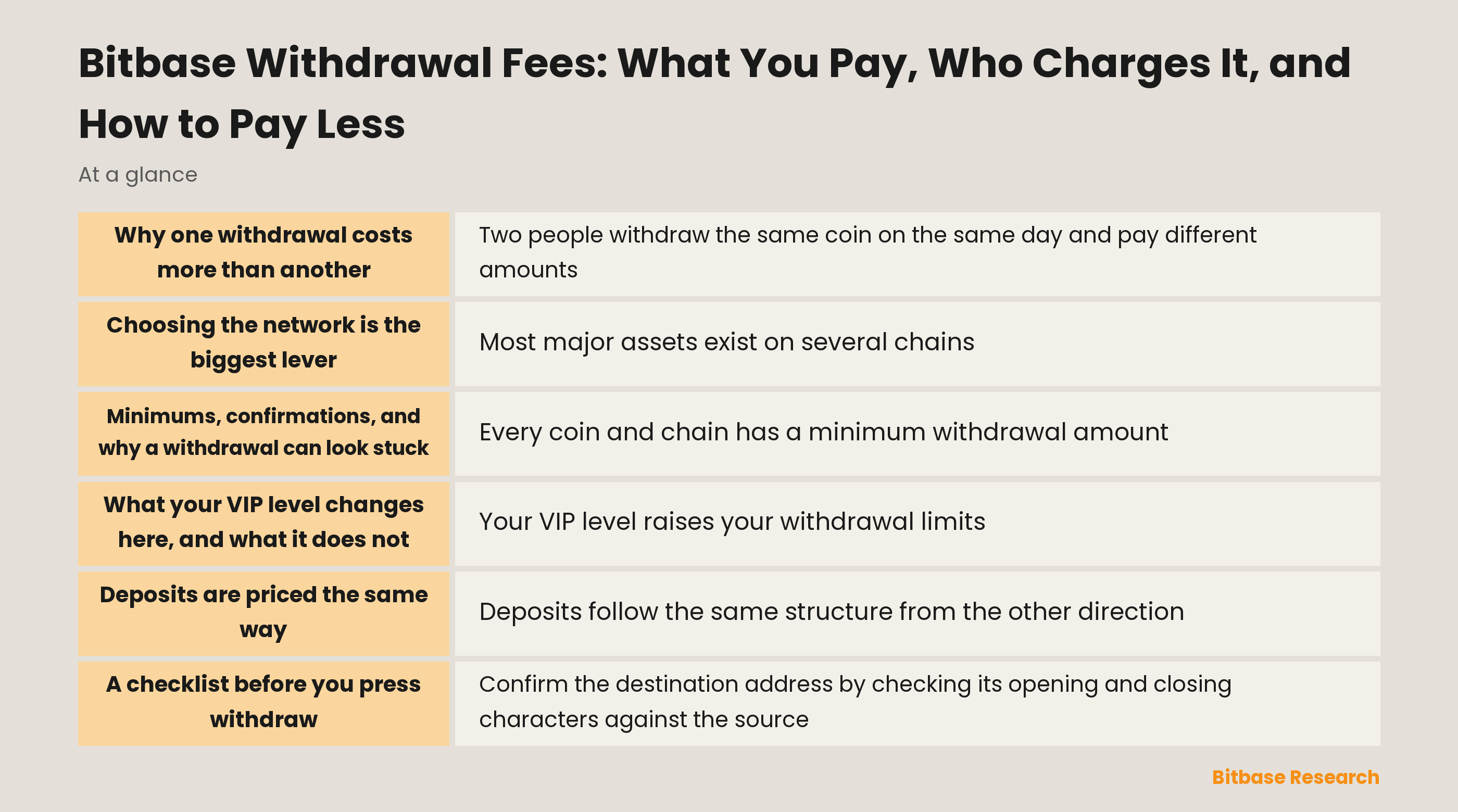
Why one withdrawal costs more than another
Two people withdraw the same coin on the same day and pay different amounts. Nothing is wrong; they chose different networks. A withdrawal is a blockchain transaction, and blockchains price their own block space independently of any exchange.
That single fact explains most of the confusion around withdrawal costs. The number you see quoted is not a service charge set by a policy team. It is dominated by what the chain itself demands to include your transaction, which moves with congestion and differs by orders of magnitude between networks.
The consequence is that withdrawal cost is largely a decision you make rather than a price you are given. Which chain, which moment, and how often you withdraw all move the total more than which platform you use.
The parts of a withdrawal cost
| Component | Who sets it | Does your VIP level change it? |
|---|---|---|
| Network fee | The blockchain, by congestion | No |
| Platform withdrawal fee | Bitbase, published per coin and per chain | No |
| Minimum withdrawal amount | Bitbase, per coin and per chain | No |
| Withdrawal limits | Bitbase, by verification level and VIP tier | Yes |
| Internal transfer between Bitbase accounts | Not an on-chain transaction | Not applicable |
The current figure for any coin and chain sits on the fee page, which is the live source and the only one worth quoting. Any number written into an article is stale the moment the network is busy.
Choosing the network is the biggest lever
Most major assets exist on several chains, and the cost of moving them differs enormously between those chains. A stablecoin sent over a high-throughput network typically costs a small fraction of the same stablecoin sent over a congested one, for a transfer that arrives in the same wallet balance at the other end.
There is one rule that matters more than the saving: the receiving address must support the chain you chose. Sending on a network the destination does not support is the most common way people lose funds permanently, and it is not reversible by anyone. Check the deposit page of wherever you are sending to, confirm the network it names, and match it exactly.
Timing is the second lever. Network fees are demand-driven, so the same withdrawal at a quiet hour can cost meaningfully less than during a busy one. Batching is the third: three withdrawals cost roughly three network fees, and one withdrawal of the same total costs one.
Minimums, confirmations, and why a withdrawal can look stuck
Every coin and chain has a minimum withdrawal amount, set so that the transfer is not consumed by its own network fee. Requests below it are rejected rather than partially filled.
After you confirm, two waits follow. The first is the platform's own processing and risk review. The second is the chain's, which requires a number of block confirmations before the transaction is considered settled, and that number varies by network. A withdrawal that shows a transaction hash has already left the platform; from that point the delay belongs to the blockchain and to the receiving service, not to Bitbase.
The practical read is that a pending withdrawal with a hash is a waiting problem, and one without a hash is a review problem. Knowing which of the two you have tells you whether to check a block explorer or to check your account status.
What your VIP level changes here, and what it does not
Your VIP level raises your withdrawal limits. It does not discount the fee, because the dominant part of that fee is paid to a blockchain that has never heard of your tier.
This is worth stating plainly because the ladder is often assumed to apply everywhere. Trading fees fall steeply across the Bitbase VIP schedule, while withdrawal economics are governed by network conditions and by the chain you selected. Optimising the tier for withdrawals is effort spent against the wrong variable.
Verification level matters here too. Limits are a function of both account verification and tier, and raising the first is usually faster than raising the second.
Deposits are priced the same way
Deposits follow the same structure from the other direction. Bitbase does not charge you to receive most crypto deposits, but the sending side pays a network fee, and the same rule about matching the network applies with equal force.
Two habits prevent the two most expensive mistakes. Always generate a fresh deposit address from the platform rather than reusing one copied from somewhere else, and always confirm that the network shown on the deposit page is the network your sending platform will actually use. Before either, confirm you are on a genuine Bitbase property at all, which is what the official channel verification guide is for.
A checklist before you press withdraw
Confirm the destination address by checking its opening and closing characters against the source, not by trusting a clipboard that malware can rewrite. Confirm the network name matches on both ends. Confirm the amount clears the minimum for that coin and chain.
Then look at the quoted fee against the size of the withdrawal. For a small amount on an expensive chain, the fee can be a large share of what you are moving, and either a different network or a larger, less frequent withdrawal is the better answer.
If anything about the page you are on feels off, stop and re-verify the domain before continuing. The broader account protections are described in Bitbase security, and the withdrawal step is exactly where an unverified domain does its damage.
The bottom line
A Bitbase withdrawal costs a network fee set by the blockchain plus a platform fee published per coin and per chain, subject to a minimum amount and to limits that rise with your verification and VIP tier. The tier raises limits and does not discount fees, because most of what you pay never reaches the exchange.
Three choices move the total more than anything else: which chain you send on, when you send, and how often. Match the network to the destination exactly, check the fee page for the live figure before you confirm, and treat any article number as an illustration. For more from Bitbase Academy, keep reading.
Related reading
Other Bitbase articles on this topic:
- How Long Does a Crypto Transaction Take?
- Can You Cancel a Crypto Transaction?
- Bitbase Futures Fees: The Full USDT-M Schedule and What a Round Trip Costs
- Normal Versus Abusive Trading in a Contest: Two Lists That Are Not the Same
- What Is a Fiat On-Ramp? Turning Cash Into Crypto
Disclaimer: This article is educational content from Bitbase Academy, provided for information only. It does not constitute investment, trading, tax, or financial advice. Crypto assets are volatile; assess your own risk. Written as of September 2026; refer to the latest official information.
References
[1] Bitbase, Fee Schedule — VIP levels, spot and futures maker and taker rates www.bitbase.com