
Because Bitcoin's ledger is public, anyone can study how coins actually move — who is holding, who is spending, and at what profit or loss. This field is called on-chain analysis, and its metrics offer a data-driven view of the market that price charts alone cannot give. Here are the ones worth knowing.
What on-chain analysis is
Every Bitcoin transaction is recorded on a public ledger forever, so analysts can measure real network behavior instead of guessing from price alone. On-chain metrics turn that raw data into signals about holder conviction, network health, and whether coins are being spent at a gain or a loss. They are read alongside price, not instead of it.
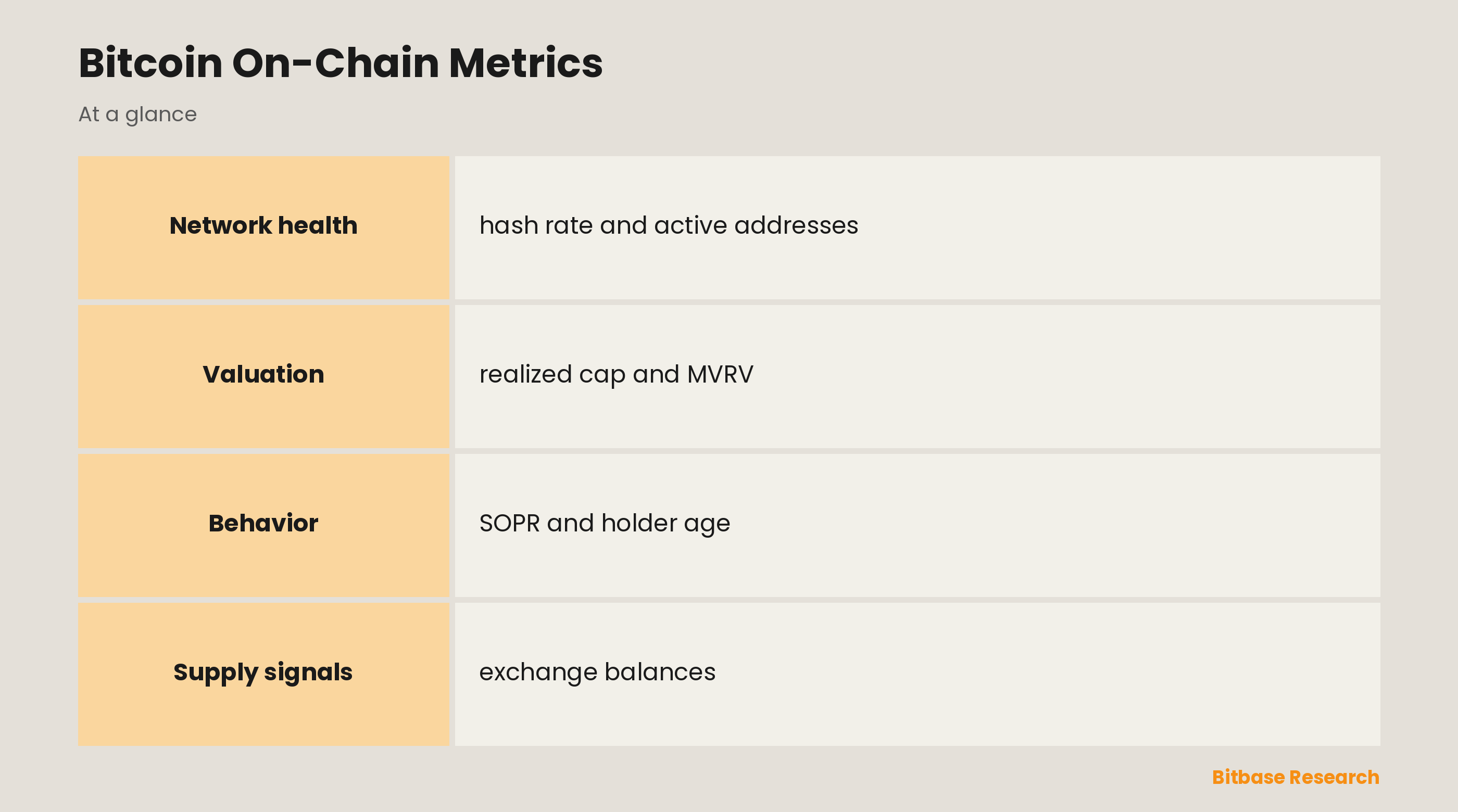
Network health: hash rate and active addresses
Two basic gauges show how alive the network is. Hash rate measures the total computing power securing Bitcoin; a rising hash rate signals miners are committing more resources, which strengthens security. Active addresses count how many addresses transact in a period, a rough proxy for real usage. Together they hint at whether the network is growing or cooling.
Valuation: realized cap and MVRV
Ordinary market cap multiplies price by supply, but on-chain data offers a subtler measure. Realized cap values each coin at the price it last moved, approximating what the whole market actually paid — its aggregate cost basis. Comparing market cap to realized cap gives the MVRV ratio; a very high MVRV suggests holders sit on large unrealized gains and may be tempted to sell, while a low one has historically marked value zones.
Behavior: SOPR and holder age
Other metrics reveal how holders are acting. SOPR, the spent output profit ratio, shows whether coins moving on a given day are being sold at a profit or a loss on average — a reading below one means the market is realizing losses. Coin-age metrics and "HODL waves" separate long-term holders from short-term traders, showing whether seasoned owners are holding tight or starting to distribute.
Supply signals: exchange balances
Where coins sit can hint at intent. When large amounts of BTC flow onto exchanges, it can signal potential selling pressure, since coins usually move there to be traded; sustained outflows to private wallets suggest accumulation and a wish to hold. These flows are watched closely, though the rise of custodians and ETFs has made some balance readings harder to interpret cleanly.
The Metrics at a Glance
| Metric | What it measures | How to read it |
|---|---|---|
| Hash rate | Computing power committed to mining | Rising means miners are committing more, not that price will follow |
| Active addresses | Addresses transacting in a period | A usage gauge, easily distorted by exchange internals |
| Realized cap | Coins valued at the price each last moved | An approximation of what the market paid in aggregate |
| MVRV | Market value against that realized value | How far price sits above or below the aggregate cost basis |
| SOPR | Whether coins move at a gain or a loss | Under one, losses are being realised |
| Exchange balances | Coins held at addresses attributed to exchanges | Inflows may precede selling, and attribution is inferred rather than certain |
The last column is where these stop being predictions: every row describes what has already happened on chain.
The bottom line
On-chain metrics — hash rate, active addresses, realized cap, MVRV, SOPR, holder age, exchange flows — turn Bitcoin's transparent ledger into a rich read on market behavior. They are powerful context, but they are signals, not crystal balls, and can be distorted by exchanges, custodians, and one-off events. Use them to inform your view, never as a guarantee of what price will do next.
Frequently asked questions
What does SOPR below one mean?
It means coins are moving at a loss relative to the price they last moved at, so the market as a whole is realising losses rather than gains. That describes behaviour that has already happened and is read alongside price, not as a forecast of it.
Can on-chain metrics predict Bitcoin's price?
No. Every metric here measures something that already occurred on a public ledger, which is why they are useful as evidence about holder behaviour and network health rather than as signals about what price will do next. Attribution adds a further caveat: exchange balances rest on address labels that are inferred rather than certain.
Related reading
Other Bitbase articles on this topic:
- Bitcoin Ordinals, Runes, and Fees
- What Is Merlin Chain? Bitcoin Layer 2 Architecture and the Role of MERL
- Bitcoin DeFi and Smart Contracts
Related market pages
Bitbase pages for the tokens named in this article:
- BTC: View price · Spot market · Perpetual market
Disclaimer: This article is educational content from Bitbase Academy, provided for informational purposes only. It is not investment, trading, tax, or financial advice. Written as of July 2026; rely on the latest official information.
References
[1] Glassnode Academy, "On-chain metrics" glassnode.com
[2] River, "Bitcoin On-Chain Analysis" river.com