When your coins sit on an exchange, what you hold is a claim against a company rather than the asset itself. Counterparty risk is the collection of ways that claim can fail to be honoured, and it has several independent sources that behave differently under pressure. Understanding which one you are worried about is what turns a vague unease into a decision about how much to leave there.
What counterparty risk actually is
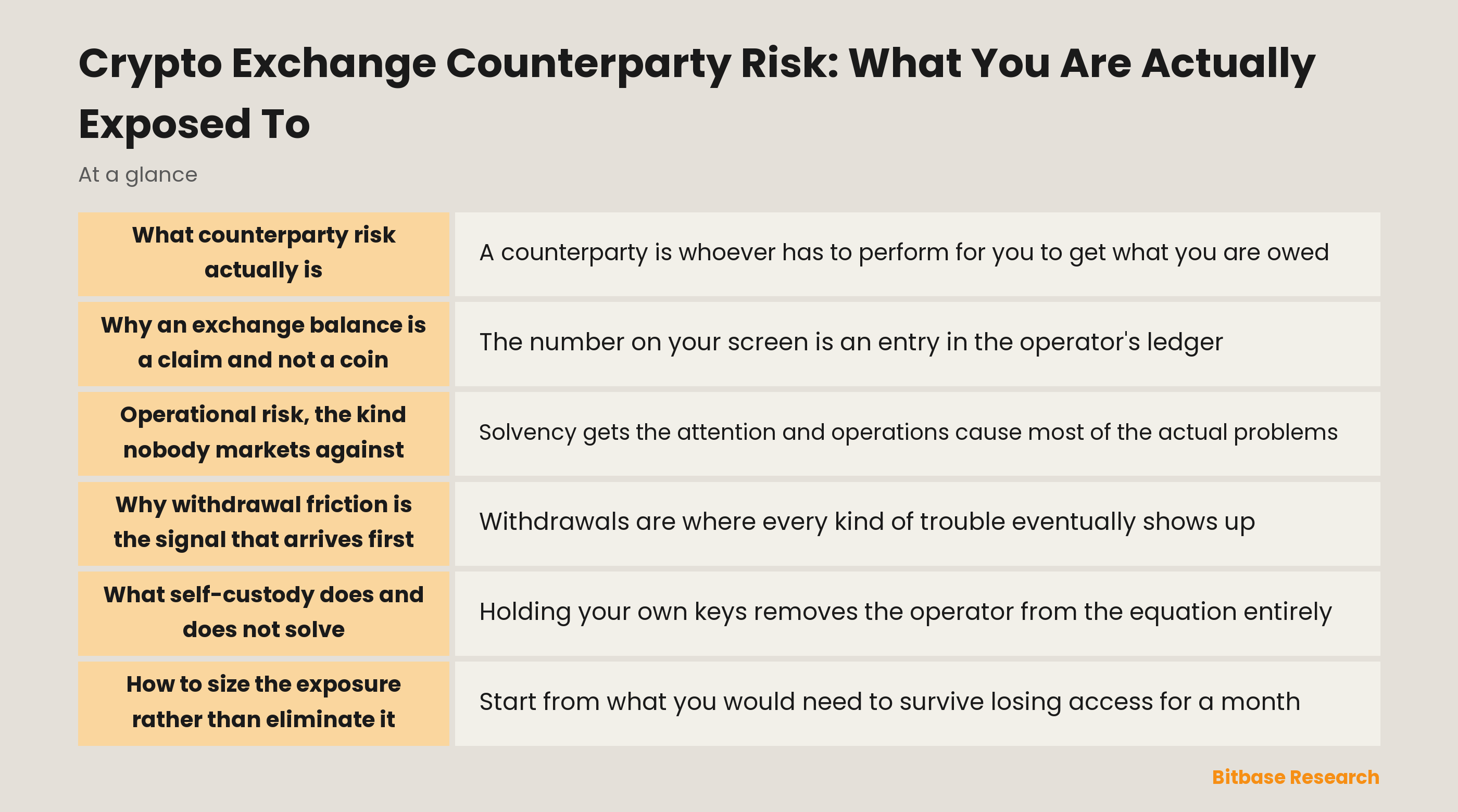
A counterparty is whoever has to perform for you to get what you are owed. On an exchange that is the operator, and the performance in question is letting you withdraw.
The risk is therefore not about price. Your asset can rise all year and you can still be unable to move it, because those are two separate questions and only one of them is about the market. Confusing the two is the most common way people underestimate this.
There is a second confusion worth naming: counterparty risk is not the same as the risk of being hacked. A theft is one way a claim fails, and the claim can also fail with nothing stolen at all. It is also not a binary. Failures range from a withdrawal that takes three days instead of three minutes to an operator that never returns anything, and most of what happens in practice sits closer to the first end than the second.
Where the risk comes from
| Source | How it shows up | What reduces it |
|---|---|---|
| Custody of your assets | Coins you cannot move without permission | Published reserves you can check |
| Business solvency | Obligations you cannot see from outside | Stated scope, outside assurance |
| Operational failure | Outages, delays, transfers that stick | Track record and how incidents are communicated |
| Legal and jurisdictional | Frozen accounts, changed terms | Knowing which entity holds the relationship |
| Concentration on one venue | One failure takes everything at once | Splitting balances across places |
| Assets used elsewhere on your behalf | Risk you inherit without choosing it | Reading what happens to idle funds |
Read the third column honestly, because several of these reduce rather than remove, and a source with no entry there is one you can only size rather than manage. The last row is the one users almost never think about, and it is the one that turns a single relationship into several without anyone mentioning it.
Why an exchange balance is a claim and not a coin
The number on your screen is an entry in the operator's ledger. The coins that back it sit in addresses the operator controls, pooled with everyone else's, and your entry is a promise to hand over that much on request.
This is not a criticism of the model. Pooling is what makes instant trading possible, and a venue that moved coins on chain for every trade would be slower and more expensive by orders of magnitude. The design has a purpose and the exposure is the price of it.
What it means practically is that your position depends on the operator's ability and willingness to perform. Proof of reserves addresses part of that by making the asset side checkable, and the part it leaves open is described in does proof of reserves prove solvency.
Operational risk, the kind nobody markets against
Solvency gets the attention and operations cause most of the actual problems. Systems go down during volatility, a network gets congested, a maintenance window runs long, and withdrawals queue.
None of that means anything is wrong with the balance sheet, and it can still leave you unable to act at the moment you most want to. For an active trader that is a real cost even when everything is resolved by the next day.
It is also the category where a track record is genuinely predictive, since operational quality changes slowly and shows itself repeatedly. The useful signal is how an operator behaves during these events rather than whether they happen. Clear notices, stated causes and a resumption time tell you something about the organisation; silence during an outage tells you something else.
Why withdrawal friction is the signal that arrives first
Withdrawals are where every kind of trouble eventually shows up, which makes them the most informative thing a user can observe directly. Solvency problems, operational problems and legal problems all surface there before they surface anywhere else.
That is why testing a withdrawal occasionally is worth more than reading about one. Moving a small amount out at a normal time establishes what the process feels like when nothing is wrong, and that baseline is what makes a change in behaviour noticeable.
The same reasoning applies to limits and to the number of confirmation steps, which are ordinary settings until they move without explanation. Watch for changes rather than absolute levels. A platform that has always taken a day to process withdrawals is not the same as one that suddenly starts taking a day, and only the second is information.
What self-custody does and does not solve
Holding your own keys removes the operator from the equation entirely. There is no claim, no promise and no queue, and for assets you are not actively trading this is the cleanest answer to counterparty risk.
It replaces that exposure with a different one. Key management becomes your problem, mistakes are irreversible, and there is nobody to appeal to when something goes wrong, which is a trade rather than an escape. How the two models differ mechanically is set out in exchange custody models.
The sensible reading is that the two suit different purposes. Trading balances belong where trading happens and long-term holdings do not have to, and most of the practical benefit comes from that separation rather than from choosing a side.
How to size the exposure rather than eliminate it
Start from what you would need to survive losing access for a month. That framing turns an abstract worry into an amount, and the amount is the only part of this you actually control.
It also helps to separate the money by purpose rather than by feeling, since an amount you are willing to risk for a week is a different number from one you are willing to risk indefinitely. Then use the checkable things. Published reserves, a per-asset breakdown, signatures you can verify and a schedule that is kept are all evidence about the operator, and their absence is evidence too, as covered in the limitations of proof of reserves.
Finally, remember that the risk is structural rather than personal. It exists in every arrangement where somebody holds assets for somebody else, and the deeper anatomy of how it propagates between institutions is developed in counterparty risk architectures.
The bottom line
Counterparty risk on an exchange is the risk that a claim against a company is not honoured, and it comes from custody, solvency, operations, jurisdiction, concentration and whatever the platform does with idle funds.
None of these is removed by a rising market, and none of them is fully removed by any disclosure. The realistic goal is to know which sources apply, use the ones that are checkable, and hold an amount you could afford to lose access to. For more from Bitbase Academy, keep reading.
Related reading
Other Bitbase articles on this topic:
- Bitbase KYC and Verification: Three Different Checks That Share One Word
- Where Is Bitbase Regulated? The Registrations, and What They Do Not Mean
- How to Check If a Crypto Exchange Is Safe: A Checklist You Can Actually Run
- Optional NFT Royalties Explained
- What Is a Watch-Only Wallet?
Disclaimer: This article is educational content from Bitbase Academy, provided for information only. It does not constitute investment, trading, tax, or financial advice. Crypto assets are volatile; assess your own risk. Written as of September 2026; refer to the latest official information.
References
[1] Bitbase, Proof of Reserves — monthly disclosure, Merkle root and open-source verifier www.bitbase.com