Two exchanges can both show full backing and hold reserves of completely different quality. Composition asks what the holdings actually are, and the answer changes what those reserves would be worth on the day they were needed. The single most important question is how much of the total depends on the platform's own token, because that part of the reserve fails at exactly the moment it would be called on.
Why composition is a separate question from amount
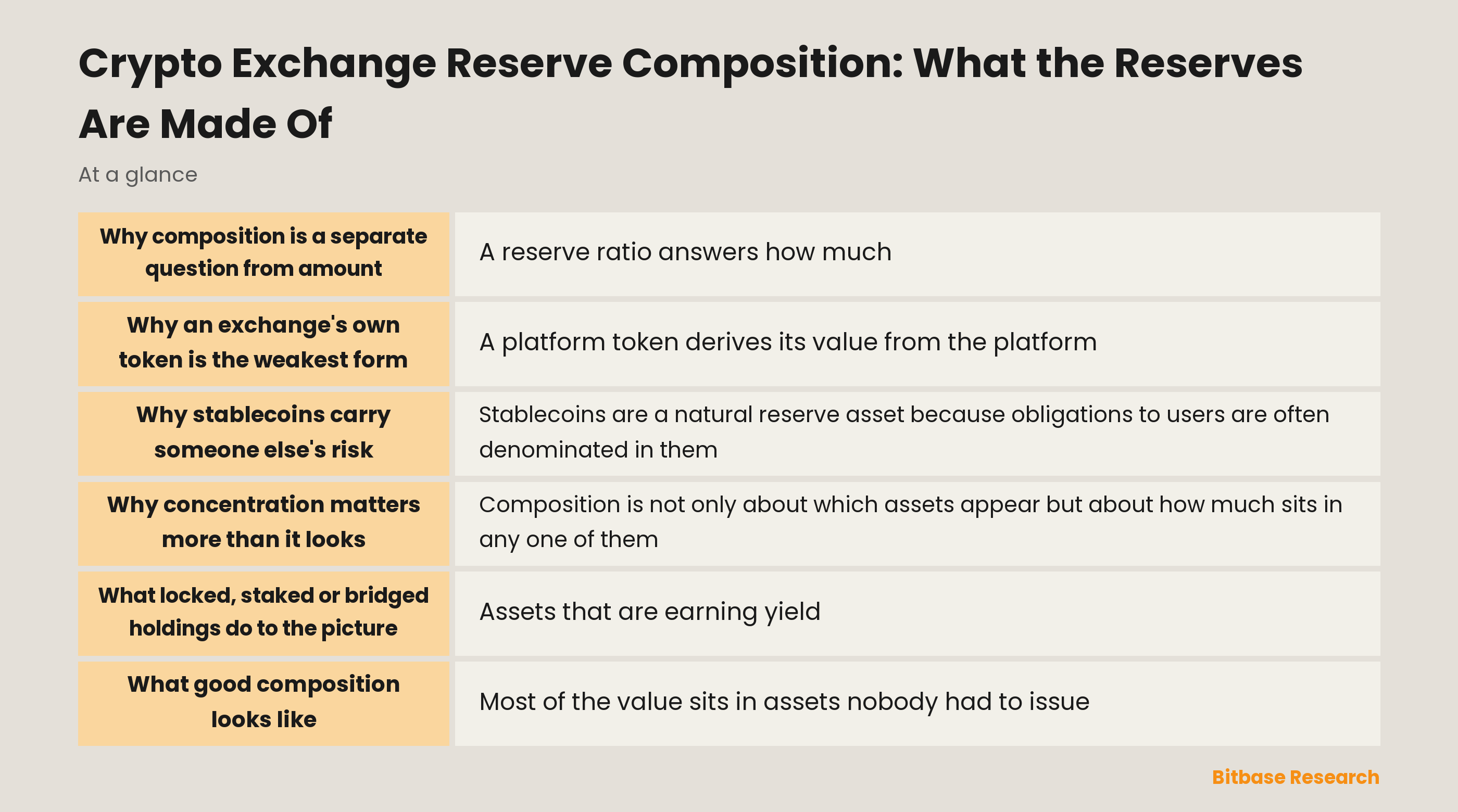
A reserve ratio answers how much. Composition answers what, and the two questions come apart in exactly the situation that matters, which is a period of stress when many users want out at once.
Reserves are useful because they can be delivered. An asset that is deep, liquid and independent of the platform can be handed over at something close to the price it was counted at. An asset that is thin, correlated or issued by the platform itself may be worth far less precisely when it is needed, and its counted value was never a promise about that.
So composition is a quality question layered on top of a quantity question. Reading the quantity side is covered in the crypto exchange reserve ratio; this article is about what sits inside the number.
Asset types rated as reserves
| Asset type | Quality as a reserve | Why |
|---|---|---|
| Major chain assets | Strongest | Deep markets and no issuer that can fail |
| Fiat-backed stablecoins | Strong but borrowed | You inherit whatever risk the issuer carries |
| Other large tokens | Adequate | Liquid, but they fall together in a bad week |
| The platform's own token | Weakest | Its price depends on the platform it is meant to support |
| Thinly traded tokens | Weak | Counted at a price that would not survive being sold |
| Locked, staked or bridged | Depends on disclosure | Present, but not immediately deliverable |
The fourth row is the one worth stopping on, and the rest of this article explains why it deserves a category of its own rather than a footnote.
Why an exchange's own token is the weakest form
A platform token derives its value from the platform. It is bought for fee discounts, tier benefits and the expectation that the venue keeps growing, and every one of those reasons depends on the venue being healthy.
That makes it circular as a reserve. If the platform is under stress, confidence in the token falls at the same time and for the same reason, so the asset shrinks exactly when it would need to be sold. A reserve is supposed to be independent of the thing it protects against, and this one is defined by it.
The counted value is also softer than it looks. Much of the supply may never trade, so a market price set by a small floating portion is applied to a very large holding, and that price would not survive the holder actually selling into it. What these tokens are and how their supply behaves is covered in exchange token events.
Why stablecoins carry someone else's risk
Stablecoins are a natural reserve asset because obligations to users are often denominated in them. Holding the same thing you owe removes a currency mismatch, which is a real advantage and the main reason they appear in reserves at all.
The cost is that you take on the issuer. A fiat-backed token is a claim on a company holding assets somewhere, so the exchange's reserve quality now includes that company's disclosure, redemption behaviour and the composition of its own backing. The risk did not disappear; it moved one layer out.
That layer is worth examining rather than assuming. What sits behind a stablecoin, and how much of it is cash rather than longer-dated instruments, is the subject of what are stablecoin reserves, and the same reading applies when those tokens appear on an exchange's own balance.
Why concentration matters more than it looks
Composition is not only about which assets appear but about how much sits in any one of them. A reserve spread across several independent assets behaves differently from one dominated by a single holding, even when both look adequate on paper.
Correlation makes this sharper. Most crypto assets fall together in a bad week, so a portfolio that appears diversified across many tokens may in practice be one position expressed several ways. Genuine diversification here means assets whose fortunes are driven by different things, which is a much shorter list.
There is also a matching question. Users are owed specific assets, so a reserve heavy in one coin and light in another can be adequate overall and still leave a particular group of users waiting, which is why per-asset reporting and composition are two halves of the same picture.
What locked, staked or bridged holdings do to the picture
Assets that are earning yield, locked in a contract or represented on another network are still assets, and they are not the same as coins sitting ready to move. Between them and a withdrawal sits an unbonding period, a contract, or a bridge.
None of that makes them illegitimate to count. It makes the disclosure around them important, because a reserve that is fully present but partly unavailable for days behaves differently under pressure than one that is immediately deliverable.
The useful thing to look for is whether the report says which category each holding falls into. If it does not, the reader cannot tell a liquid reserve from an encumbered one, and that ambiguity is one of the structural gaps described in the limitations of proof of reserves.
What good composition looks like
Most of the value sits in assets nobody had to issue, meaning coins whose existence does not depend on any company remaining solvent. That is the single strongest property a reserve can have.
Stablecoin exposure is disclosed by issuer rather than lumped together, so a reader can see whose credit is involved. Holdings that are locked or staked are labelled as such. And the platform's own token is either absent from the reserve or small enough that its collapse would not change the answer.
None of this requires trusting a description. Composition is visible on chain once the addresses are published, which means this is one of the few quality judgements a reader can make without asking anyone's permission.
The bottom line
Reserve composition asks what the reserves are made of, and it decides what they would be worth in the situation they exist for. Assets nobody issued are the strongest, stablecoins import an issuer's risk, thin tokens are counted at prices that would not survive a sale, and locked positions need labelling.
The platform's own token is the case to watch, because it is the one asset guaranteed to fall at the same moment the reserve is needed. Full backing made of the right things and full backing made of the wrong ones are not the same claim. For more from Bitbase Academy, keep reading.
Related reading
Other Bitbase articles on this topic:
- Bitbase KYC and Verification: Three Different Checks That Share One Word
- Where Is Bitbase Regulated? The Registrations, and What They Do Not Mean
- How to Check If a Crypto Exchange Is Safe: A Checklist You Can Actually Run
- Fill or Kill, Immediate or Cancel, and All or None Explained
- What Is ATH (All-Time High)?
Disclaimer: This article is educational content from Bitbase Academy, provided for information only. It does not constitute investment, trading, tax, or financial advice. Crypto assets are volatile; assess your own risk. Written as of September 2026; refer to the latest official information.
References
[1] Bitbase, Proof of Reserves — monthly disclosure, Merkle root and open-source verifier www.bitbase.com