Choosing between a crypto stock and a spot bitcoin ETF looks like picking a style of the same bet: both routes end in a share in a brokerage account, quoted on one exchange, in one session. What each share is a claim on is not the same thing at all, and both claims are written down in annual reports that open side by side.
Two Filings, One Asset Name
The iShares Bitcoin Trust ETF files an annual report on Form 10-K, the same form an operating company uses. Item 1 gives its objective in one sentence: "The Trust seeks to reflect generally the performance of the price of bitcoin." The registrant is a Delaware trust, its shares trade on Nasdaq under IBIT, and the filing records that it "is not registered as an investment company for purposes of U.S. federal securities laws."
Strategy Inc. files a 10-K too. Its Item 1 opens with "Strategy is the world's first and largest Bitcoin Treasury Company" and also calls the company "an industry leader in AI-powered enterprise analytics software." Both are self-descriptions with no measurement behind them. What the filing does establish is that bitcoin "serves as the primary treasury reserve asset on an ongoing basis, subject to market conditions and anticipated needs of the business for Cash Assets."
Put the two objectives side by side and that trailing clause is the whole difference. One states a job with no condition attached; the other states a policy, a second business, and a clause that lets the policy bend. Which companies carry the crypto label at all is sorted into five groups elsewhere.
Where a Ten Per Cent Day Goes
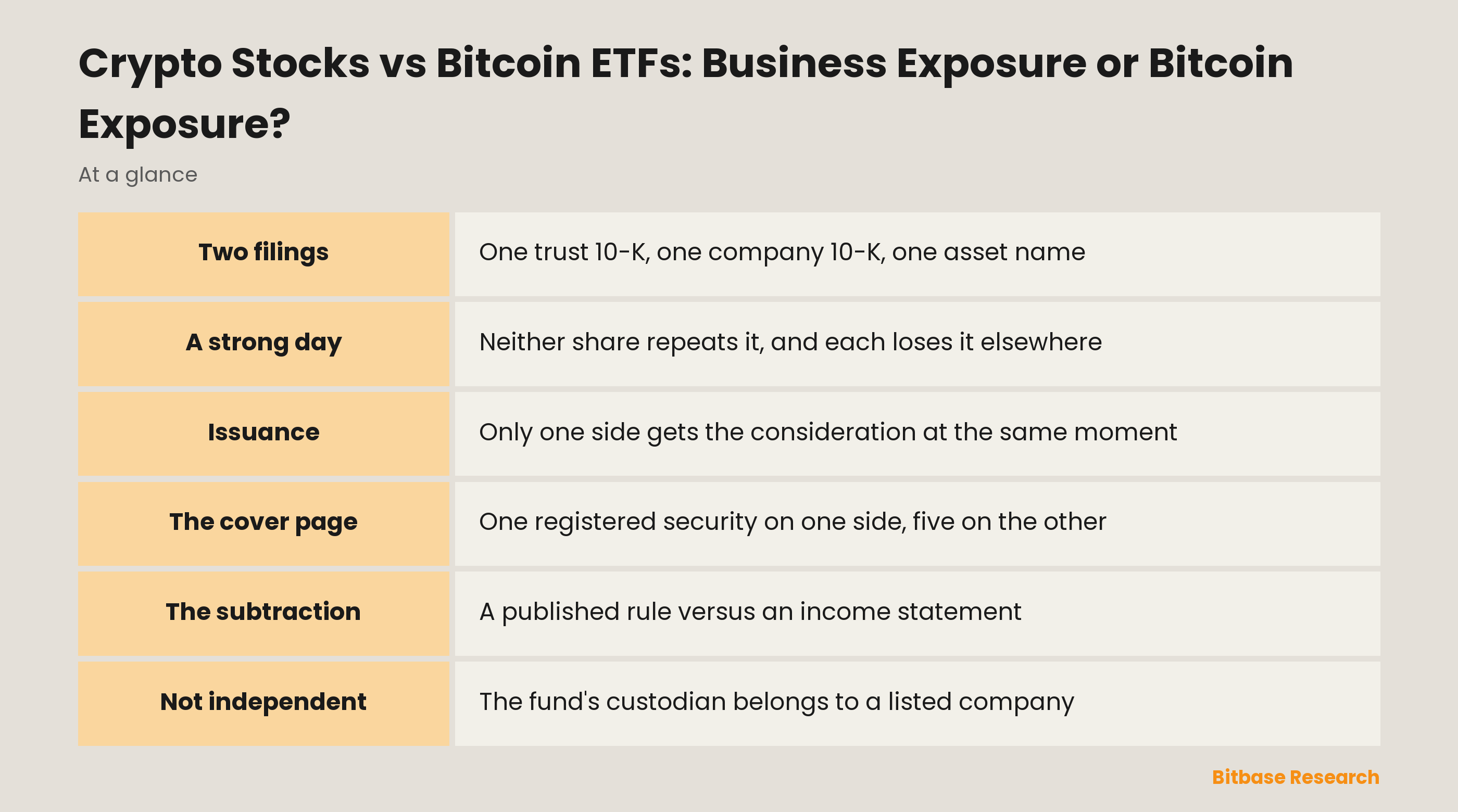
Suppose bitcoin has a strong day. Neither share reproduces it, and each loses the difference somewhere that can be named and looked up.
| Spot bitcoin ETF share | Crypto company share | |
|---|---|---|
| A claim on | The trust's bitcoin, less expenses | The company's assets, after everyone ahead |
| The move arrives | In a value struck once each business day | On whichever accounting line the filing names |
| What subtracts | A sponsor's fee accrued daily | Costs, interest, and a second business |
| Ranked ahead of you | Nobody: one class of shares | Four listed preferred series |
| Also moves the price | Trading above or below that value | Everything else the company does |
| Where to read it | Item 1 of the trust's 10-K | Item 1, Item 1A and the accounts |
The trust is explicit about the arithmetic: each business day, after the New York close, it values its bitcoin by reference to the CME CF Bitcoin Reference Rate (New York Variant) and determines a net asset value, adding that "Shares may trade at, above or below their NAV." The company side has no equivalent, because no daily per-share value is struck at all.
Both Issue Shares; Only One Issues Them Against Delivered Consideration
The share count moves on both sides, and that is where the resemblance ends.
The trust's activities are limited by its own documents: it issues shares in blocks the filing calls baskets, against consideration deposited with its custodian. A new share cannot appear unless the value behind it arrives at the same moment. Who may run that exchange, and whether it settles in cash or in kind, is a mechanism worth reading once.
Strategy funds its purchases the other way round. Item 1 says it funds them "primarily from proceeds of our offerings of our class A common stock and various preferred stock instruments pursuant to our ATM," and has "previously used proceeds from offerings of convertible notes and senior secured notes, and a loan secured by bitcoin." Securities are sold first; what the proceeds buy is settled afterwards.
So the word issuance means opposite things in the two documents. In one it keeps a share tied to the asset; in the other it is how the asset gets paid for.
The Queue Is Printed on the Cover Page
The most useful page in either filing needs no accounting knowledge to read.
The trust's cover page carries one security registered under Section 12(b): its title is the word "Shares" and its symbol is IBIT. That is the entire capital structure, on one line.
Strategy's cover page carries five, all on the same exchange: class A common stock under MSTR, and four perpetual preferred series under STRF, STRC, STRK and STRD. The company's own description of registered securities calls the class A stock "dividend junior stock and liquidation junior stock," and says a preferred series ranks "senior to any equity security, including our Class A Stock ... with respect to the payment of dividends and with respect to the distribution of assets upon our liquidation, dissolution or winding up."
A holder of the common stock therefore stands behind four listed claims before reaching anything the company owns. That count sits on the first page, before any figure inside has had time to go stale. A share of the trust stands behind nobody.
A Fee Is Not a Cost Base
Both structures take something out, and the mechanisms are not comparable.
The trust's subtraction is a single accrual. Its 10-K describes a sponsor's fee accrued daily against net asset value and payable in cash or in kind, then gives the consequence: "The number of bitcoin represented by a Share will decline each time the Trust pays the Sponsor's Fee or any Trust expenses not assumed by the Sponsor by transferring or selling bitcoin." The bitcoin behind each share is designed to fall, by a rule written in advance. What such a rule does and does not promise is set out with custody in its own page.
A company's subtraction follows no rule of that kind. It employs people, runs an analytics platform, services notes, and owes whatever the preferred series are owed. None of that is a percentage or fixed in advance: it is an income statement, to be read rather than quoted.
The Two Routes Are Not Independent
One assumption usually goes unexamined, which is that these are separate bets. The trust's 10-K names its bitcoin custodian as Coinbase Custody Trust Company, LLC, and Coinbase Global, Inc. lists that entity among its subsidiaries in its own annual report. The class A common stock of Coinbase Global is itself registered under Section 12(b) and trades under COIN.
An operating dependency inside the fund therefore belongs to a company whose shares sit on the other side of the comparison: a reason to read the service-provider section before treating a fund as a bare asset holding. The checks that apply on either side are written up as a checklist, each starting from a document rather than a ranking.
One layer sits under both routes: a ticker is no guarantee of what is quoted. The MSTR price page here carries a tokenized instrument from an outside issuer, not the registered share above.
The Bottom Line
The trust registers one class of shares, states one objective, strikes a value each business day, and subtracts a fee by a published rule. The company registers five securities, runs two businesses, funds its holdings by selling securities and borrowing, and puts four preferred series ahead of the common. Neither is a proxy for the other, and neither is a proxy for bitcoin. Read the objective, count the securities on the cover, and find the sentence naming what subtracts.
Related reading
Other Bitbase articles on this topic:
- How to Buy Adobe (ADBE) Stock: Trading Methods, Costs and Risks
- How to Buy Cboe (CBOE) Stock: Trading Methods, Costs and Risks
- How to Buy CME Group (CME) Stock: Trading Methods, Costs and Risks
- How to Buy SQQQ: Daily Inverse Exposure vs Shorting QQQ
- What Is a Fiat On-Ramp? Turning Cash Into Crypto
Disclaimer: This article is educational content from Bitbase Academy, provided for information only. It explains what a company or fund does and how the instruments referenced here differ from one another; it does not constitute investment, trading, tax, or financial advice, and it is neither a recommendation nor an endorsement of any security, token, or trading strategy. A tokenized stock is issued by a third party and is designed to give economic exposure to an underlying asset: it is not a share, it carries no shareholder rights, and it depends on the issuer's structure, eligibility rules, and redemption terms, which the issuer can change. Perpetual futures are leveraged derivatives that hold no underlying asset and can be liquidated, and trading hours, product availability, and eligibility differ by instrument and by jurisdiction and can change at any time. Written as of September 2026; verify everything yourself through company filings, the issuer's own documentation, and the product pages of the venue you trade on.
References
[1] iShares Bitcoin Trust ETF FY2025 Form 10-K: objective, NAV, sponsor's fee, custodian www.sec.gov
[2] Strategy Inc. FY2025 Form 10-K: Item 1 self-description, treasury policy, ATM funding www.sec.gov
[3] Strategy Inc. description of registered securities: ranking of the preferred series www.sec.gov
[4] Coinbase Global FY2025 list of subsidiaries: Coinbase Custody Trust Company, LLC www.sec.gov