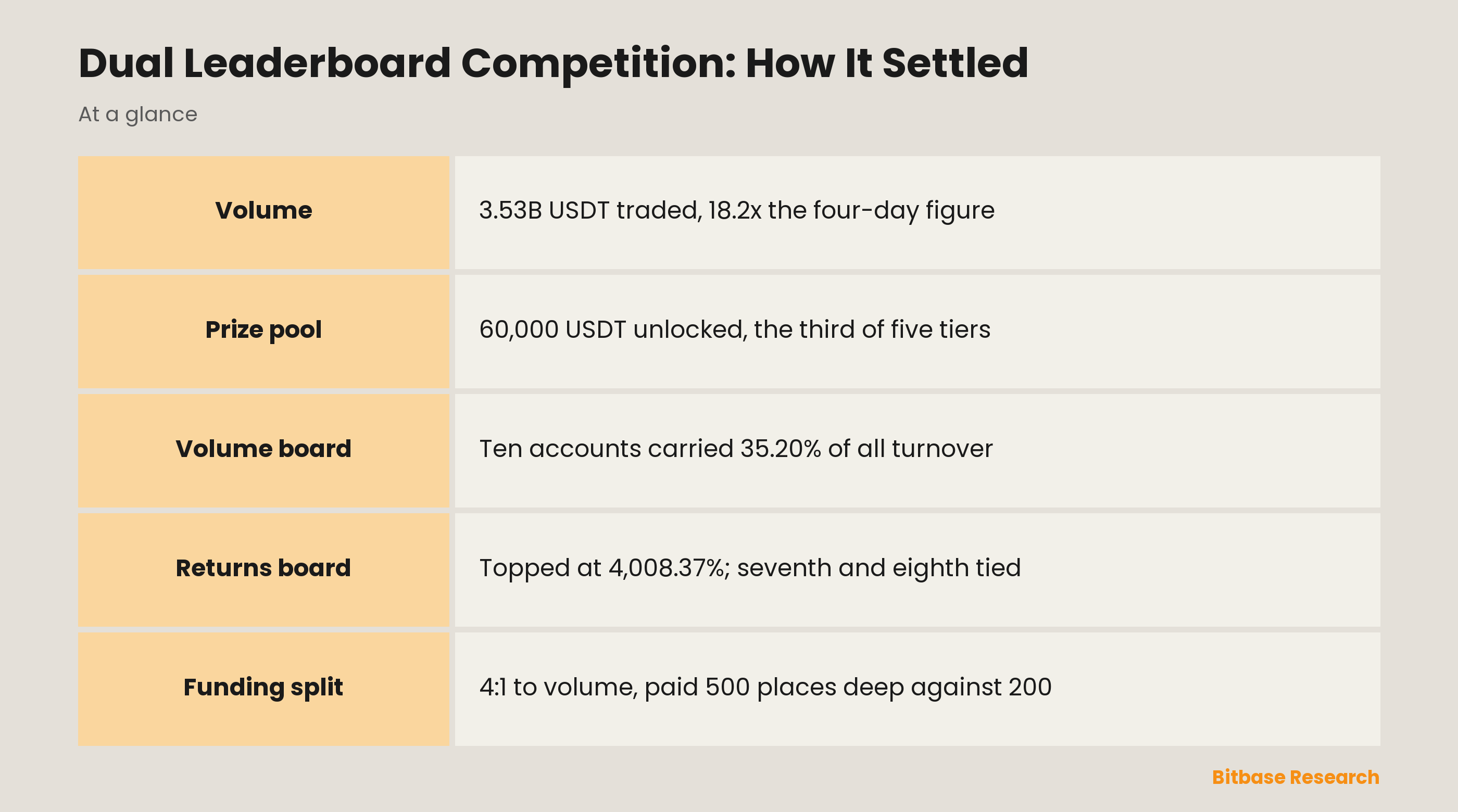
Bitbase's dual leaderboard futures competition closed on 18 September 2026 with 3,533,475,278.77 USDT in combined futures volume and 60,000 USDT unlocked across the two boards. Here are the final standings, and the three mechanics that decided them.
The final figures
The event ran on Bitbase futures from 3 September 2026 at 12:00 UTC to 18 September at 11:59 UTC. Every figure below comes from the event page after the close; the board carries a last-updated stamp of 19:50 on 18 September 2026.
| Final | |
|---|---|
| Combined futures volume | 3,533,475,278.77 USDT |
| Prize pool unlocked | 60,000 USDT |
| Volume board pool | 48,000 USDT |
| Returns board pool | 12,000 USDT |
| Unlock tier reached | 2B–5B, the third of five |
Two qualifications travel with all of it. The reward column on both boards is labelled an estimate, and rule 5 places final rankings, qualified users, reward eligibility and data calculations under Bitbase's review. Rule 12 sets distribution at within ten business days of the close.
Mechanic one: the pool is collective, and it grew
The pool opens in tiers driven by the combined futures volume of everyone entered, not by any one account. That is why it starts at zero and why it moved the way it did.
At the four-day mark, the standings showed the pool holding 0.00 USDT against combined volume of 194,455,837.08 USDT — below the first tier. Volume finished 18.2 times that figure and cleared three tiers.
| Combined volume tier | 500M | 1B | 2B | 5B | 10B |
|---|---|---|---|---|---|
| Total pool | 15,000 | 30,000 | 60,000 | 150,000 | 300,000 |
| Volume board | 12,000 | 24,000 | 48,000 | 120,000 | 240,000 |
| Returns board | 3,000 | 6,000 | 12,000 | 30,000 | 60,000 |
The practical consequence for an entrant is that the value of a given rank is not fixed when you enter it. Tenth place on the volume board paid 120 USDT at the first tier and 480 at the third. Every participant's volume moved the tier for everyone, which is a different incentive from a fixed-pot contest, and it is worth reading before deciding when to trade.
Mechanic two: the two boards reward different things
| Rank | Nickname | Valid volume, USDT | Est. reward, USDT |
|---|---|---|---|
| 1 | LON\*\*\*\*\* | 306,400,353.52 | 4,800 |
| 2 | 现货老\*\*\* | 178,564,166.36 | 4,320 |
| 3 | ERI\*\*\*\*\* | 113,287,317.28 | 2,880 |
| 4 | BIT\*\*\*\*\*\*\*\* | 106,683,600.83 | 2,400 |
| 5 | AVT\*\*\*\*\*\*\* | 106,618,294.23 | 1,920 |
| 6 | BIT\*\*\*\*\*\*\*\* | 97,015,818.77 | 1,680 |
| 7 | BIT\*\*\*\*\*\*\*\* | 95,385,715.08 | 1,440 |
| 8 | JAS\*\*\*\*\*\*\*\* | 93,804,571.89 | 960 |
| 9 | BIT\*\*\*\*\*\*\*\* | 76,649,408.49 | 720 |
| 10 | ENN\*\*\*\*\* | 69,341,054.49 | 480 |
| Rank | Nickname | Futures ROI | Est. reward, USDT |
|---|---|---|---|
| 1 | BIB\*\*\* | 4,008.37% | 1,200 |
| 2 | LON\*\*\*\*\*\* | 3,319.54% | 1,080 |
| 3 | LUC\*\*\*\*\*\* | 2,815.92% | 960 |
| 4 | LIM\*\*\*\*\*\*\* | 2,518.08% | 720 |
| 5 | VOL\*\*\*\*\*\*\*\* | 2,053.24% | 600 |
| 6 | LIQ\*\*\*\*\*\*\*\* | 1,861.80% | 540 |
| 7 | BIT\*\*\*\*\*\*\*\* | 1,273.86% | 480 |
| 8 | BIT\*\*\*\*\*\*\*\* | 1,273.86% | 420 |
| 9 | BRE\*\*\*\*\*\*\*\* | 1,088.55% | 360 |
| 10 | 无信仰\* | 985.37% | 220 |
The volume board answers how much you traded and the returns board answers what your account did with it. They are close to independent, and an entrant can be competitive on one while nowhere near the other.
Two structural differences tell you which one to target. The volume pool is four times the returns pool, at every tier. The volume board also pays deeper: its reward table runs to rank 500, where the returns board stops at 200. If your account is large enough to move real turnover, the volume board is both richer and easier to place on. If it is not, the returns board is the one where a small account can finish ahead of a large one — first place there ran 4,008.37% on an account whose size the board never shows.
Both tables distribute their pools exactly. Adding the per-rank awards for the tier that applied gives 48,000 on the volume board and 12,000 on the returns board, with nothing held back.
Mechanic three: the fine print did the work
Three rules that read as boilerplate before the event decided outcomes in it.
Rule 11, the tiebreak. Ranks 7 and 8 on the returns board finished on the same figure to two decimal places, 1,273.86%. Rule 11 separates them by valid event volume, high to low. Without it the two would have been unresolvable.
Rule 8, no double counting. An entrant qualifying for both boards receives only the higher of the two rewards. The two tables above cannot be added together for any individual.
Rule 9, what counts as volume. API trades, zero-fee orders, turnover generated with futures bonuses or trial funds, and positions held under three minutes are all excluded. Every volume figure on the board is already net of these, which is why the board total is not the same thing as raw account turnover.
Alongside the two boards, fifteen iPhone 18 Pro Max draws were published, one for each day from 4 to 18 September. The event opened at midday on 3 September and the draw runs at 04:00 UTC, which places the first draw on the 4th. Rule 8 allows a draw prize to sit alongside a leaderboard reward.
Limits on reading these numbers
The event page publishes no participant count and no count of ranked traders. The reward tables set depth limits — 500 on the volume board, 200 on the returns board — and those are ceilings on how many placed, not a population. Rule 7's 50,000 USDT volume floor, plus the five-position requirement for the returns board, means the two boards do not share a denominator either.
On names: the volume board's first place is LON\*\*\*\*\* at UID 14\*\*\*\*07 and the returns board's second is LON\*\*\*\*\*\* at UID 12\*\*\*\*07. The masked nicknames resemble each other and the UIDs do not match. These are two accounts.
Not a performance illustration. The return figures above are competition results measured over a fifteen-day window on the event's own basis. They are not a return to expect. A board that pays ten places out of a field the page never sizes is, by construction, showing its extreme tail; the great majority of entrants finished far from these figures, and some finished the period down. Futures trading carries substantial risk, leverage magnifies losses as much as gains, and rewards paid as trial funds carry their own terms, including the 50% deduction ratio and 1:1 matching requirement in rule 12.
Where anything here differs from the event page or Bitbase's terms, the official materials govern.
The bottom line
Combined volume of 3,533,475,278.77 USDT unlocked 60,000 USDT across the third of five tiers. The volume board's ten highest accounts carried 35.20% of all competition turnover; the returns board topped out at 4,008.37% and needed the tiebreak rule to separate seventh from eighth.
For anyone entering the next one, the three things that mattered were structural rather than tactical: the pool grows with everyone's volume, so rank value is not fixed; the two boards are funded 4:1 and paid 500-deep against 200-deep, so the board that fits your account size is a decision to make before you start; and the rules on valid volume, tiebreaks and double counting are where close finishes are actually resolved.
Final rankings and rewards remain subject to Bitbase's review, with distribution due within ten business days of the close.
Related reading
Other Bitbase articles on this topic:
- Auto Compounding vs Manual Staking: What the Difference Is Worth
- Automatic Margin Addition Explained: What It Does to Your Liquidation Price
- Bitbase Review: The Facts, the Registration Numbers, and How to Check Them Yourself
- Stablecoin and Infrastructure Stocks: What You Are Buying
- Bitcoin vs Ethereum: What's the Difference?
Disclaimer: This article is educational content from Bitbase Academy, provided for information only. It does not constitute investment, trading, tax, or financial advice. Crypto assets are volatile; assess your own risk. Written as of September 2026; refer to the latest official information.
References
[1] Bitbase, dual leaderboard futures trading competition, official rules and event page www.bitbase.com