ES and MES are the same exposure in two sizes: both are CME futures on the S&P 500 index, both move in increments of 0.25 index points, and one of them is worth exactly a tenth of the other. What separates them is not what they track but what a specification sheet answers — how large a contract is, how margin works, when the market is genuinely open, and what happens on the third Friday of March, June, September and December. That last date is where most of the surprises live, because the value a quarterly contract finally settles against is a number that never appears on a chart.
What the Two Contracts Actually Are
ES is the CME ticker for the E-mini S&P 500 future. MES is the ticker for its Micro E-mini sibling. Both are cash-settled futures whose underlying is the S&P 500 index, so neither delivers anything at expiry and neither carries a claim on a share of any company in it.
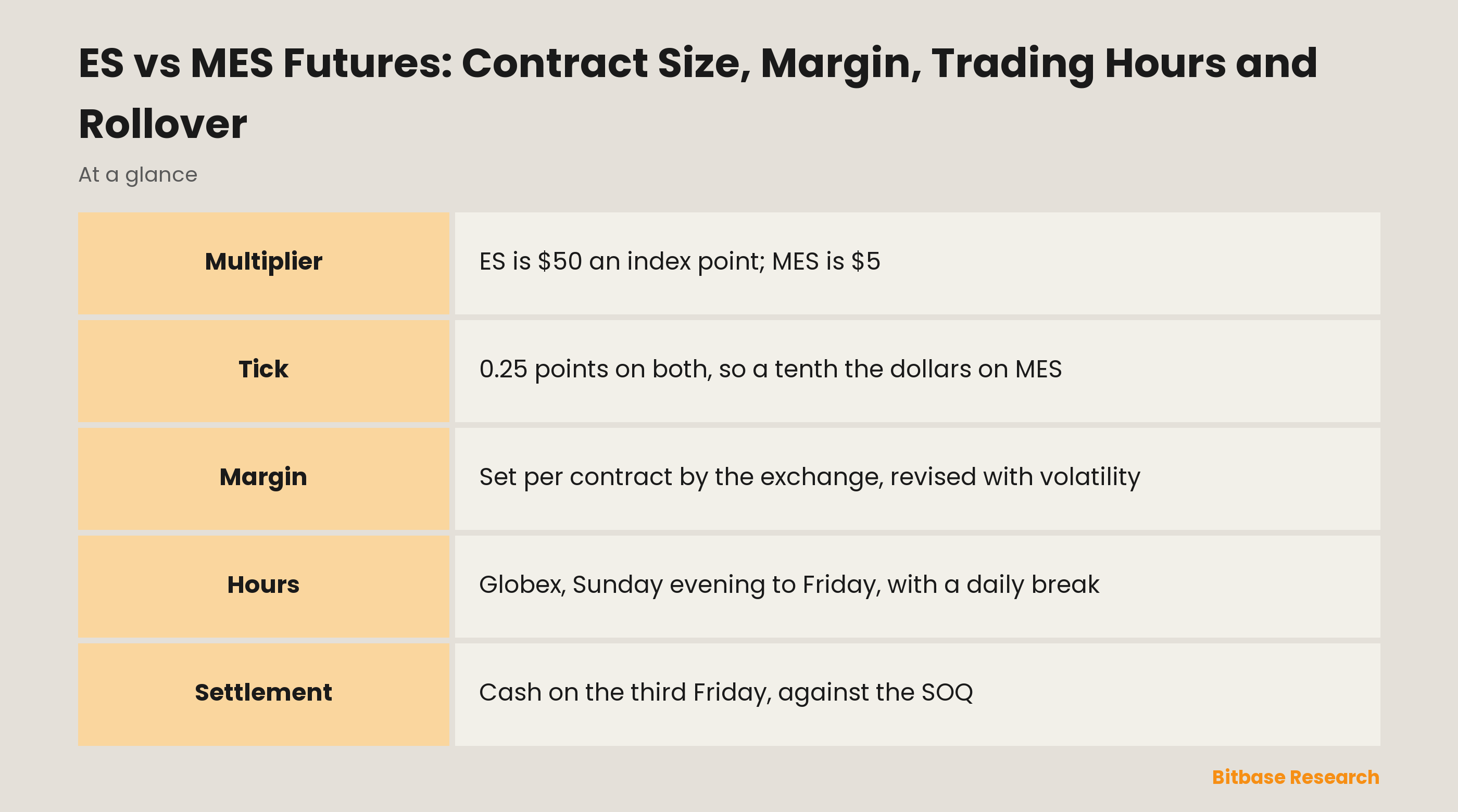
The structural difference between them is the multiplier. One ES contract is $50 per index point; one MES contract is $5 per index point. The micro is a tenth of the full-size contract, and everything downstream of the multiplier scales by that same tenth: notional value, the cash value of a one-tick move, and the daily variation credited to or debited from the account.
That ratio is the reason the pair exists. It lets an index position be sized in smaller steps, using one order book convention and one calendar. For what the E-mini is and what moves it, rather than how the two compare, the ES contract has its own walkthrough.
The Tick Is the Same in Points, Not in Dollars
Both contracts trade in a minimum increment of 0.25 index points. The tick is identical in points and a tenth the size in dollars: on ES one tick is $12.50, and on MES it is $1.25.
That distinction is worth holding onto, because a chart shows points and a statement shows dollars. Two traders watching the same candle are watching the same tick; the amount that lands in their accounts differs by a factor of ten because of the multiplier, and for no other reason.
It also settles a recurring confusion about sizing. Ten MES contracts carry the same notional as one ES contract. The micro is a smaller unit of account, and the risk in a position still comes from how large that position is and how much margin supports it. Choosing the smaller ticker changes the granularity available, not the arithmetic of a loss.
Margin Is a Mechanism, Not a Number to Memorise
A futures position is opened by posting initial margin, a fraction of notional rather than the full value of the contract. From then on the position is marked to market daily: gains are credited and losses debited each session, and if the balance falls below the maintenance level, more margin is called for. That sequence is identical on ES and MES, and it is the same shape as the margin and margin call mechanics on any leveraged contract.
What this guide will not give is the amounts. Exchange margin requirements are set per contract and revised as volatility changes, and a broker may require more than the exchange minimum. Any figure printed here would be stale by the next revision, and a stale margin number is worse than none at all: it produces a sizing decision that is confidently wrong. The exchange's own contract page is where that answer is current, and the broker's rules sit on top of it.
Trading Hours: Three Calendars That Do Not Line Up
ES and MES trade on CME Globex from Sunday 18:00 ET through Friday 17:00 ET, with a daily maintenance break from 17:00 to 18:00 ET. That is close to continuous on weekdays, and it is still neither around the clock nor the session the underlying shares keep.
Three calendars are therefore in play at once. The futures session runs through most of the night. The cash equity session, during which the index constituents themselves trade, occupies a fraction of it. And a stock perpetual, which is a different product on a different kind of venue, has no expiry and no scheduled break at all, charging funding where a future charges a roll. Reading a quote from one calendar while holding a position on another is how an opening gap becomes a shock rather than an expectation.
Rollover: Four Dates a Year, and They Are Yours to Manage
ES and MES follow one quarterly cycle: March, June, September and December, with the contract expiring on the third Friday of the month. Nothing carries a position forward automatically. Staying exposed past expiry means closing the expiring contract and opening the next one, which is the roll.
What the pair adds to that is arithmetic rather than mechanism. Both tickers roll on the same date and settle against the same SOQ, so a trader holding both is making one decision and not two. What differs is the size of its two legs: the roll spread is quoted in index points, so the identical spread costs a tenth as much per contract on MES, and an exposure built from ten micros carries the same total while rolling in finer pieces. Why the calendar forces the decision at all, and what the spread between two contract months is made of, belong to the ES walkthrough rather than to a comparison of specifications.
The SOQ: the Settlement Value Nobody Sees
At expiry the contract is cash-settled against a Special Opening Quotation, which the CME describes as "based on the opening price of each component stock in the relative index, regardless of when those stocks open."
That clause does more work than it appears to. The S&P 500 is built from 500 constituents, and they do not all print their first trade at the same instant. The SOQ is stitched together from those individual opening prices, so it is not a snapshot of the index at any one moment and can sit apart from every index value quoted that morning.
Breadth is what makes this matter more here than on a narrower contract. The more constituents an index holds, the more separate openings go into the stitch, and the wider the room between the settlement value and anything that was tradeable on a screen. The same mechanism applies to the Nasdaq-100 contract over a shorter list of names. A position carried into the third Friday is settled at that stitched value whether or not it was the plan, which is the practical case for rolling or closing before the date rather than through it.
ES, MES and a Perpetual, Side by Side
| Feature | ES | MES | Stock perpetual |
|---|---|---|---|
| Multiplier | $50 per index point | $5 per index point | Set by the venue |
| Minimum tick | 0.25 index points | 0.25 index points | Set by the venue |
| Expiry | Third Friday, quarterly | Third Friday, quarterly | None |
| Settlement | Cash, against the SOQ | Cash, against the SOQ | No settlement date |
| Session | Globex, with a daily break | Globex, with a daily break | No scheduled break |
| Cost of holding | The roll spread | The roll spread | Funding, paid both ways |
The first two rows are the whole of the ES and MES comparison, and every other row in those two columns is identical. The third column is a different instrument answering a different question: with no expiry there is no roll, and the cost of time arrives as periodic funding instead. Funding intervals, mark price construction and margin tiers on a perpetual are venue parameters, so the contract rules page of the platform being traded is the authority on them.
The Bottom Line
ES and MES differ in one number and agree on everything else. The multiplier sets the notional, the tick value and the size of a daily variation; the quarterly calendar, the third-Friday expiry, the Globex session with its maintenance break and the cash settlement against the SOQ are shared. Contract sizes, tick increments, hours and the expiry calendar are published on the CME Group contract specification pages, which is also where margin requirements are kept current. Anything about a perpetual belongs on the rules page of the venue listing it, and that page supersedes any guide, including this one.
Related reading
Other Bitbase articles on this topic:
- Automatic Margin Addition Explained: What It Does to Your Liquidation Price
- FOMC and Equity Derivatives: Volatility, Execution and Position Risk
- NQ vs MNQ Futures: Contract Size, Margin, Trading Hours and Rollover
- Stock Perpetual Funding Rates: Calculation, Direction and Holding Costs
- Blockchain State and Merkle Trees
Disclaimer: This article is educational content from Bitbase Academy, provided for information only. It explains what a company or fund does and how the instruments referenced here differ from one another; it does not constitute investment, trading, tax, or financial advice, and it is neither a recommendation nor an endorsement of any security, token, or trading strategy. A tokenized stock is issued by a third party and is designed to give economic exposure to an underlying asset: it is not a share, it carries no shareholder rights, and it depends on the issuer's structure, eligibility rules, and redemption terms, which the issuer can change. Perpetual futures are leveraged derivatives that hold no underlying asset and can be liquidated, and trading hours, product availability, and eligibility differ by instrument and by jurisdiction and can change at any time. Written as of September 2026; verify everything yourself through company filings, the issuer's own documentation, and the product pages of the venue you trade on.
References
[1] CME E-mini S&P 500 contract specifications: multiplier, tick, hours and quarterly settlement www.cmegroup.com
[2] CME Micro E-mini S&P 500: contract size and quarterly cash settlement against the SOQ www.cmegroup.com