When you withdraw from an exchange and it briefly pauses, or when signup asks for your ID, you are meeting the compliance machinery every regulated exchange now runs. Anti-money-laundering rules and transaction screening are the price of operating legally — and understanding them explains a lot of what an exchange does behind the scenes.
What AML and screening mean
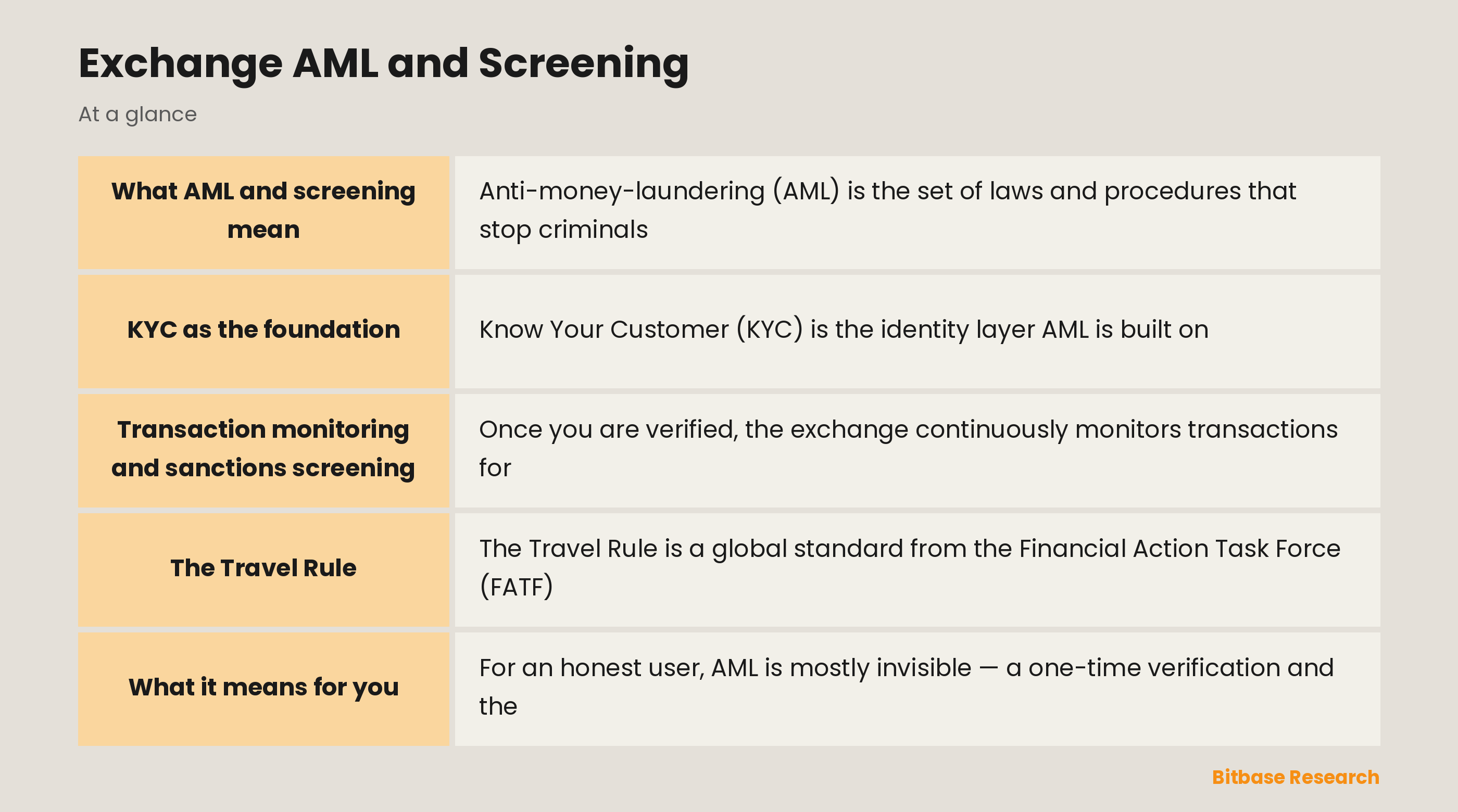
Anti-money-laundering (AML) is the set of laws and procedures that stop criminals from using financial services to disguise illicit funds. For a crypto exchange, that means verifying who its users are, watching how money moves, and blocking or reporting suspicious activity. Screening is the automated part: checking users and transactions against sanctions lists and risk databases. Together they let an exchange serve ordinary customers while keeping regulators and banks willing to work with it.
KYC as the foundation
Know Your Customer (KYC) is the identity layer AML is built on. Before you can trade at scale, a regulated exchange verifies your name, date of birth, and a government ID, sometimes with a selfie or proof of address. This is not bureaucratic theatre: without a verified identity behind each account, none of the later monitoring means anything, because funds could simply hop between anonymous accounts. KYC ties on-chain activity to a real, accountable person.
Transaction monitoring and sanctions screening
Once you are verified, the exchange continuously monitors transactions for patterns that look like laundering — sudden large movements, links to known criminal addresses, or funds arriving from sanctioned entities. Specialised blockchain-analytics firms score the risk of each address, and the exchange screens deposits and withdrawals against those scores and against government sanctions lists. A transaction touching a flagged source can be held for review, which is why a withdrawal is occasionally delayed.
The Travel Rule
The Travel Rule is a global standard from the Financial Action Task Force (FATF) requiring that when value moves between regulated providers, the sender's and recipient's identifying information travels with it — much like it does for a bank wire. By 2026 it has been legislated in a large majority of jurisdictions, and the EU's transfer rules require this information regardless of amount. In practice, this is why sending crypto between two exchanges can trigger extra questions about the counterparty.
What it means for you
For an honest user, AML is mostly invisible — a one-time verification and the rare paused withdrawal. But it has real consequences worth knowing. Funds that pass through a sanctioned or stolen-linked address can become hard to move, so accepting crypto from unknown sources carries a hidden risk. Keeping your own activity clean, and dealing with reputable counterparties, is the simplest way to avoid being caught in a compliance freeze.
The Controls and What Each One Catches
| Control | What it checks | What it catches | What it cannot catch |
|---|---|---|---|
| Identity verification | Who the account holder is | An account opened under a false identity | Someone verified who later acts for another |
| Sanctions screening | Names and addresses against published lists | A match with a listed party | A party not on any list |
| Transaction monitoring | How money moves through the account | Patterns that fit known typologies | Behaviour no rule was written for |
| The Travel Rule | Originator and beneficiary data sent with a transfer | Transfers missing required information | Whether that information is true |
Every row catches a defined thing, and the fourth column is why a passed check is not the same as a clean customer.
The bottom line
AML and screening are the rules that let crypto exchanges plug into the regulated financial system, resting on KYC identity, continuous transaction monitoring, sanctions checks, and the Travel Rule. They add friction, but they are also why funds on a compliant exchange are far less likely to be tangled with crime. Expect verification, understand why a withdrawal may pause, and keep the sources of your funds clean.
Frequently asked questions
Why does an exchange ask for my documents?
Identity verification is the foundation the other controls rest on: monitoring and screening only mean something once an account is tied to a person. It is a legal requirement for regulated venues rather than a preference of the platform.
Why was my withdrawal held for review?
Transaction monitoring flags patterns that fit known typologies, and a flag is a question rather than an accusation. Transfers can also pause when the originator or beneficiary information required to travel with them is missing or incomplete.
Does passing these checks mean a platform is safe?
No. Each control catches a defined thing and misses what falls outside its definition, so a compliant venue is one that meets specific obligations, not one that has removed risk. Custody, solvency and operational risk sit outside these checks entirely.
Related reading
Other Bitbase articles on this topic:
- Crypto Broker vs Exchange: What's the Difference?
- Crypto ETF Expense Ratios and Custody Models
- What Is a Cryptocurrency Exchange: CEX vs DEX, Explained
Disclaimer: This article is educational content from Bitbase Academy, provided for informational purposes only. It is not investment, trading, tax, or financial advice. Written as of July 2026; rely on the latest official information.
References
[1] FATF, "Virtual assets and the travel rule" fatf-gafi.org
[2] Chainalysis, "Crypto AML and transaction monitoring" chainalysis.com