Holding an equity derivative through an FOMC decision is a scheduling problem before it is a directional one. The minute is on the calendar; the contents are not, and nothing turns one into the other. What can be settled in advance is how the position behaves at that minute: which calendar the instrument follows, what one tick is worth, and how far the exit sits from the entry.
A Known Time With Unknown Contents
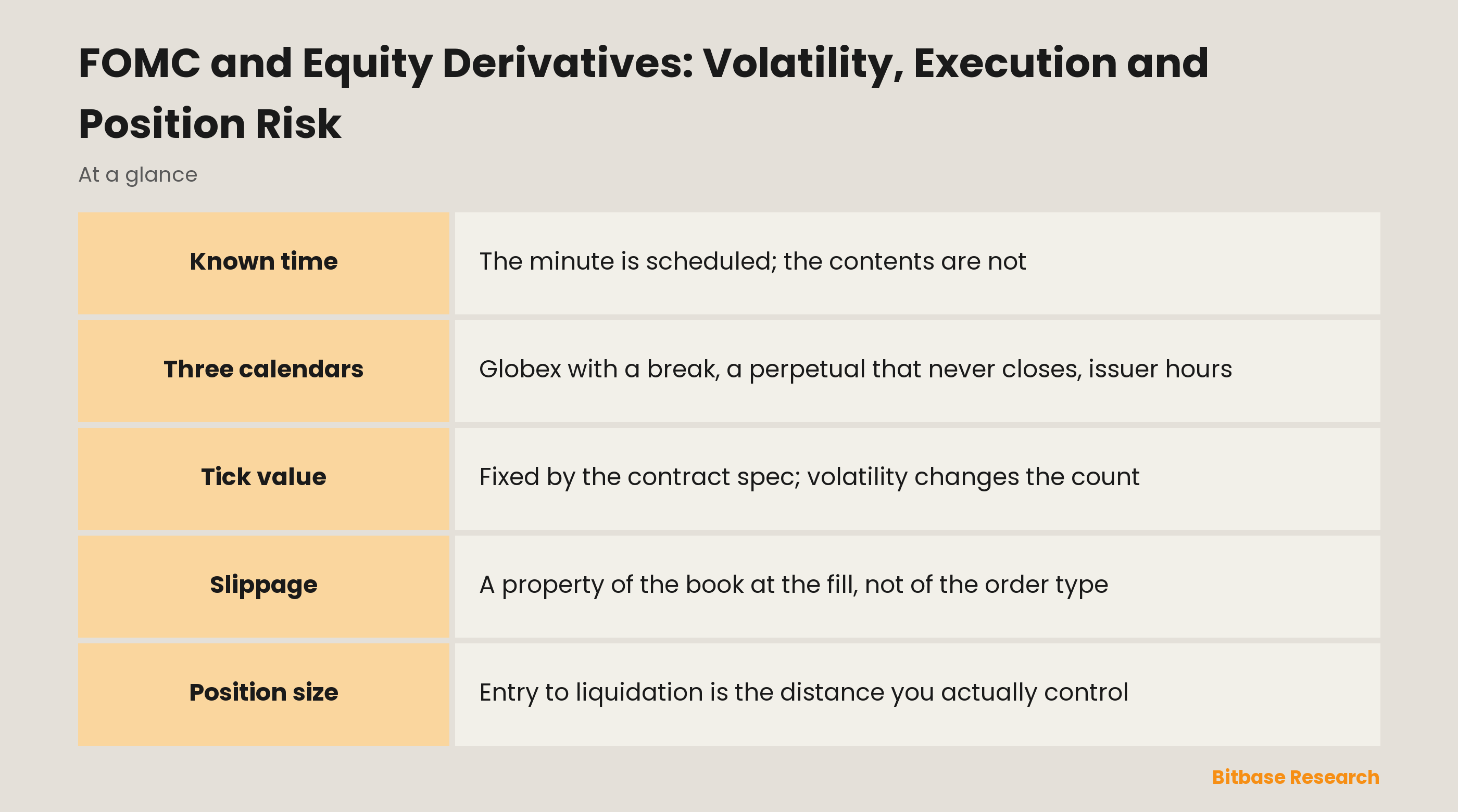
Most price-moving information arrives unannounced. A scheduled policy decision is the opposite: the date is published well ahead, every participant watches the same countdown, and the only unknown is what the statement says and how it is read.
That shape differs from a company's earnings release, which is also scheduled. Issuers overwhelmingly publish results outside the listed session, so the first print in the share comes after hours of digestion, through an opening auction. A policy decision is not queued behind an auction: it lands while the cash equity market is open, so the reaction happens in continuous trading.
Dates and release times belong to the central bank's own calendar, not to a guide.
Three Calendars, and They Do Not Line Up
Exposure to the same index can sit in three different places at the moment of the release, and the differences are structural.
| At the moment of the release | CME index futures | Stock perpetual | Tokenized stock |
|---|---|---|---|
| Venue state | Globex open, outside the daily maintenance break | Does not close | Session set by the issuer |
| Unit of price | Multiplier times index, fixed minimum tick | Quoted against a mark price | Issuer's reference price |
| What can end the position early | Exchange and broker margin rules | Liquidation on the mark price | Issuer and venue terms |
| Cost that keeps running | No funding; a roll at quarterly expiry | Funding, on its own schedule | Per issuer terms |
Globex runs from Sunday evening to Friday afternoon with a daily maintenance break — neither the cash session of the listed exchanges nor a continuous week. A stock perpetual does not close at all, and its funding keeps accruing on whatever period the venue sets. A tokenized stock follows a third schedule, set by its issuer. Three calendars open at once is why the same view, expressed in three instruments, produces three different outcomes.
Funding intervals, formulas and bounds are venue parameters, and they are adjusted. The contract rules page of the platform being traded is the only authoritative answer.
What One Tick Is Worth, and How Many Get Crossed
The CME E-mini Nasdaq-100 contract is $20 times the Nasdaq-100 index and the Micro E-mini is $2 times the same index; the E-mini S&P 500 is $50 times the S&P 500 and its micro is $5. All four move in minimum increments of 0.25 index points.
The dollar value of one tick is fixed by the contract specification and does not widen because the market is busy. Assume a twenty-point move: that is $400 on the E-mini Nasdaq-100 and $40 on its micro, announcement or not.
What volatility changes is the number of ticks, not the size of one. A move that would take an hour on a quiet afternoon can be crossed in seconds. One naming note, since the confusion is common: the E-mini Nasdaq-100 tracks the Nasdaq-100 index, while QQQ is an ETF on that same index. An index future is not a futures contract on the ETF.
Spread, Depth, and the Order That Has to Cross It
Three things about the book change around a scheduled release, and all three are measurable. The quoted spread widens, so the gap between best bid and best offer covers more ticks. Each price level holds less size, because participants who cannot price the unknown pull quotes rather than quote them wide. A marketable order therefore walks through more levels before it fills — the whole mechanism behind a fill that comes back worse than the screen suggested.
Slippage is a property of the book at the instant of the fill, not of the order type. A limit order does not remove it; it converts it into the risk of not trading at all. A stop is an instruction to send an order once a price prints, not a promise about the price that order receives. How each type behaves on entry and exit is worked through in orders and closing.
Distance to Liquidation, Not Direction
The question to settle beforehand is not which way the decision resolves, but whether the position survives the move it might make while the answer arrives.
That reduces to one distance: from the entry to the level at which the position is closed out for you. On a futures position the arithmetic is linear and public — points moved, times the multiplier, times the number of contracts, against the margin posted. On a perpetual, the trigger is the mark price rather than the last trade, and it keeps moving whether or not the underlying market is open.
The distance is under direct control; the size of the move is not. Size and margin set it, and both are decided before the release. How large a move is plausible at such a minute is not something a guide can put a number on. An assumed move is a stress test, not a forecast. Work the distance out in index points, compare it with a move you would consider severe, and size so the comparison is comfortable rather than marginal. Maintenance rates and tiers are set per venue and belong on its rules page.
When the Event Sits Next to a Roll
Index futures do not run forever. The quarterly cycle expires on the third Friday of March, June, September and December, cash-settled against a Special Opening Quotation built from the opening price of each component stock, regardless of when those stocks open. That settlement print is therefore not a snapshot of the index at any single instant.
In the sessions before that date, open interest migrates to the next contract: the front month thins while the deferred month fills out. When a policy decision lands in that window, two things are happening to the book at once, and a poor fill may be the migration rather than the event. The timing and mechanics of that migration are covered in the rollover guide.
The Bottom Line
A scheduled event is one of the few risks that can be prepared for mechanically, because the only unknown in it is the content. The specification fixes what a tick is worth, the book decides what crossing it costs, and size and margin decide how far the exit sits from the entry. The contract figures above come from the CME Group specification pages; every funding, margin and availability parameter comes from the rules page of the venue being traded.
Related reading
Other Bitbase articles on this topic:
- ES vs MES Futures: Contract Size, Margin, Trading Hours and Rollover
- NQ vs MNQ Futures: Contract Size, Margin, Trading Hours and Rollover
- Stock Perpetual Funding Rates: Calculation, Direction and Holding Costs
- What Is a Blockchain Bridge?
- Breakout Trading Strategy
Disclaimer: This article is educational content from Bitbase Academy, provided for information only. It explains what a company or fund does and how the instruments referenced here differ from one another; it does not constitute investment, trading, tax, or financial advice, and it is neither a recommendation nor an endorsement of any security, token, or trading strategy. A tokenized stock is issued by a third party and is designed to give economic exposure to an underlying asset: it is not a share, it carries no shareholder rights, and it depends on the issuer's structure, eligibility rules, and redemption terms, which the issuer can change. Perpetual futures are leveraged derivatives that hold no underlying asset and can be liquidated, and trading hours, product availability, and eligibility differ by instrument and by jurisdiction and can change at any time. Written as of September 2026; verify everything yourself through company filings, the issuer's own documentation, and the product pages of the venue you trade on.
References
[1] CME Micro E-mini Nasdaq-100 contract specifications: multiplier, tick, hours and settlement www.cmegroup.com
[2] CME Micro E-mini S&P 500: contract size and quarterly cash settlement against the SOQ www.cmegroup.com