Fully backed is a claim about a comparison: holdings on one side, counted user balances on the other. It is a real and checkable statement when a report stands behind it, and an empty phrase when it appears alone on a marketing page. The difference is not the wording but whether anything in the claim can be tested by someone who does not work there.
What the phrase is claiming
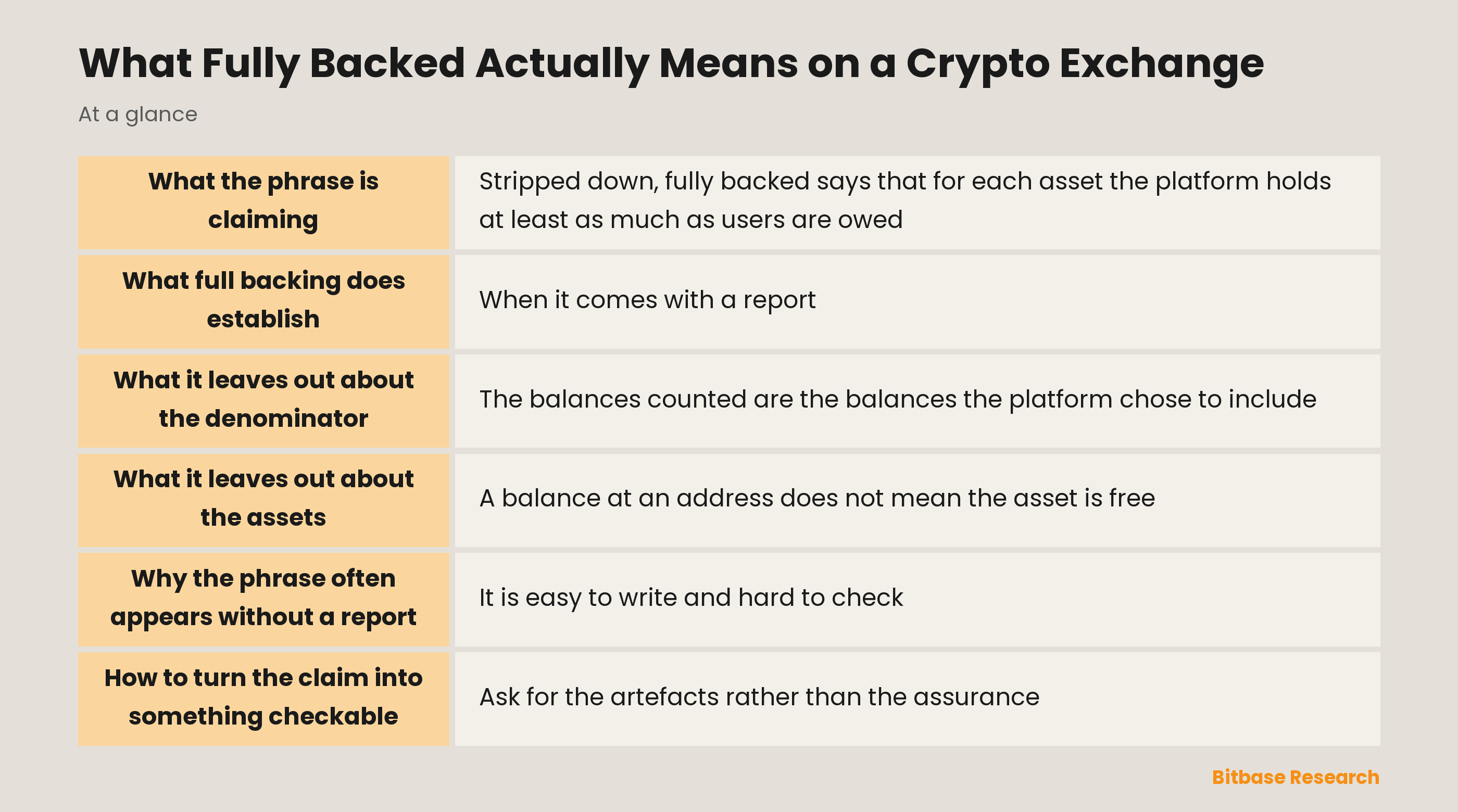
Stripped down, fully backed says that for each asset the platform holds at least as much as users are owed. It is a statement about two quantities at one moment, and nothing more than that.
Everything interesting sits in how those two quantities were produced. The holdings side is measurable by outsiders when addresses are published. The owed side is assembled internally, and the phrase gives no indication of what was included in it.
The phrase also carries a grammatical trap worth noticing: it describes a state that was true, in the past tense, at a moment already gone. So the claim is meaningful in proportion to its documentation. With a published report, addresses and a method, it is a testable assertion. Without those, it is a sentence, and sentences do not survive stress.
Common phrasings and what each actually means
| Phrase | What it actually means |
|---|---|
| Fully backed | Holdings match the balances the platform itself counted |
| Backed one to one | The same claim, stated for each asset separately |
| Your funds are safe | A promise about intent, not a measurement of anything |
| Reserves exceed liabilities | True only if liabilities means customer balances alone |
| Audited reserves | Depends entirely on who signed and what scope they accepted |
| Verified by users | Individual inclusion was checked, not completeness of the set |
Rows four and six are where careful readers slow down, because both sound like more than they are and both are frequently used in good faith by people who have not thought about the gap.
What full backing does establish
When it comes with a report, quite a lot. That specific assets exist at specific addresses is readable by anyone, and that the platform controls those addresses can be demonstrated with signatures rather than asserted.
That your own balance was part of the set can also be checked individually, which is the part users most often skip. The check takes a minute and turns a company statement into a personal verification, and the procedure is set out in how to verify proof of reserves.
It is also worth appreciating how unusual this is. In most of finance a customer cannot inspect the assets behind their account at all, and here the inspection costs nothing and needs nobody's cooperation. Those two facts together are genuinely more than the industry had before. The mistake is not taking them seriously; the mistake is reading them as covering things they never touched.
What it leaves out about the denominator
The balances counted are the balances the platform chose to include. A user account left out of the set makes the ratio look better, and no other user can detect the omission by checking their own row.
Wide participation in verification pushes back on this, because every excluded account belongs to somebody who might check. That converts silent omission into a risk rather than into an impossibility, which is meaningful but is not the same as proof of completeness.
A second and quieter gap is that the count includes only the accounts the platform recognises as accounts, so anything held under a different arrangement never enters the comparison at all. Beyond that, customer balances are not everything a business owes. Borrowings, obligations to counterparties and commitments that never appear in any customer account are all real liabilities that sit outside the comparison, which is the subject of does proof of reserves prove solvency.
What it leaves out about the assets
A balance at an address does not mean the asset is free. Coins can be borrowed for the day, pledged as collateral elsewhere, or committed under an agreement that never touches a chain, and all of them read as ordinary holdings.
Quality also varies more than the phrase suggests. A reserve made of assets nobody had to issue behaves very differently from one leaning on the platform's own token, which is the distinction developed in crypto exchange reserve composition.
Liquidity belongs in the same paragraph. Assets that are locked, staked or sitting on another network are genuinely held and are not immediately deliverable, and a claim of full backing does not distinguish between the two. And the claim describes an instant. Balances are frozen at a timestamp, so fully backed on the day of the snapshot is what was established, and the interval between snapshots is not covered by anything.
Why the phrase often appears without a report
It is easy to write and hard to check, which is exactly the combination that produces marketing language. A platform can say fully backed on a landing page at no cost, and most readers will not go looking for what supports it.
The absence of support is itself information. If a claim of this kind is made, the natural follow-up is where the addresses are, what the method was, and when the last report was published, and an operator who has done the work will have those answers ready.
This is not a reason for suspicion by default. It is a reason to treat the phrase as the beginning of a question rather than the end of one, and to notice that the answer is usually one click away or not available at all.
How to turn the claim into something checkable
Ask for the artefacts rather than the assurance. A published set of addresses, a stated method, a per-asset breakdown and a date are the four things that turn a slogan into a document, and any one of them missing narrows what you can conclude.
Then do the one check that is yours alone. Confirming that your own balance sits inside the committed set is the only part of the whole exercise that nobody else can do for you, and it is also the part that makes the claim about the denominator harder to fake.
It is also worth checking whether the same claim was made in previous periods and whether the method stayed the same, because a series measured consistently says more than any single strong result. Finally, read the frame as carefully as the number. What counts as an asset, what counts as a liability and which wallets are included are all choices, and a report that states them plainly is telling you something a report that does not state them is hiding.
The bottom line
Fully backed means holdings met counted balances at a moment in time. It does not mean the count was complete, the assets were unencumbered, the composition was sound, or that anything outside customer balances was considered.
Treated as a claim with documents behind it, it is one of the more useful things an exchange can publish. Treated as a phrase on its own, it is an assertion with the same evidential weight as any other sentence. For more from Bitbase Academy, keep reading.
Related reading
Other Bitbase articles on this topic:
- How to Verify a Merkle Proof: Running the Check Yourself
- Merkle Trees vs Zero-Knowledge Proofs of Reserves: The Privacy Trade-Off
- Small Balance Conversion After a Token Delisting
- Stablecoin and Infrastructure Stocks: What You Are Buying
- ADX Indicator: How to Measure Trend Strength
Disclaimer: This article is educational content from Bitbase Academy, provided for information only. It does not constitute investment, trading, tax, or financial advice. Crypto assets are volatile; assess your own risk. Written as of September 2026; refer to the latest official information.
References
[1] Bitbase, Proof of Reserves — monthly disclosure, Merkle root and open-source verifier www.bitbase.com