Searching for Adobe stock turns up two unrelated things: the royalty-free asset library Adobe sells under that name, and the equity that trades on Nasdaq as ADBE. This profile is about the second one — what Adobe sells, why the revenue it reports in any quarter is largely a record of selling done earlier, and what each route hands you. On Bitbase the ticker resolves to a price page and a perpetual contract, and the tokenized instrument behind that price page is issued by Robinhood as a derivative rather than as a share.
What Is Adobe (ADBE)?
Adobe states its mission as empowering everyone to create, and describes what it builds as "innovative platforms and tools that unleash creativity, productivity and personalized customer experiences." Commercially that means software sold by subscription, reported in three segments.
Digital Media is the one most people have touched: Adobe describes it as serving "the productivity and creativity needs of business professionals, consumers, creators and creative professionals," and it holds Acrobat, Adobe Express, the Creative Cloud subscriptions and the Firefly generative models. Digital Experience serves "the end-to-end content supply chain needs of marketing professionals" around Adobe Experience Platform. Publishing and Advertising is the oldest, and Adobe itself calls its contents "legacy solutions."
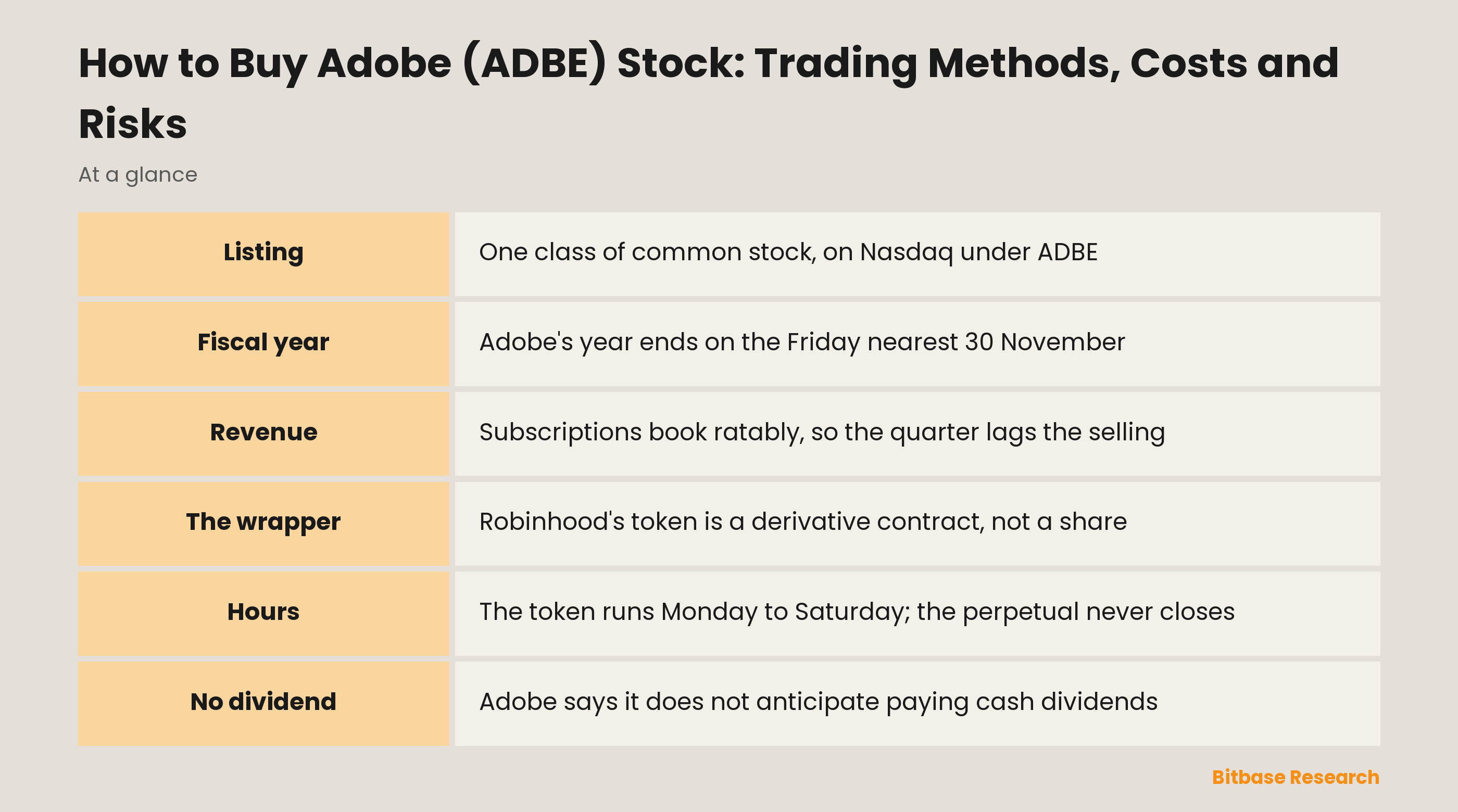
Two structural details are worth fixing in mind first. Adobe Inc. is a Delaware corporation, and the only security it registers under Section 12(b) is a single class of common stock, listed on Nasdaq as ADBE — there is no second share class to read around. And the reporting calendar is not the ordinary one: Adobe states that "our fiscal year is a 52- or 53-week year that ends on the Friday closest to November 30," so fiscal 2025 closed on 28 November 2025.
Why People Trade ADBE
The reason usually given is exposure to creative and marketing software spending. The sharper reason is exposure to revenue that is contracted before it is earned. Adobe recognises subscription revenue "ratably over the term of agreements with our customers, beginning with commencement of service," and states the consequence in its own risk factors: "most of the subscription revenue we report each quarter is the result of subscription agreements entered into during previous quarters."
That sentence explains much of how this ticker behaves. A calm quarter can conceal a collapse in new selling that has not reached the income statement; a weak one can sit on a book already signed. Adobe warns that lower sales, reduced demand and a rising attrition rate "may not be fully reflected in our results of operations until future periods."
Its link to crypto is structural, not economic. Nothing in Adobe's segments touches digital assets; what connects the ticker to a crypto venue is only the wrapper around it.
Two Contracts, Neither of Them a Share
On Bitbase this ticker is titled Adobe Inc. • Robinhood Token (ADBE). The issuer name in that title is the whole point, because Robinhood builds its product on a legal footing unlike the other tokenized stock structures in circulation.
Robinhood's description is blunt: Classic Stock Tokens "are derivative contracts between you and Robinhood," and "they are priced at the prices of the underlying securities without granting rights to them." The underlying is real and Robinhood holds it — "the underlying assets of Classic Stock Tokens are owned by Robinhood and held with a US-licensed institution" — but the holder's claim runs against Robinhood, not against Adobe. The tokens "do not grant any rights to the underlying shares or ETPs." Trading runs from Monday at 02:00 CET to Saturday at 02:00 CET, and the issuer is Robinhood Europe, UAB, supervised by the Bank of Lithuania.
One clause of that structure reads oddly against this particular company. Robinhood says that if the underlying stock or ETP pays a dividend, it "will pass on a corresponding amount to eligible holders … in cash." Adobe tells shareholders that "we do not anticipate paying any cash dividends in the foreseeable future." While both statements hold, the pass-through has nothing to pass through, and the return here arrives entirely as price.
The perpetual futures contract is the second contract, and a different kind. Nothing sits behind it: no share, no token, no custodian. Its price is referenced to the equity, its settlement is in stablecoin, its cost is a funding payment passed periodically from one side of the book to the other, and its end can be forced by the venue when margin thins. Where the Robinhood token is a claim on an issuer that owns the asset, the perpetual is a claim on a counterparty that owns nothing. The comparison here is therefore not tokenized against real; it is contract against contract, with a share sitting outside both.
How to Trade ADBE on Bitbase
Begin at the price page, which quotes the tokenized instrument and names its issuer in the title. Reading that title before anything else is the cheapest check available.
The tradeable route on the venue is the perpetual contract. Margin is posted in stablecoin, the position is valued against an index rather than the last print, and funding is charged or credited at intervals according to which side of the book is crowded. Over weeks that funding is paid many times, so what it costs to hold belongs in the arithmetic before entry rather than after. This is also where a bearish view goes, since a perpetual is symmetrical between long and short in a way a cash holding is not.
Outside the venue, the Nasdaq listing is reachable through any broker with US market access, settling through the US equity system on the exchange session rather than around the clock.
What Moves ADBE
Adobe publishes its own list of what moves the stock, and it is more specific than any narrative about creative software. Among the named factors are shortfalls against guidance, "changes in annualized recurring revenue, unearned revenue, remaining performance obligations and revenue recognized at a point in time," changes in the amounts or frequency of stock repurchases, and the loss of large customers.
The forward book matters most, because of that recognition lag. Adobe defines remaining performance obligations as "contracted revenue that has not yet been recognized, which includes deferred revenue and unbilled amounts that will be recognized as revenue in future periods," while warning that deferred revenue "does not represent the total contract value" of its multi-year agreements. Those disclosures sit closer to a leading indicator than the revenue line does.
Competition presses on the same book. Adobe describes markets "characterized by rapid technological innovation, new industry standards, evolving distribution and sales models, limited barriers to entry, short product lifecycles, customer price sensitivity" and the frequent entry of new competitors, and names AI among its risks: its development and use in Adobe's solutions "may result in reputational harm, liability and adverse business and financial results." Firefly models are "trained on data Adobe has the rights to use" — a competitive claim and a liability claim at once.
Capital returns arrive as repurchases rather than income, and Adobe counts changes in the pace of buybacks among the things that move the price.
Risks and Limits
Issuer risk is what the wrapper adds. A Classic Stock Token is a contract with Robinhood Europe, UAB, and its value depends on that entity continuing to operate and to honour terms it can change. Holding it on-chain does not move the obligation somewhere safer.
The calendars do not line up. The Nasdaq session, a token running Monday to Saturday on Central European time, and a perpetual that never closes are three clocks. News landing while one is shut is priced first by whichever is open.
Leverage turns those gaps into closures. Liquidation follows the mark, not the last trade, and funding keeps accruing whichever way the position faces. A size that is unremarkable inside a regular session can be ended by a move a share owner would have watched.
The wrapper does not change the business. Renewal rates, competition, the AI liability question and the recognition lag reach the share, the token and the perpetual alike.
How to Verify ADBE Information
For the company, pull the filings on SEC EDGAR under CIK 796343; every company sentence quoted above is in the annual report there. Because the fiscal year ends on the Friday closest to 30 November, the report you want shows a period ending in late November — filtering on a calendar year end hands you the wrong document or none at all.
For the instrument, Robinhood's European investing pages carry the Classic Stock Tokens terms: the derivative characterisation, the custody statement and the trading window. For the venue, read the issuer out of the instrument title — a page that names no issuer is not describing a tokenized equity at all.
A search note specific to this ticker: Adobe Stock is the name of the company's royalty-free asset library of "photos, vectors, illustrations, videos, templates, audio and 3D assets." Search that phrase and you reach a product page, not a quote.
Conclusion
Buying ADBE means picking which contract you want, or stepping outside the venue to avoid contracts altogether. The perpetual owns nothing and charges funding for direction. The Robinhood token is a derivative against an issuer that does hold the shares, priced at the underlying but granting no rights in it. The Nasdaq listing is a single class of common stock and the only route that makes you an owner.
Underneath all three is a subscription business whose reported quarter mostly describes the past. Read the remaining performance obligations, the deferred revenue and the renewal language before the headline revenue line.
Related reading
Other Bitbase articles on this topic:
- Crypto Stocks vs Bitcoin ETFs: Business Exposure or Bitcoin Exposure?
- How to Buy Cboe (CBOE) Stock: Trading Methods, Costs and Risks
- How to Buy CME Group (CME) Stock: Trading Methods, Costs and Risks
- How to Buy TLT: Trading Hours, Costs and Bond ETF Risks
- What Is Pudgy Penguins
Disclaimer: This article is educational content from Bitbase Academy, provided for information only. It explains what a company or fund does and how the instruments referenced here differ from one another; it does not constitute investment, trading, tax, or financial advice, and it is neither a recommendation nor an endorsement of any security, token, or trading strategy. A tokenized stock is issued by a third party and is designed to give economic exposure to an underlying asset: it is not a share, it carries no shareholder rights, and it depends on the issuer's structure, eligibility rules, and redemption terms, which the issuer can change. Perpetual futures are leveraged derivatives that hold no underlying asset and can be liquidated, and trading hours, product availability, and eligibility differ by instrument and by jurisdiction and can change at any time. Written as of September 2026; verify everything yourself through company filings, the issuer's own documentation, and the product pages of the venue you trade on.
References
[1] Adobe FY2025 Form 10-K: fiscal year, share class, segments, revenue recognition and risk factors (SEC EDGAR) www.sec.gov
[2] Robinhood Europe: Classic Stock Tokens terms — derivative contract, custody and trading hours robinhood.com