You can trade on Cboe all week and own none of it. The company operates the marketplaces where S&P 500 index options and VIX products are listed, and its own common stock is registered on an exchange it runs. Buying CBOE moves you from one side of that arrangement to the other, so the question stops being where the market went and becomes what the venue gets paid for.
What Is Cboe Global Markets (CBOE)?
Cboe Global Markets, Inc. is a Delaware corporation whose fiscal year ends on 31 December. Its annual report calls the company "the world's leading derivatives and securities exchange network", one that "delivers cutting-edge trading, clearing, and investment solutions to people around the world." Set the adjectives aside and a plain structure remains: it owns marketplaces and sells admission to them.
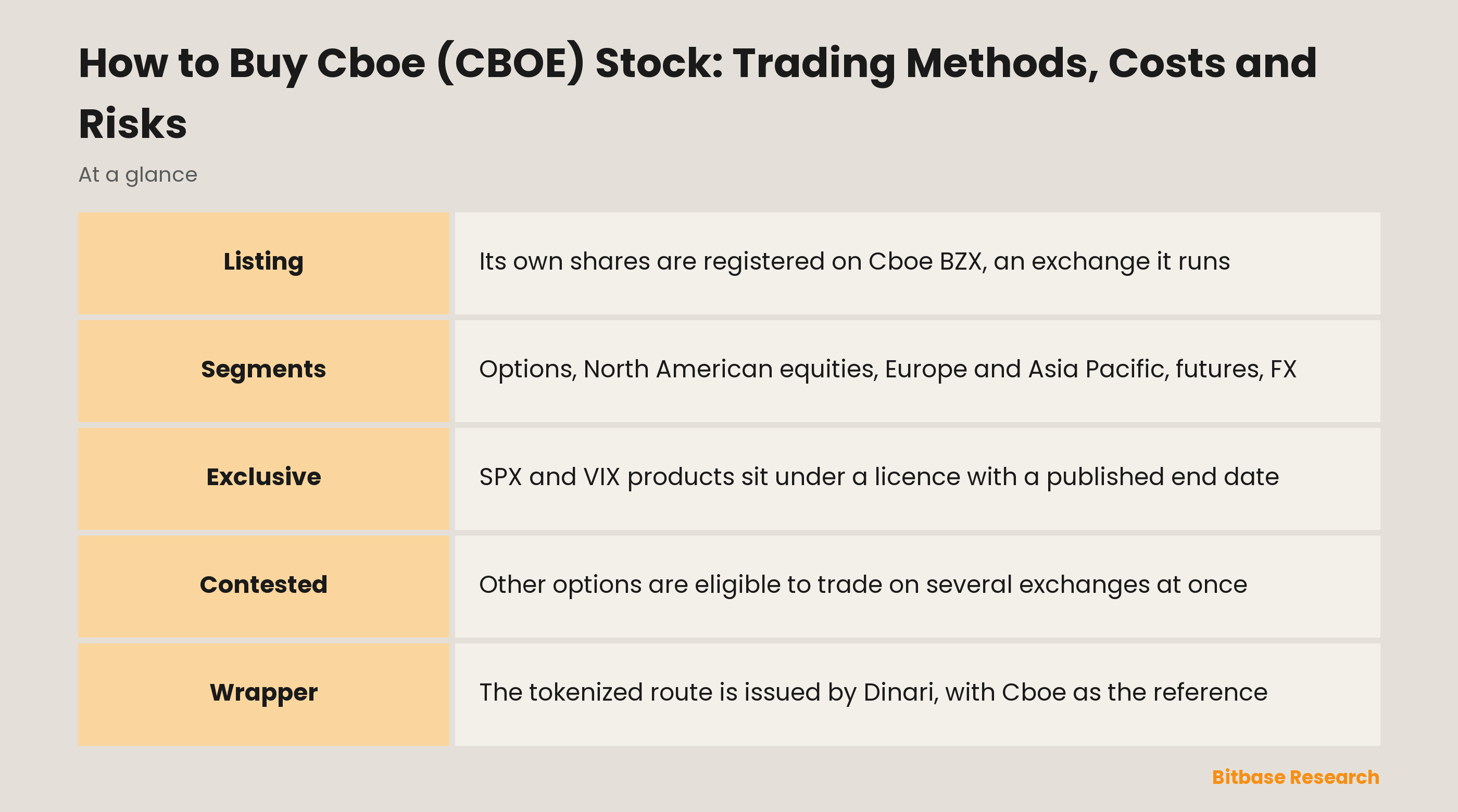
The cover page carries a detail worth pausing over. The common stock trades under the symbol CBOE and is registered on Cboe BZX, an exchange the company itself operates. The filing confirms it from the other direction too, placing "the Cboe Global Markets, Inc. common stock listing" inside the North American Equities segment. The share a buyer holds is, in the company's own accounting, one of its listing customers.
Cboe reports in five segments, and their names show how far the business reaches.
| Segment | What sits inside it |
|---|---|
| Options | Index and equity options, with market data, index licensing, routing and access services |
| North American Equities | Cboe Canada corporate listings, BZX listings for ETPs, and the Cboe Global Markets common stock listing |
| Europe and Asia Pacific | Pan-European derivatives and equities venues, Cboe Clear Europe, and Cboe Australia |
| Futures | Transaction services provided by CFE, a fully electronic futures exchange |
| Global FX | Institutional FX on the Cboe FX platform, plus non-deliverable forwards |
The Options segment is the one the name was built on. Cboe describes it as covering options on market indices, which it calls index options, alongside options on the stocks of individual corporations, which it calls equity options. The two look alike on a screen and behave nothing alike as a business.
Why People Trade CBOE
A marketplace is paid when something changes hands. Transaction fees are charged per contract, so that line answers to how many contracts traded, not to where the index closed. Every listed exchange shares this shape.
What sets Cboe apart is that some of what trades on its markets cannot be traded anywhere else in the country. The company states that it holds "exclusive U.S. rights to list options on the S&P 500 Index, S&P 100 Index, S&P 500 ESG Index, and S&P Select Sector Indices", and names its "most frequently traded proprietary products" as "SPX options and VIX options and futures". The volatility gauge those products reference is defined off the first of them: the report calls the VIX Index "not directly tradable", "based on the mid-point of real-time quotes of SPX options", and built to reflect "investors' consensus view of future 30-day expected stock market volatility."
Other options carry no such protection. The filing describes contracts that "are eligible to trade, as applicable, on Cboe Options, C2, BZX, EDGX, and/or other U.S. national securities exchanges" — an instrument able to sit on several venues at once, including venues this company does not own. One operator therefore runs a book nobody may copy and, beside it, a book everybody competes for.
Crypto sits inside that structure rather than alongside it. The company reports that "on June 9, 2025, Cboe successfully completed the migration of cash-settled Bitcoin and Ether futures contracts from Cboe Digital Exchange to CFE" — the same futures entity that carries VIX futures. The arithmetic matches the way revenue at listed exchanges and brokers is assembled: fees on activity, plus lines billed whether or not anybody trades.
An Exchange Operator, Wrapped by Someone Else
The Bitbase price page for this ticker is titled Cboe Global Markets (Dinari Tokenized Stock) (CBOE). The issuer marker is the load-bearing part: whatever the page quotes was issued by Dinari, and Cboe is the reference, not the counterparty. Keep that distinction whenever tokenized stocks are set beside the security itself.
Dinari defines its product as a dShare, "a token 1:1 backed by a security, commonly a U.S. equity." Minting and burning happen only after the matching brokerage order fills, and those orders are placed through Alpaca. That is a narrower promise than "stock on a blockchain" suggests, and a more specific one: the backing is a position a broker acquired, not an exposure conjured on demand.
Trading hours are where assumptions break. Dinari runs four windows: the regular US session, pre-market and post-market periods accepting limit orders only, an overnight period under the same restriction, and an on-chain window covering the hours when the rest are shut. That last window serves some tickers only and carries thinner liquidity, so the honest summary is that most dShares follow the US equity calendar and only part of the range reaches around the clock. A market order placed outside regular hours becomes a marketable limit order automatically, and may fill completely, partly, or not at all.
Dividends follow the underlying. Once cash reaches the holder of the security, Dinari calculates and distributes it, direct holders receiving USD+, with amounts under a stated minimum not distributed at all. That documentation says nothing about voting or other shareholder rights, so nothing here claims the wrapper grants them or withholds them. Read the issuer's terms before assuming either.
A perpetual futures contract is a third shape, and the easiest to misread. It holds neither share nor token. It tracks a price, settles in stablecoin, and moves a funding rate between longs and shorts at intervals, so a position held for weeks pays or collects many times over. It gives direction with leverage and ownership of nothing.
What Moves Cboe
Begin with what does not move it. Cboe is not long the S&P 500 and not long volatility. It is paid when either is traded, which makes activity rather than level the variable that reaches the revenue line.
The exclusive licence is the part of the business with a calendar attached. The company states that its "license with S&P extends through December 31, 2033, with exclusive rights to trade S&P 500 Index options through December 31, 2032." A published end date is not market risk and is not repriced by a trading session; it is a renewal question sitting underneath the most distinctive line the company has. Nothing here predicts how it resolves; the dates are in the filing.
Beside it sits the contested half of the book, where instruments eligible to trade on several national securities exchanges move on fee schedules, routing terms and technology rather than on anything exclusive. One quarter can be good for that half and poor for the other, which is why a single headline about options volume rarely explains a move in the share.
Then come the lines that need no trade at all. The company earns from "licensing of proprietary options market data, index licensing, routing services, and access and capacity services", and states that "we license proprietary indices for third parties to use to create third-party indices and products." A fund built elsewhere on a Cboe index pays Cboe for the reference — a subscription question, not a trading one.
The shape of the company is itself a variable. Moving cash-settled Bitcoin and Ether futures between owned entities, as the filing records for June 2025, changes which segment reports the activity without changing the activity. Compare segment tables across periods only after checking the perimeter.
Risks and Limits
The wrapper carries risk of its own, ahead of anything the company does. A dShare is a claim on Dinari's structure: on the issuer continuing to operate, on the backing being held as described, and on redemption working to terms the issuer publishes and can revise. Holding the token on-chain relocates that dependency rather than removing it.
The calendar is the detail most often misread. Most dShares track the US equity session, the extended windows accept limit orders only, and the round-the-clock route reaches part of the range rather than all of it. News arriving while a market is closed gets priced by whichever venue opens first, and a holder who placed no order can still find the position repriced.
A licence with a date is a dependency by construction. The exclusive rights above run to stated dates, and they cover the products the company names as its most frequently traded. A narrow family sharing one reference means a change in how that reference is licensed or calculated would touch more than one line at once.
Cboe states its own risks in a section this profile did not read. Item 1A of the annual report is where the company sets out what it considers material. Nothing above is a summary of it; open that section directly before treating any list of risks, this one included, as complete.
How to Verify Cboe Information
For the company, EDGAR under CIK 1374310 holds the filings, and the cover page of the annual report answers more per line than any profile can: legal name, state of incorporation, trading symbol, and the exchange the stock is registered on. Item 1 names the segments quoted above; Item 1A gives the company's own risks. The investor relations site carries the same documents and the results calendar.
One check is specific to this issuer. Cboe operates several marketplaces under one brand, among them Cboe Options, C2, BZX, EDGX and CFE. A fee schedule, a rule filing or a trading notice belongs to one of those entities and not automatically to the others, so confirm which venue a document governs before applying it to the one you use.
For the wrapper, Dinari's own documentation is the authority on backing, order routing, trading windows and distributions. For the market, the Bitbase price page shows the issuer name inside the instrument title. Where a title names no issuer, the letters may belong to an unrelated crypto project that happens to share them.
Conclusion
Cboe sits on both sides of the screen: the venue where index options and volatility products are listed, and a share anyone can buy. It collects a fee when contracts change hands, a licence fee when somebody else builds on its indices, and a connection fee from firms that want to sit close to the matching engine. Part of that is protected by an exclusive right with a published expiry; part is fought over daily.
The routes to exposure are not equivalent. The ownership question is settled on the cover page of a filing, the dShare question in an issuer's documentation, the perpetual question by funding and margin. Decide which of the three you are buying before deciding what it is worth.
Related reading
Other Bitbase articles on this topic:
- Crypto Stocks vs Bitcoin ETFs: Business Exposure or Bitcoin Exposure?
- How to Buy Adobe (ADBE) Stock: Trading Methods, Costs and Risks
- How to Buy CME Group (CME) Stock: Trading Methods, Costs and Risks
- How to Buy Tokenized Stocks: Access, Fees and What You Own
- The DATA Foundation, Formerly Story Protocol: the IP to DATA Token Migration
Disclaimer: This article is educational content from Bitbase Academy, provided for information only. It explains what a company or fund does and how the instruments referenced here differ from one another; it does not constitute investment, trading, tax, or financial advice, and it is neither a recommendation nor an endorsement of any security, token, or trading strategy. A tokenized stock is issued by a third party and is designed to give economic exposure to an underlying asset: it is not a share, it carries no shareholder rights, and it depends on the issuer's structure, eligibility rules, and redemption terms, which the issuer can change. Perpetual futures are leveraged derivatives that hold no underlying asset and can be liquidated, and trading hours, product availability, and eligibility differ by instrument and by jurisdiction and can change at any time. Written as of September 2026; verify everything yourself through company filings, the issuer's own documentation, and the product pages of the venue you trade on.
References
[1] Cboe Global Markets FY2025 Form 10-K: cover page, segments and proprietary products (SEC EDGAR) www.sec.gov
[2] Dinari documentation: what a dShare is, backing, order routing and trading windows docs.dinari.com
[3] Cboe Global Markets investor relations: filings and results calendar ir.cboe.com