Buying CME Group is a different trade from anything listed on its exchanges, and the distinction is easy to lose. Its Class A common stock is registered on Nasdaq under the symbol CME, while the products most traders associate with the name are what the company sells rather than what it is. This profile covers what CME Group does, where its income comes from in its own words, and what a share carries that a contract never will.
What CME Group (CME) Is
The company opens its annual report with one sentence about itself. CME Group "enables clients to trade futures, options, cash and over-the-counter (OTC) products, optimize portfolios and analyze data" for participants who want "to efficiently manage risk and capture opportunities."
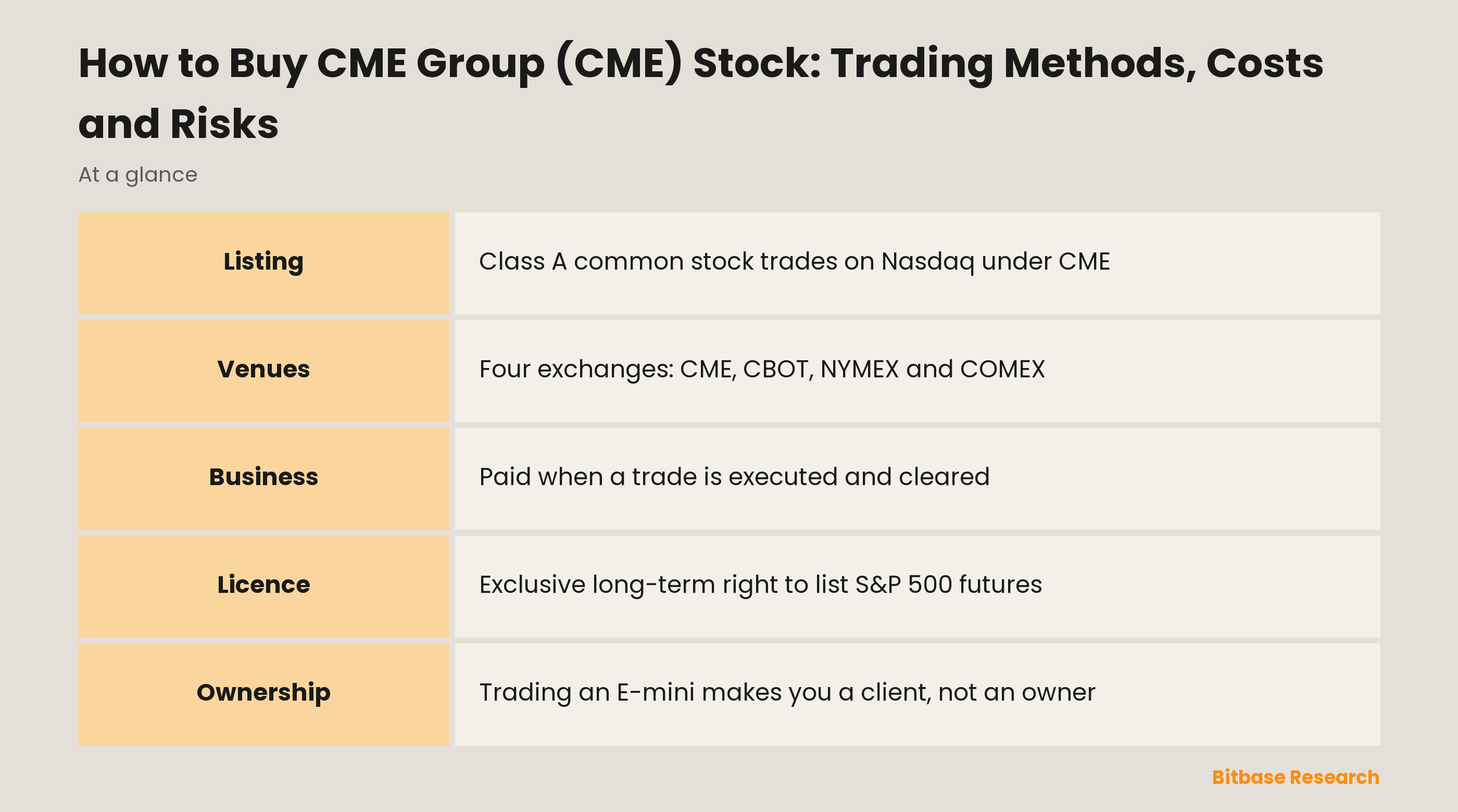
Underneath it sit four marketplaces: "our derivatives exchanges (CME, CBOT, NYMEX and COMEX)" — two Chicago futures markets and two New York markets for energy and metals, once separate institutions and now venues inside one holding company.
The product range is wide. The filing enumerates interest rates — "SOFR, U.S. Treasury and Federal Funds" — equity indices — "E-mini S&P 500, E-mini Nasdaq 100 and E-mini Russell 2000" — then foreign exchange, agricultural commodities, energy, metals, and cryptocurrencies: "Bitcoin, Ether, Solana and XRP."
Execution is mostly electronic but not entirely: products "are traded primarily through CME Globex, as well as by open outcry in Chicago for SOFR options and through privately negotiated transactions." Clearing is what separates an exchange group from a broker — an "integrated clearing function" that works by "serving as the counterparty to every trade, becoming the buyer to each seller and the seller to each buyer."
CME Group Inc. is a Delaware corporation headquartered in Chicago, its fiscal year ends on 31 December, and the security registered under Section 12(b) is the Class A common stock, symbol CME, listed on Nasdaq — a detail to read off the filing rather than assume.
Why People Trade CME
The economics reduce to one sentence: "The majority of clearing and transaction fees received from clearing firms represents charges for trades executed and cleared on behalf of their customers."
Read closely, that says the input is a count rather than a direction. A hedge placed because rates are falling and one placed because rates are rising are both trades, and both are cleared. What the business needs is participants with a reason to act, and the filing names those reasons: its products "provide a means for hedging, speculation and asset allocation." Demand for certainty is the raw material.
A second line runs on a different clock. The company sells "primary price discovery and referential pricing information" as "real-time, historical and derived data." Subscriptions do not spike on a busy afternoon the way a per-trade fee does, nor fall silent in a quiet one.
Then there is a contractual asset with no operational equivalent. Through a joint venture with S&P Global, the company holds "a long-term, ownership-linked, exclusive license to list futures and options based on the S&P 500 Index" — a legal position, defended in renewals rather than in product releases.
For a crypto trader the appeal is specific: bitcoin, ether, solana and XRP products sit on the same fee schedule as corn and Treasuries, inside a company whose shares clear through the ordinary equity system. The Nasdaq-100 futures listed alongside them show how far that schedule reaches.
Which Route Actually Buys You the Company
The route that makes you an owner is the ordinary one: a Class A common share bought through a broker with access to Nasdaq. It carries shareholder rights and settles through the US equity system, and every other route should be measured against it.
The distinction worth making precise is between using this market and owning it. A position in an E-mini contract makes you a customer of this company; a position in its shares makes you a part owner of the fee schedule that customer pays. A view on where an index is going and a view on how much trading happens around it are separate views, and they can be right and wrong on the same afternoon. An index can finish a quarter near where it started while the number of contracts cleared against it rises or falls sharply, and it is the second number that reaches this company's revenue line.
Expiry makes the point from another angle. Index futures are listed on a quarterly cycle, so a position meant to outlast a quarter has to be moved from the expiring contract into the next one. Each move is a pair of trades, and both are cleared — the calendar reaches the fee line whether or not anyone's direction was right.
Exposure can also be packaged by someone other than a broker, and the packaging changes what is owned. A tokenized stock is issued by a third party to give economic exposure without shareholder rights, on eligibility and redemption terms the issuer sets and can change. A perpetual futures contract holds no share and no token at all; it follows a price, margins in stablecoin, moves funding between the two sides periodically, and closes out on its own if margin runs short.
Which names a venue carries in which of those forms varies from ticker to ticker, and is not to be inferred from a company's prominence. The tokenized stock and futures lineup is where a venue's own list can be read directly.
What Moves CME Group
Activity is the engine, and activity is not the same as price movement. A market that drifts on thin volume and one that swings on heavy volume can end a month at the same level, and only one of them was busy for the venue clearing it. Trades come from disagreement about the future, combined with someone holding a risk they would rather not hold.
Monetary policy reaches the business through the product list rather than through sentiment. When the path of short-term rates is genuinely in dispute, the instruments used to hedge that dispute include the SOFR, Treasury and Federal Funds products the filing names. Policy that surprises nobody generates less of that hedging.
The licensing position is structural and quiet. An exclusive, long-term right to list S&P 500 futures and options never appears on a daily chart and shapes what competitors can offer. Fee competition works on the same slow clock: a business paid per cleared trade is exposed to a rival pricing a comparable contract lower, and that shows up over years in fee levels rather than over days in a share price.
Risks and Limits
Revenue depends on conditions the company does not set. Volatility, hedging demand and willingness to transact are supplied by the wider world. A long stretch of calm is not a management failure and is not fixed by management action.
The clearing house is a concentration as well as a service. Acting as counterparty to every trade binds the group's standing to its own risk controls and to the members clearing through it.
Contractual rights can be renegotiated. A licence that is exclusive today is exclusive on terms, and terms have dates — a dependency invisible in trading statistics.
Wrappers change what you own without changing what moves it. Through a third-party token, exposure arrives with issuer structure and redemption terms, and without shareholder rights; through a leveraged derivative, with funding and a liquidation price. Neither alters the business; both alter your claim on it.
This profile is not a substitute for the company's own risk disclosure. CME Group sets out its risks in its own words in the Risk Factors section of its annual report, and that section is more specific than any summary written from outside it.
How to Verify CME Group Information
Start with the filing. On SEC EDGAR, CME Group files under CIK 1156375, and every sentence quoted above comes from its annual report on Form 10-K. The cover page is the fastest check in the document: the Section 12(b) table names the class, the trading symbol and the exchange on one line, settling where a company is listed without interpretation. Further in, the Risk Factors section is where the company names what it considers capable of harming it — worth reading in the original.
Contract terms belong somewhere else entirely. Multipliers, tick sizes, listed months and settlement procedures live on the exchange's own specification pages, and those get revised; an annual report will not tell you what a contract is worth per point. For anything traded on a crypto venue, that venue's product pages are the authority on listings, fees and margin.
Conclusion
Buying CME Group is a bet on how much the world needs to transfer risk, not on which way a particular price goes. The company earns when a trade is executed and cleared, sells the data that trading produces, and holds a licensing position that is hard to reproduce. None of that requires an opinion about the level of the S&P 500 or the price of bitcoin.
The mistake to avoid is treating a position in the venue as a larger version of a position in its products. A share buys a claim on the fee schedule and the rights of equity ownership; a contract buys a view on a price and an obligation to the clearing house.
Related reading
Other Bitbase articles on this topic:
- Crypto Stocks vs Bitcoin ETFs: Business Exposure or Bitcoin Exposure?
- How to Buy Adobe (ADBE) Stock: Trading Methods, Costs and Risks
- How to Buy Cboe (CBOE) Stock: Trading Methods, Costs and Risks
- How to Buy TQQQ: Daily Leverage, QQQ and Nasdaq Futures Compared
- What Is SuperVerse
Disclaimer: This article is educational content from Bitbase Academy, provided for information only. It explains what a company or fund does and how the instruments referenced here differ from one another; it does not constitute investment, trading, tax, or financial advice, and it is neither a recommendation nor an endorsement of any security, token, or trading strategy. A tokenized stock is issued by a third party and is designed to give economic exposure to an underlying asset: it is not a share, it carries no shareholder rights, and it depends on the issuer's structure, eligibility rules, and redemption terms, which the issuer can change. Perpetual futures are leveraged derivatives that hold no underlying asset and can be liquidated, and trading hours, product availability, and eligibility differ by instrument and by jurisdiction and can change at any time. Written as of September 2026; verify everything yourself through company filings, the issuer's own documentation, and the product pages of the venue you trade on.
References
[1] CME Group FY2025 Form 10-K: listing, exchanges, products and fee structure (SEC EDGAR) www.sec.gov
[2] SEC EDGAR filing index for CME Group, CIK 1156375: every annual report in one list www.sec.gov