The financial year CrowdStrike calls fiscal 2026 ended on 31 January 2026, so almost all of the work inside it happened during calendar 2025, and that one line on the cover of the annual report decides whether any comparison with a December year-end peer means anything. The company sells cybersecurity as a subscription priced per endpoint and per module, which makes reported revenue largely the unwinding of agreements signed earlier. This profile covers what CrowdStrike sells, why the billing model decides which news moves the price, and how owning the Class A share differs from trading the USDT-margined perpetual on Bitbase.
What Is CrowdStrike (CRWD)?
CrowdStrike Holdings, Inc. is a Delaware corporation with principal offices in Austin, Texas. Its annual report describes the CrowdStrike Falcon platform as one that "serves as the operating system for cybersecurity," built to stop breaches "through a single lightweight sensor."
That sensor shapes the commercial model. It collects data "from across the enterprise, including endpoints, cloud workloads, identities, and third-party sources," and once customers deploy it "they can easily add additional cloud modules." Subscriptions are "generally priced on a per-endpoint and per-module basis," so the bill grows in two directions at once: more machines protected, and more modules switched on for each. A smaller line covers professional services such as incident response, viewed "primarily as an opportunity to cross-sell subscriptions."
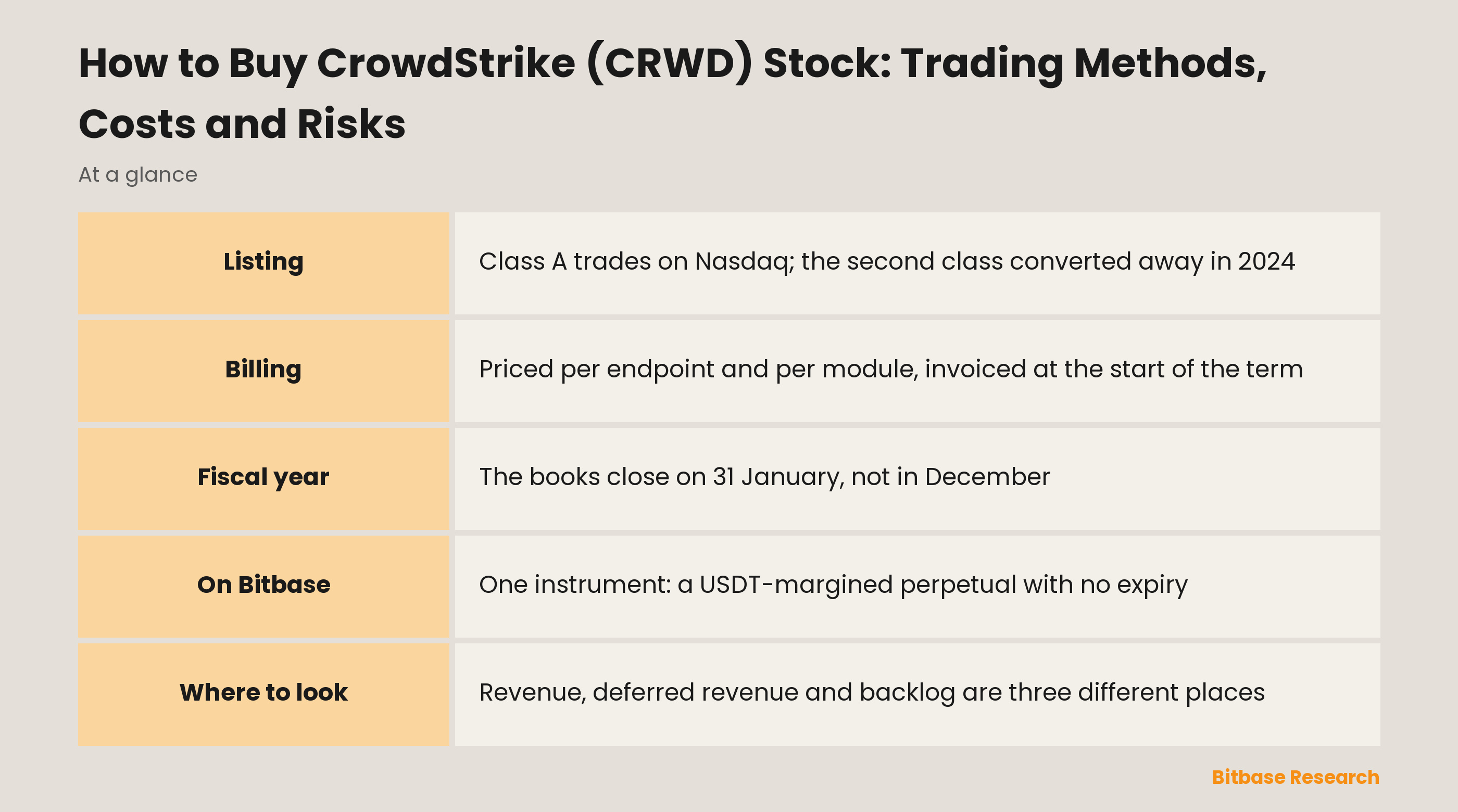
What trades under CRWD is the Class A common stock, registered on The Nasdaq Stock Market and listed since June 2019. A second class existed until December 2024, when the outstanding Class B shares converted automatically into Class A. The dual-class structure many technology listings still carry is, here, already gone.
Why People Trade CRWD
A position in CRWD is a position on renewals rather than on any single product launch. Contracts are "generally non-cancelable" and run terms "generally one to three years," and the failure case appears verbatim among the risk factors: "If our customers do not renew their subscriptions for our products and add additional cloud modules to their subscriptions, our future results of operations could be harmed."
Growth inside that installed base has its own disclosed metric. The dollar-based net retention rate compares ARR from a set of subscription customers "against the same metric for those subscription customers from the prior year," reflecting "customer renewals, expansion, contraction, and churn." It measures the installed base, not new logos.
Demand follows the buyer's calendar. "Given the annual budget approval process of many of our customers, we see seasonal patterns in our business," the filing states, with net new annual recurring revenue "typically greater in the second half of the year, particularly in the fourth quarter." Because that quarter closes on 31 January, the heaviest selling season straddles a calendar year boundary.
The link to crypto is thin and worth saying plainly: nothing in this revenue depends on token prices. What puts CRWD in front of a crypto-native audience is the instrument, not the business.
Buying the Share, or Buying the Price
The routes to CRWD divide on one question: does the transaction end with a claim on the company, or with a contract about its price?
A purchase through a broker with Nasdaq access ends with the claim. The buyer holds Class A common stock and the rights attached to it, settled through the United States equity system. Even here a layer sits in between, and the company names it: most stockholders "are beneficial owners but whose shares are held in street name by brokers and other nominees."
The perpetual futures contract ends with the price and nothing else. It is margined and settled in a stablecoin, holds no share, and has no expiry date. Selling it is not the mirror image of selling a share: a sale opens a short position instead of reducing a holding, which is the mechanical answer to how to short CRWD stock without arranging a stock loan.
Cost behaves differently on each route. A share position pays on the way in and on the way out. A perpetual adds an ongoing funding rate exchanged between longs and shorts and charged to whichever side is crowded, so the bill scales with holding period rather than trade count.
How to Trade CRWD on Bitbase
On Bitbase, CRWD is a USDT-margined perpetual contract. Collateral is posted in stablecoin, size is chosen in contracts rather than share counts, and no settlement date has to be managed. Anyone looking to buy CRWD stock with USDT should be clear about what that phrase buys here: exposure to a price, not a share.
Spread and fee are charged on entry and exit and then finished with. Funding is not, because it accrues for as long as the position stays open, which turns holding period into a price input. The margin buffer decides survival: the contract closes out against a mark price rather than the last trade on the book, so what matters is how far that mark can travel before the buffer runs out.
The part specific to a stock perpetual is the calendar underneath it. A crypto perpetual references a spot market that never closes; this one references a share that stops trading every weekday afternoon, all weekend and on market holidays, so the next equity opening print can arrive as a gap. How a venue derives its mark price during those hours, and what it does with funding while the reference market is closed, are questions its contract rules page has to answer before a position is sized. Instrument coverage is not uniform across tickers, and the TradFi lineup is the page that lists it.
What Moves CRWD
The income statement is a lagging record of decisions already taken. CrowdStrike recognises subscription revenue "ratably over the contract term," and states the consequence itself: "any increase or decline in new sales or renewals in any one period will not be immediately reflected in our revenue for that period."
That makes reported revenue a poor early-warning system and moves attention to the balance sheet. Customers are generally invoiced at the beginning of the subscription term, and those prepayments sit as deferred revenue until the service has been delivered.
Then there is a pool that appears in neither line. Where a contract is signed but the right to invoice has not yet arrived, the amount is "classified as backlog," and such amounts "are not recorded in deferred revenue or elsewhere in our consolidated financial statements." Reading revenue and deferred revenue alone covers two of the three places where contracted future work is held.
Annual recurring revenue compresses this into one figure, and its definition matters more than its level. ARR is "calculated as the annualized value of our customer subscription contracts as of the measurement date, assuming any contract that expires during the next 12 months is renewed on its existing terms." That assumption does real work, which is why ARR has to be read next to the retention rate rather than instead of it.
Around the accounting sit drivers the company names for itself: sales cycles that are "long and unpredictable"; reliance on third-party data centres, "such as Amazon Web Services," to host the platform; and the standing condition of being "a target of cyberattacks" as a cybersecurity provider.
Risks and Limits
CrowdStrike carries an incident with a date on it. On 19 July 2024 the company "released a content configuration update for our Falcon sensor that resulted in system crashes for certain Windows systems," referred to throughout the filings as the July 19 Incident. It is still a named risk factor, expected "to continue to have, an adverse effect on our business, sales, customer and partner relations, reputation, results of operations and financial condition."
Profitability is not settled either. The company's own heading reads: "We have a history of losses, and while we have achieved profitability in certain periods, we may not be able to achieve or sustain profitability in the future."
Product risk is unusually direct here because the product is the defence: "If our solutions fail or are perceived to fail to detect or prevent incidents or have or are perceived to have defects, errors, or vulnerabilities, our brand and reputation would be harmed." The word "perceived" appears twice in that sentence, and it is not padding.
Leverage changes what those business risks feel like. A shareholder sitting through a bad quarter watches a drawdown; a perpetual position of the same notional can be closed out by the same move, and a weekend gap can carry the mark across a liquidation level with no chance to trade in between.
How to Verify CRWD Information
Every quoted line above comes from CrowdStrike's annual report on Form 10-K, filed with the US Securities and Exchange Commission under CIK 1535527 and free to read on EDGAR. The cover page settles most identity questions on its own: the registrant name, the state of incorporation, and the Section 12(b) table, which states the class, the trading symbol and the exchange.
The cover also settles the fiscal year. It reads "For the fiscal year ended January 31," and that line reframes every comparison, because a headline about fiscal 2026 results describes a period that ran almost entirely through the previous calendar year.
Beyond the cover, Item 1 describes the business, Item 1A lists risk factors under headings written by the company rather than by an analyst, and the notes carry the revenue recognition policy and the deferred revenue tables. The investor relations site publishes the same filings alongside the results calendar. For the contract, the venue's own rules and fee pages are the authority on funding, margin and eligibility.
Conclusion
Buying CRWD starts with deciding whether the goal is to own a business or to hold a view on its price. The Class A share on Nasdaq is ownership, in a structure that is now single-class and settled through the equity system. The perpetual on Bitbase is a stablecoin-margined contract with no expiry, no shareholder rights and a running funding cost, and it is also how a short is opened rather than a holding reduced.
Underneath both sits one company: it bills per endpoint and per module, collects in advance, recognises revenue slowly across one to three years, and stores its contracted future across revenue, deferred revenue and a backlog line that appears in neither.
Related reading
Other Bitbase articles on this topic:
- Crypto Stocks vs Bitcoin ETFs: Business Exposure or Bitcoin Exposure?
- How to Buy Adobe (ADBE) Stock: Trading Methods, Costs and Risks
- How to Buy Cboe (CBOE) Stock: Trading Methods, Costs and Risks
- How to Buy Vertiv (VRT) Stock: Trading Methods, Costs and Risks
- What Is Venice AI?
Disclaimer: This article is educational content from Bitbase Academy, provided for information only. It explains what a company or fund does and how the instruments referenced here differ from one another; it does not constitute investment, trading, tax, or financial advice, and it is neither a recommendation nor an endorsement of any security, token, or trading strategy. A tokenized stock is issued by a third party and is designed to give economic exposure to an underlying asset: it is not a share, it carries no shareholder rights, and it depends on the issuer's structure, eligibility rules, and redemption terms, which the issuer can change. Perpetual futures are leveraged derivatives that hold no underlying asset and can be liquidated, and trading hours, product availability, and eligibility differ by instrument and by jurisdiction and can change at any time. Written as of September 2026; verify everything yourself through company filings, the issuer's own documentation, and the product pages of the venue you trade on.
References
[1] CrowdStrike FY2026 Form 10-K: fiscal year end, Section 12(b) registration, business, revenue recognition and risk factors (SEC EDGAR) www.sec.gov
[2] CrowdStrike investor relations: filings, results calendar and company disclosures ir.crowdstrike.com