Three routes lead to CoreWeave exposure and only one of them makes you a shareholder. The Class A share trades on Nasdaq under CRWV; Bitbase carries a tokenized version issued by Ondo, a spot book for that token, and a perpetual that holds nothing at all. This profile covers what CoreWeave actually sells, why its share price answers to power contracts and debt rather than to AI sentiment, and how the three routes differ on rights, hours and settlement.
What Is CoreWeave (CRWV)?
CoreWeave rents AI computing capacity. The company describes itself in its annual report as "The Essential Cloud for AI, purpose-built to accelerate breakthroughs by AI pioneers," and it sells through three lines: Infrastructure Services, Managed Software Services and Application Software Services. The first is the business most people mean — racks of accelerators, the networking between them, the storage underneath, and the scheduling layer that keeps them busy.
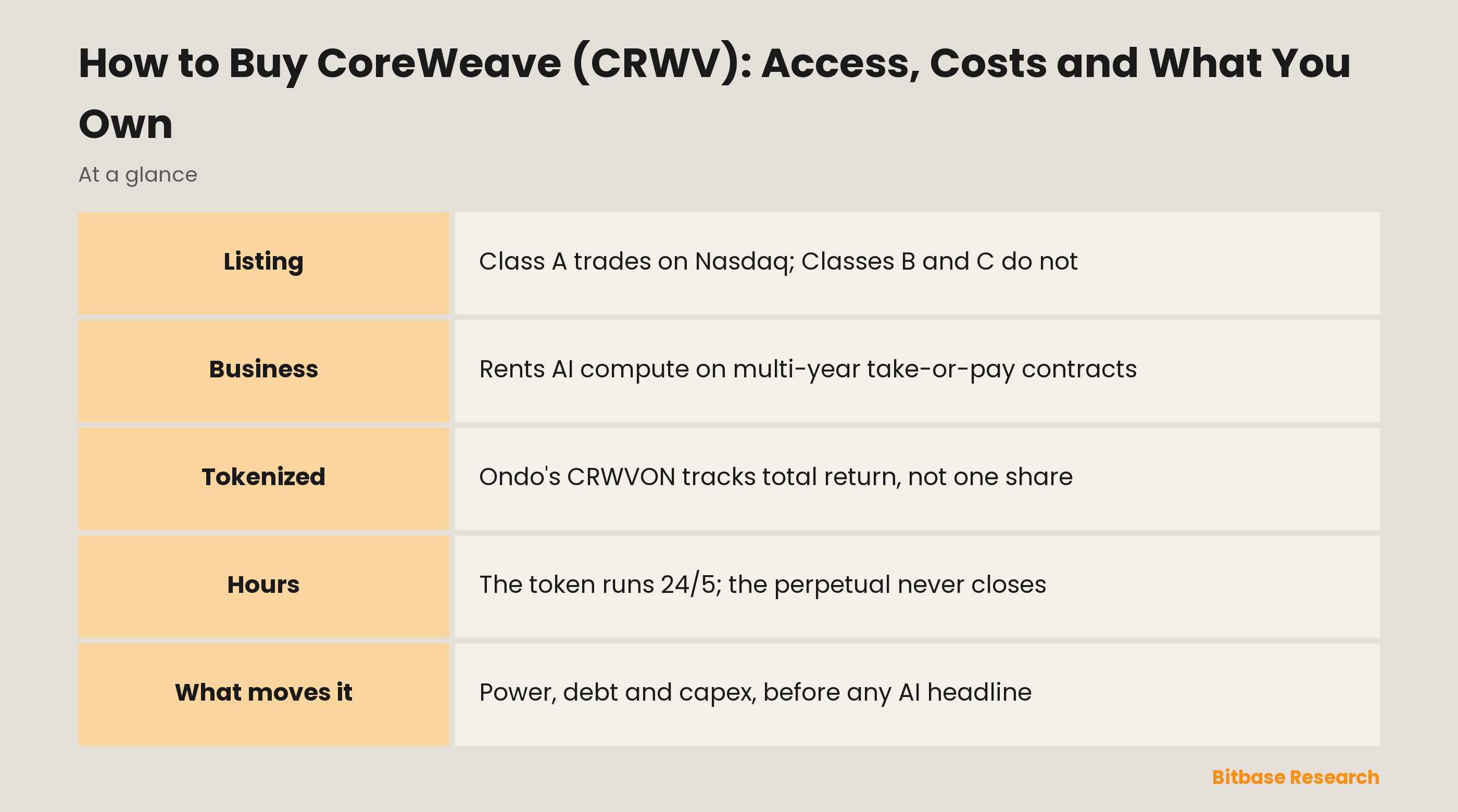
The contract structure is the part worth reading twice. CoreWeave states that "Customers generally access our platform through multi-year committed contracts, under which they purchase a specified amount of capacity on a take-or-pay basis over the contract term." Take-or-pay means the customer owes for the capacity whether or not it is used. Revenue visibility therefore comes from signed contracts rather than from metered consumption, which is the opposite of how a general-purpose cloud bills.
CoreWeave, Inc. is a Delaware corporation listed on The Nasdaq Stock Market, and its fiscal year ends on 31 December. What trades under CRWV is the Class A common stock. There are also Class B and Class C shares, which is a detail that comes back later: the share a retail buyer can reach is one of three classes, and the classes do not carry the same weight in a vote.
Why People Trade CRWV
CRWV is a pure-play on rented AI compute, which is a narrower thing than "AI stock." A chip designer sells into every buyer of accelerators; a hyperscaler sells compute alongside a dozen other products. CoreWeave sells capacity, on contracts, to a small number of very large counterparties. That makes it a leveraged read on one specific question: whether the organisations training and serving large models keep signing multi-year commitments.
The company names customer concentration as a risk in its own filings, under the heading that "A substantial portion of our revenue is driven by a limited number of our customers, and the loss of, or a significant reduction in, spending from one or a few of our top customers would adversely affect our business." A trader holding CRWV is therefore exposed not to AI adoption in the abstract but to the renewal decisions of a handful of buyers.
Its relationship to crypto is one of shared plumbing rather than shared economics. CoreWeave's revenue does not move with token prices. What the two do share is a dependence on cheap capital and on the same scarce inputs — data centre shells, grid interconnects, high-end accelerators — which is why the names sometimes trade together without being connected.
Tokenized Stock, Spot and Perpetuals: Three Different Things
The Bitbase price page for this ticker lists CoreWeave (Ondo Tokenized), trading under the symbol CRWVON. The naming is the signature: the instrument is issued by Ondo, and it is not a share.
Ondo's documentation is explicit on three points, and each one contradicts a common assumption. First, the token is not one-for-one with a share: "One token does not necessarily represent the value of one share, and the price of one token will not always match the price of the underlying asset." The tokens are structured as total return trackers, designed to reproduce the economics of holding the share with dividends reinvested, net of withholding tax. Second, holders receive no shareholder rights — the documentation states you "do not receive shareholder voting rights, statutory information rights or other shareholder rights." Third, the product is generally available to non-US investors, subject to jurisdictional and other restrictions.
Trading hours are where expectations usually break. Ondo describes minting and burning as instant and atomic, with trading generally running 24/5, and pauses possible around corporate actions and risk limits. That is longer than a Nasdaq session and shorter than the continuous schedule crypto traders assume. Being on a blockchain does not make a market run on weekends.
A perpetual futures contract is a third thing again. It holds no share and no token. It tracks a price, settles in stablecoin, charges or pays a periodic funding rate between longs and shorts, and can be liquidated if margin runs out. It gives direction with leverage and ownership of nothing.
So the ownership question has three answers stacked on top of each other. The perpetual owns nothing. The Ondo token gives economic exposure without shareholder rights. And the Nasdaq share gives shareholder rights — but Class A rights, inside a three-class structure where the votes are not distributed evenly. Each step toward the underlying gives more, and none of them gives control.
How to Trade CRWV on Bitbase
Three surfaces exist for this ticker, and they answer different questions.
The price page is the reference point: quote, chart and market data for the tokenized stock. It requires no position and no decision, and it is where the issuer name and symbol can be confirmed before anything else.
The tokenized stock spot market is where the Ondo token is bought and sold against a stablecoin. An order here leaves you holding the token itself — the total return tracker described above, with its trading calendar and its absence of shareholder rights. The cost of a round trip is the spread plus the trading fee, and both are visible on the order book before the order is sent.
The perpetual contract is the leveraged route. It is margined in stablecoin, marked against an index rather than against the last trade, and carries funding as an ongoing cost or credit depending on which side is crowded. Holding it for weeks means paying or collecting funding many times over, which is a different cost structure from a spot position that charges once on entry and once on exit.
A fourth route exists outside Bitbase entirely: buying the Class A share through a broker with access to Nasdaq. That is the only one of the four that makes you a shareholder of record, and the only one that settles through the US equity system rather than on-chain.
What Moves CRWV
The risk factors CoreWeave files are more useful here than any narrative about artificial intelligence, because they name constraints that are physical and dated rather than atmospheric.
Power is the first. The company warns it "would be harmed if we were not able to access sufficient power or by increased costs to procure power, prolonged power outages, shortages, or capacity constraints." Accelerator racks draw more per square foot than the facilities they replace, and grid interconnects are granted on utility timetables, not on procurement ones. A contract signed cannot be served until there is power to serve it.
Debt is the second. CoreWeave states that its "substantial indebtedness could materially adversely affect our financial condition," and that it "may still incur substantially more indebtedness in the future." A business that buys hardware before it earns the revenue that hardware will produce is financing a timing gap, and the price of closing that gap moves with credit conditions. This is why CRWV can fall on a day when AI news is good: the news that matters was about rates.
Capital expenditure is the third, and it is continuous rather than cyclical: operations "require substantial and growing capital expenditures," with more capital needed "to fund our business and support our growth." Accelerators depreciate against newer parts, so maintaining capacity is itself a recurring cost.
Around those three sit the ones the company shares with its sector: a limited number of suppliers for significant components, dependence on data centre providers, intense competition from far larger cloud operators, and the acknowledgement that "the broader adoption, use, and commercialization of artificial intelligence ("AI") technology, and the continued rapid pace of developments in the AI field, are inherently uncertain."
Read together, the picture is a company converting capital and electricity into contracted compute. Anything that changes the cost of capital, the availability of power, or the willingness of a few large buyers to commit will move the share before any change in AI enthusiasm does.
Risks and Limits
Issuer risk sits above market risk on the tokenized route. The Ondo token is a claim on a structure, not on CoreWeave. Its value depends on the issuer continuing to operate, to hold whatever backs the product, and to honour redemption on its own terms. Nothing about holding it on-chain removes that dependency.
The calendar creates gaps. The Nasdaq session and the token's 24/5 schedule do not overlap completely, and neither matches a perpetual that never closes. News arriving while the equity market is shut is priced first by whichever venue is open, which is how a position can gap against a holder who never traded.
Leverage compounds the above. A perpetual is liquidated on a mark price, not on the last print, and funding accrues regardless of direction. A position sized for an ordinary session can be closed out by a gap that a spot holder would merely have watched.
The business risks do not vanish because the wrapper changed. Customer concentration, power availability and debt service apply identically to the share, the token and the perpetual. The wrapper decides what rights come with exposure; it does not decide what the exposure is to.
How to Verify CRWV Information
For the company: the SEC EDGAR filings under CIK 1769628 carry the annual report, and every quoted line above appears in it. CoreWeave's investor relations site publishes the same documents alongside its results calendar.
For the tokenized product: Ondo's own documentation is the authority on backing, rights and trading hours, and it is specific enough to settle most disputes in a sentence.
For the market: the Bitbase price page shows the issuer name in the instrument title. If the title does not say who issued the token, the token is not what the page appears to be about — the same ticker can name an unrelated crypto project.
Conclusion
Buying CRWV means choosing what to own before choosing what to pay. The perpetual owns nothing and charges funding for the privilege of direction. The Ondo token owns economic exposure and no rights, on a 24/5 calendar set by its issuer. The Nasdaq share owns a Class A vote inside a three-class structure.
Whichever route is taken, the thing being bought is a company that turns capital and electricity into contracted compute for a small number of customers. Read the power, debt and capital expenditure risk factors before the AI headlines. They are what moves the price.
Related reading
Other Bitbase articles on this topic:
- Crypto Stocks vs Bitcoin ETFs: Business Exposure or Bitcoin Exposure?
- How to Buy Adobe (ADBE) Stock: Trading Methods, Costs and Risks
- How to Buy Cboe (CBOE) Stock: Trading Methods, Costs and Risks
- How to Buy Exxon Mobil (XOM) Stock: Trading Methods, Costs and Risks
- What Is Wayfinder?
Disclaimer: This article is educational content from Bitbase Academy, provided for information only. It explains what a company or fund does and how the instruments referenced here differ from one another; it does not constitute investment, trading, tax, or financial advice, and it is neither a recommendation nor an endorsement of any security, token, or trading strategy. A tokenized stock is issued by a third party and is designed to give economic exposure to an underlying asset: it is not a share, it carries no shareholder rights, and it depends on the issuer's structure, eligibility rules, and redemption terms, which the issuer can change. Perpetual futures are leveraged derivatives that hold no underlying asset and can be liquidated, and trading hours, product availability, and eligibility differ by instrument and by jurisdiction and can change at any time. Written as of September 2026; verify everything yourself through company filings, the issuer's own documentation, and the product pages of the venue you trade on.
References
[1] CoreWeave FY2025 Form 10-K: incorporation, share classes, contract structure and risk factors (SEC EDGAR) www.sec.gov
[2] Ondo Stocks overview: backing, rights and trading hours (Ondo official documentation) docs.ondo.finance
[3] CoreWeave investor relations: filings, results calendar and corporate overview investors.coreweave.com