Dell Technologies keeps a calendar of its own: the fiscal year ends on the Friday nearest January 31, so the results that reprice this ticker land weeks from where a calendar-quarter screen looks. The security registered under DELL is the Class C common stock on the New York Stock Exchange, and on Bitbase the same four letters also reach an Ondo-issued token, a spot book against a stablecoin, and a perpetual holding neither.
What Dell Technologies Sells
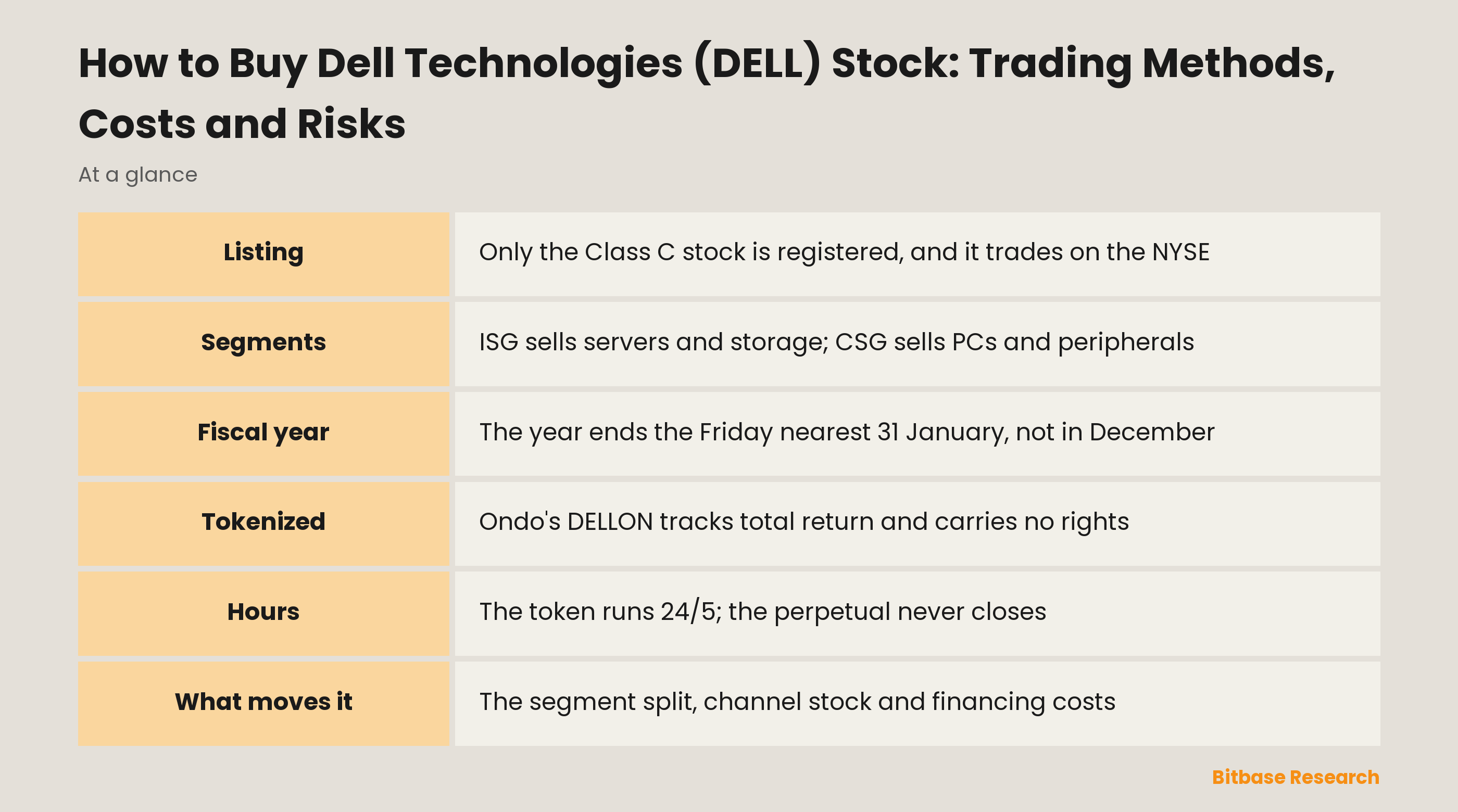
Dell Technologies Inc. is a Delaware corporation, and the security registered under DELL is its Class C common stock, listed on the New York Stock Exchange. The annual report's cover page registers one class under Section 12(b) of the Exchange Act, and it is the C; Classes A and B appear in the share-count disclosures but are not what a broker fills.
Its shape fits one sentence: "We are organized into two business units which are also our reportable segments: Infrastructure Solutions Group and Client Solutions Group."
ISG is the data-centre half, and it "enables our customers' digital transformations with solutions that address AI, machine learning, data analytics, and multicloud environments." Its products group into AI-optimized servers, traditional servers and networking, and storage.
CSG is the half most people have touched. It "offers branded personal computers (PCs), including notebooks, desktops, and workstations and branded peripherals that include displays, docking stations, keyboards, mice, and webcam and audio devices, as well as third-party software and peripherals."
Nothing else is a segment. The other businesses — the historical resale of standalone VMware offerings, and Secureworks until its sale — "are divested businesses or their offerings are no longer actively sold, and are not classified as reportable segments."
Two structures sit underneath. Dell sells "directly to customers and through other sales channels, which include value-added resellers, system integrators, distributors, and retailers." And Dell Financial Services and its affiliates "originate, collect, and service customer receivables primarily related to the purchase or use of our product, software, and services offerings" — lending inside a hardware business.
Why People Trade DELL
Dell is a way to hold the AI build-out without holding a chip designer. The accelerators inside an AI-optimized server come from somebody else; Dell supplies the chassis around them, the storage they read from and the support contract that keeps a rack in service. Holding the ticker is a view on how much of the spending stops with an integrator.
The segments not sharing a cycle is the other draw. ISG answers to data-centre budgets, CSG to corporate refresh waves and consumer appetite, and one ticker carries both — so a headline about server demand explains less of a move here than at a pure-play.
Revenue shape matters too. Recurring revenue, as Dell defines it, is "revenue recognized that is primarily related to hardware and software maintenance as well as operating leases, subscription, as-a-Service, and usage-based offerings" — a line that accumulates on renewals rather than on launches.
The link to crypto is the wrapper, not the business: here the ticker is reachable as a token and a contract, priced in stablecoin, during hours the New York Stock Exchange does not keep.
Where the Share Ends and the Token Begins
Look DELL up on Bitbase and the instrument that answers is Dell Technologies (Ondo Tokenized), symbol DELLON. Whoever issued it is named inside the title, and the name is not Dell.
Ondo publishes its terms, and they rule out most of what the word stock implies. A token is not a pegged unit of ownership: the documentation says "One token does not necessarily represent the value of one share, and the price of one token will not always match the price of the underlying asset." The design is a total return tracker instead, rolling dividends back in after withholding tax rather than paying anything out. Voting is off the table as well, because holders "do not receive shareholder voting rights, statutory information rights or other shareholder rights." Eligibility is bounded too: the product is aimed at investors outside the United States and limited further by jurisdiction.
The calendar is the next surprise. Issuance and redemption settle immediately, in one atomic step, while the market around them generally keeps a 24/5 schedule that Ondo can suspend for corporate actions and risk limits. That window outruns a New York session and still stops short of Saturday: writing an instrument to a blockchain does not buy it a seven-day market.
The perpetual belongs to neither category. Nothing is held on either side of it; a price is referenced, stablecoin settles it, and a recurring funding rate moves from the crowded side of the book toward the other. Each step away from the New York listing surrenders something: the perpetual the asset, the token the rights.
How to Trade DELL on Bitbase
Three surfaces carry this ticker here, and each answers a different question.
The DELL price page carries the live quote, the chart and the reference data behind the token. Nothing is bought there. It still deserves opening first, because the issuer name is printed in the title and nowhere else on the trade path.
The spot book for the token prices the Ondo instrument against a stablecoin. Whatever fills stays in the account as the token described above, with the calendar and the missing rights that come with it. A round trip costs the spread and the fee, both quoted before the order is sent.
The DELL perpetual is the leveraged way in. Collateral is posted in stablecoin, the mark comes from an index rather than the last trade, and funding is debited or credited according to where the book leans. What it makes expensive is duration: a month of holding settles funding many times over, which a spot position never does. Going short lives here too, since selling the contract opens a short while selling spot merely unwinds one.
A fourth route stays off the platform: buying the Class C share through a broker with New York Stock Exchange access, the only one that puts the registered security in your own name. Which surfaces exist differs by ticker, and the tokenized stock lineup is the page that says which.
What Moves DELL
Two segments, two sets of buyers. ISG sells into AI, machine learning, analytics and multicloud projects; CSG sells notebooks, desktops, workstations and peripherals. Different committees sign those off on different timetables, so the number worth finding in a release is the split rather than the total.
The fiscal calendar is not the market's. Dell's "fiscal year is the 52- or 53-week period ending on the Friday nearest January 31," and it labels the years ended January 30, 2026, January 31, 2025 and February 2, 2024 as Fiscal 2026, Fiscal 2025 and Fiscal 2024. Lining Dell up against a December year-end peer compares weeks that do not match.
Storage carries a season. In the company's words: "Our sales can be affected by seasonal trends. Within ISG, our storage sales are typically stronger in our fourth fiscal quarter." That quarter closes in late January or early February, so the seasonal peak and the year-end land in one release.
The channel decides when revenue appears. Part of the demand signal passes through resellers, integrators, distributors and retailers, who stock ahead of what they expect and destock when they were wrong. Demand into the channel and out of it can point opposite ways for a quarter.
Financing sits inside the business. Because Dell Financial Services originates and services receivables tied to purchases of Dell's own offerings, the cost of money and customer credit quality reach the accounts without a shipment in between.
Risks and Limits
The token answers to Ondo, not to Dell. DELLON is an obligation of a structure Ondo runs. What stands behind it, who qualifies to hold it and on what terms it is redeemed are Ondo's to decide and revise, and the venue displaying the quote underwrites none of it.
Three schedules, none aligned. A New York session, a 24/5 token and a contract that never stops cover different slices of the week. Anything breaking with the equity book closed is priced wherever trading is still open, then reaches the rest as a gap — which is how a position moves against somebody who entered no order.
Leverage turns that gap into an outcome. A perpetual is liquidated against a mark price rather than the last trade, and funding accrues whichever way the position faces. Results days are when session boundaries matter most.
Changing the wrapper does not change the company. Segment mix, channel inventory, financing costs and that January close reach all three routes without distinction. A wrapper fixes the rights and running costs that arrive with exposure; what the exposure is taken to does not move.
How to Verify DELL Information
Go to the filing. Dell Technologies files with the SEC under CIK 1571996, and the Form 10-K carries the registered class and its exchange on the cover, the segment definitions in Item 1, and the sentence defining the fiscal year.
Check the year label against its end date first. "Fiscal 2026" ended in January 2026, so a screen mapping Dell's quarters onto calendar ones aligns periods that do not match — and that mistake survives quietly into everything built on it.
On the token itself, the issuer's documentation governs and an exchange listing does not. On the venue, read the instrument title where DELL is quoted before reading the number next to it: four letters are no guarantee of which asset is on the other side, because tickers and crypto symbols collide more often than the tidy naming suggests.
Conclusion
Dell Technologies is two reportable segments and a financing arm, selling direct and through partners, on a fiscal year closing the Friday nearest January 31. The ticker reaches a market as a Class C share on the New York Stock Exchange, as an Ondo token tracking total return without conferring rights, and as a perpetual owning nothing and charging funding for direction.
The share is the only route that makes anyone a stockholder, the token the only one on an issuer's calendar, the perpetual the only one that can be closed without its holder agreeing. The same company sits underneath all three, and the first thing worth establishing is which quarter you are looking at.
Related reading
Other Bitbase articles on this topic:
- Crypto Stocks vs Bitcoin ETFs: Business Exposure or Bitcoin Exposure?
- How to Buy Adobe (ADBE) Stock: Trading Methods, Costs and Risks
- How to Buy Cboe (CBOE) Stock: Trading Methods, Costs and Risks
- How to Buy Block (XYZ) Stock: Trading Methods, Costs and Risks
- Solana Meme Tokens: BOME, MEW, and Why MYRO Now Has Two Live Contracts
Disclaimer: This article is educational content from Bitbase Academy, provided for information only. It explains what a company or fund does and how the instruments referenced here differ from one another; it does not constitute investment, trading, tax, or financial advice, and it is neither a recommendation nor an endorsement of any security, token, or trading strategy. A tokenized stock is issued by a third party and is designed to give economic exposure to an underlying asset: it is not a share, it carries no shareholder rights, and it depends on the issuer's structure, eligibility rules, and redemption terms, which the issuer can change. Perpetual futures are leveraged derivatives that hold no underlying asset and can be liquidated, and trading hours, product availability, and eligibility differ by instrument and by jurisdiction and can change at any time. Written as of September 2026; verify everything yourself through company filings, the issuer's own documentation, and the product pages of the venue you trade on.
References
[1] Dell Technologies Fiscal 2026 Form 10-K: share class, segments and fiscal year (SEC EDGAR) www.sec.gov
[2] Ondo Stocks overview: backing, rights and trading hours (Ondo official documentation) docs.ondo.finance
[3] EDGAR filing index for that annual report, with every exhibit filed alongside it www.sec.gov