ETHA is the ticker of the iShares Ethereum Trust ETF, a Delaware statutory trust whose shares list on Nasdaq and whose stated aim is to reflect the price of ether. Holding that share is not holding ether, and holding a tokenized version of that share on-chain is a third arrangement again. What follows separates the layers, names the document that settles each question, and quotes the sentence in the trust's own filings that most readers expect to read the other way round.
The Trust That Sits Behind ETHA
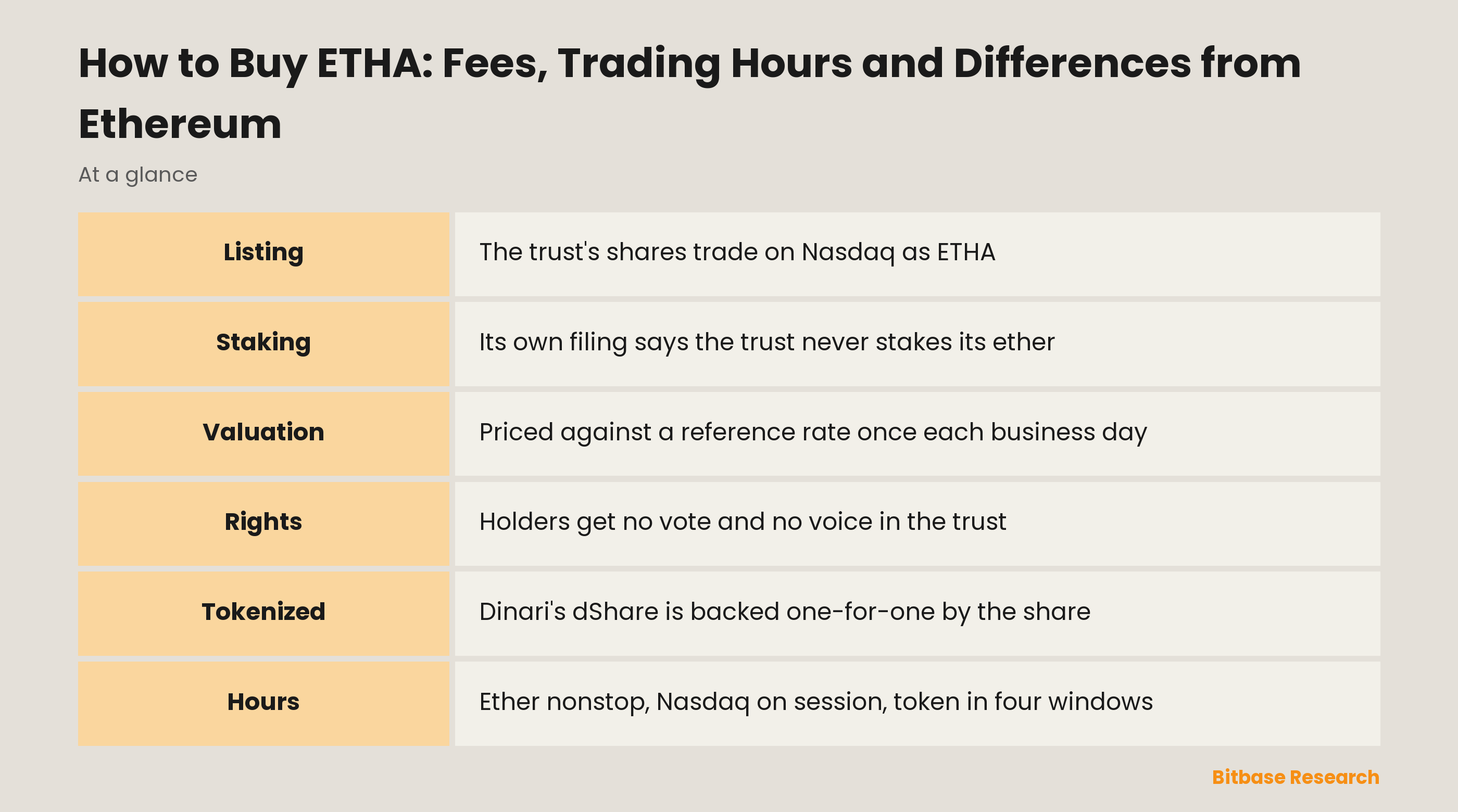
The iShares Ethereum Trust ETF was formed as a Delaware statutory trust on 8 November 2023, and its shares are listed and traded on The Nasdaq Stock Market under the ticker ETHA. The sponsor states its objective as a fund that "seeks to reflect generally the performance of the price of ether, the native token of the Ethereum network." The word doing the work there is *generally*: the trust is valued against a reference rate, and a reference rate is not every print on every venue.
Behind that single line sits a chain of institutions the shareholder never deals with directly. Running the trust is the job of iShares Delaware Trust Sponsor LLC as sponsor and BlackRock Fund Advisors as trustee; holding the ether is the job of Coinbase Custody Trust Company, LLC, with Anchorage Digital Bank N.A. named as an additional available custodian. Valuation runs on a schedule rather than continuously. On each business day, meaning any day other than a Saturday, a Sunday or a day Nasdaq is closed for regular trading, the trust evaluates its ether as soon as practicable after 4:00 p.m. Eastern, using the CME CF Ether-Dollar Reference Rate, New York Variant. Ether does not stop at four o'clock.
Two disclosures set the legal frame. The trust states that it "is not an investment company registered under the Investment Company Act of 1940," and that because it is neither registered nor regulated by the SEC as one, "the owners of Shares do not have the regulatory protections provided to registered investment companies." On governance the prospectus is equally direct: owners of shares "do not have any voting rights, take no part in the management or control of, and have no voice in, the Trust's operations or business."
Why People Hold ETHA Instead of Ether
The plain answer is the account. A share settles into an ordinary brokerage account alongside equities, so there is no wallet, no seed phrase and no self-custody decision to make. For money already sitting in a retirement account or a managed portfolio, this is often the only route available.
What that convenience costs is the question people type as etha vs buying ethereum. Part of the answer is the fee, placed precisely below. The rest is specific to this asset, and it is why an ether fund is not a bitcoin fund with a different logo.
Ether can be staked; bitcoin cannot. Staking is how the Ethereum network rewards participants who help secure it, and a large pool of ether sitting with a custodian is exactly the kind of position that could in principle earn those rewards. The trust's own filing removes the possibility in one sentence: "Neither the Trust, nor the Sponsor, nor the Ether Custodian, nor the Additional Ether Custodian, nor any other person associated with the Trust will, directly or indirectly, employ the Trust's ether in Staking Activities." The prospectus repeats the point in the same terms.
So the share follows the price of ether and nothing else about ether. The line is drawn at the product level: iShares registered a separate trust, the iShares Staked Ethereum Trust ETF, listed under the ticker ETHB. It is a different fund with its own registration statement, and reading one prospectus tells you nothing about the other.
Three Holdings, and Only One of Them Can Stake
Three things can be held here, and they are not versions of one another. Ether settles on-chain, trades on venues that never close, can be self-custodied and can be staked by whoever controls the keys. A share of ETHA is a unit of a trust that holds ether: no vote, no registered-investment-company status, valued against an index once each business day, tradable only while Nasdaq is open, and permanently outside staking.
The tokenized layer sits on top of that share. Bitbase lists ETHA on a price page whose instrument title reads "iShares Ethereum Trust ETF (Dinari Tokenized ETF)", and the parenthesis is the part that matters: the token is issued by Dinari, not by iShares. Dinari's product is a dShare, orders are routed through Alpaca, and each token is backed one-for-one by the underlying share. Its calendar splits into four sessions, and only some tickers run around the clock, which is a question for Dinari's own documentation rather than an assumption carried over from another token.
What a wrapper passes through is set by the issuer's terms, and those terms belong to the issuer. That is the general shape of everything on the list of tokenized stocks and ETFs. Because the share itself carries no vote, governance is already settled underneath, and nothing at the token layer can add a right the underlying share never had. What the fund's documents do not settle is redemption, eligibility and the mechanics of getting back to a share; those answers live in the issuer's documentation, not in the iShares prospectus.
What Moves ETHA
The dominant input is the price of ether, filtered through the index the trust uses rather than through any single venue. A dislocation on one exchange does not move the trust's valuation unless it moves the reference rate.
The sponsor's fee works in the other direction, quietly and without interruption. The trust accrues it daily at an annualized rate applied to net asset value and pays it at least quarterly in arrears, in dollars or in kind, which over time reduces the quantity of ether standing behind each share. The rate is deliberately absent from this article because it can change. Staking rewards are absent from the same arithmetic by the trust's own rule, so the share's path is the reference price less an accruing fee, never the reference price plus a yield.
Between the reference price and the price a buyer pays sits the supply of shares, which large intermediaries expand and contract through creation and redemption. That link is a tendency rather than a guarantee, and it holds only while those intermediaries can trade, finance and settle.
The calendar moves the price in its own right. Ether trades through weekends and holidays; the Nasdaq session does not. News arriving while the equity market is shut is absorbed by the continuous market first, and the share reprices when it reopens, so a holder who did nothing can find the position marked somewhere new on Monday. The etha trading hours question is therefore not one of convenience but of where the risk sits overnight.
Where This Can Go Wrong
The etha investment risks worth listing are structural rather than directional, because the direction is simply the price of ether.
Structure sits above price. The trust is not a registered investment company, and its own filing says shareholders therefore lack the protections such companies carry. That is a statement about the framework, not a forecast: the comparison with a conventional fund has to be made on documents rather than on the shared word "ETF".
The fee never pauses. Accruing daily against net asset value, it applies in flat markets and falling ones alike, and a long holding period compounds its effect on the ether behind each share. The general treatment of fund charges and safekeeping arrangements appears in the discussion of expense ratios and custody.
Custody is delegated, not removed. The trust's ether sits with a custodian, and the shareholder has no key, no address and no standing to instruct anyone. Operational risk at that layer is carried on the holder's behalf.
A wrapper on a wrapper adds a party. The tokenized version depends on its issuer continuing to operate and to honour its own terms. Holding it on-chain does not remove that dependency; it creates it.
Checking ETHA Against Its Own Documents
Every claim above sits in a document a reader can open, and the documents are not interchangeable.
For the fee, the iShares fund page for ETHA carries the figure under Key Facts, labelled Sponsor Fee, and the prospectus states the same charge under its trust expenses heading. That is the honest answer to etha expense ratio: a live field on the sponsor's page, not a number memorised from an article written months earlier. For what the trust does with its ether, open the prospectus or the annual report and search the text for "Staking Activities".
For the corporate facts, the trust files with the SEC under CIK 2000638, and the Documents tab of the fund page links the prospectus, the fact sheet and the Form 10-K from one place. If a fund page and an EDGAR filing appear to disagree, the filing is the one with a date on it.
The names are close enough to confuse, so check which product is on the screen: the iShares Ethereum Trust ETF trades as ETHA, while the iShares Staked Ethereum Trust ETF is a separate trust with the ticker ETHB. Read the cover page of the document rather than the search box. For the tokenized layer, the Bitbase price page for ETHA names the issuer in the instrument title, and a title that does not say who issued a token is not yet telling you what you need before holding it.
Conclusion
Ether runs continuously and can be staked by whoever holds the keys. A share of ETHA runs on the Nasdaq session, is valued once a business day against a reference rate, carries no vote, and is kept out of staking by the trust's own rule. A token backed one-for-one by that share runs on its issuer's schedule and lives by its issuer's terms.
Each step toward convenience surrenders something specific, and none of them can be reversed by the holder alone. Read the sponsor's page for the fee, the prospectus for what the trust will and will not do, and the issuer's documentation for anything that happens to the token. Then choose the layer you actually meant to be on.
Related reading
Other Bitbase articles on this topic:
- How to Buy CME Group (CME) Stock: Trading Methods, Costs and Risks
- How to Buy CrowdStrike (CRWD) Stock: Trading Methods, Costs and Risks
- How to Buy Dell Technologies (DELL) Stock: Trading Methods, Costs and Risks
- How to Trade MSTR: Strategy and Its Bitcoin Balance Sheet
- What Is Hemi? A Bitcoin-Ethereum Supernetwork, hVM, hBK, PoP, Tunnels, and HEMI
Disclaimer: This article is educational content from Bitbase Academy, provided for information only. It explains what a company or fund does and how the instruments referenced here differ from one another; it does not constitute investment, trading, tax, or financial advice, and it is neither a recommendation nor an endorsement of any security, token, or trading strategy. A tokenized stock is issued by a third party and is designed to give economic exposure to an underlying asset: it is not a share, it carries no shareholder rights, and it depends on the issuer's structure, eligibility rules, and redemption terms, which the issuer can change. Perpetual futures are leveraged derivatives that hold no underlying asset and can be liquidated, and trading hours, product availability, and eligibility differ by instrument and by jurisdiction and can change at any time. Written as of September 2026; verify everything yourself through company filings, the issuer's own documentation, and the product pages of the venue you trade on.
References
[1] iShares Ethereum Trust ETF, Form 10-K for FY2025: trust structure, custodians, valuation and the staking clause (SEC EDGAR) www.sec.gov
[2] ETHA prospectus (post-effective amendment): 1940 Act status, absence of voting rights, trust expenses www.sec.gov
[3] Official ETHA fund page: stated objective, the Sponsor Fee field under Key Facts, and the Documents tab www.ishares.com
[4] iShares overview of its Ethereum products, which names the separate staked trust and its ticker ETHB www.ishares.com