Buying IBIT is a way of taking bitcoin exposure without ever holding bitcoin, and the gap between those two is wider than three shared letters suggest. A share of the iShares Bitcoin Trust ETF is an interest in a trust whose coins sit with named custodians; on Bitbase that same ticker reappears as a tokenized ETF issued by Dinari, which is a token of the share rather than of the coin. This profile covers which layer a buyer ends up holding, where the fee is disclosed rather than what it is today, and why one ticker answers to three separate clocks.
What Is the iShares Bitcoin Trust ETF (IBIT)?
The prospectus states the purpose twice over: "The Trust seeks to reflect generally the performance of the price of bitcoin. The Trust seeks to reflect such performance before payment of the Trust's expenses and liabilities." The second sentence is the one readers skip. Whatever the trust spends is subtracted from what a holder receives, permanently and by design.
What sounds like a single product is a list of named parties. iShares Delaware Trust Sponsor LLC is the Sponsor. BlackRock Fund Advisors is the Trustee, and Wilmington Trust, National Association is the Delaware Trustee. The coins sit with Coinbase Custody Trust Company, LLC as Bitcoin Custodian, with Anchorage Digital Bank N.A. named as an available alternative, while The Bank of New York Mellon holds and administers the trust's cash. That roster is the quickest way to see that a share is a claim on an arrangement between institutions, not on a coin.
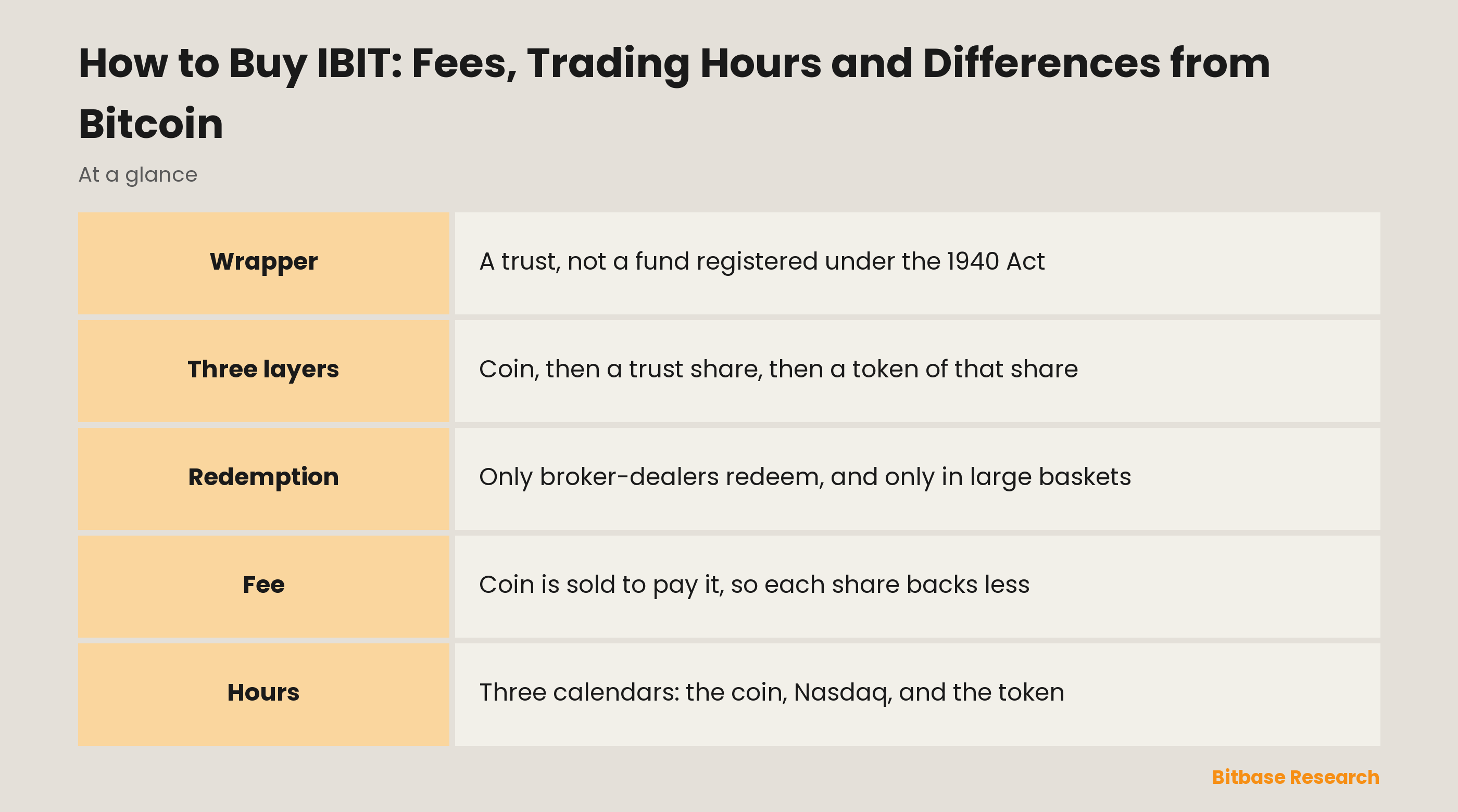
"The Shares are listed and traded on NASDAQ under the ticker symbol 'IBIT,'" which places them inside the US equity system and its holiday calendar, but not inside the regime most people assume covers anything called a fund. The trust "is not an investment company registered under the Investment Company Act of 1940," and it "is not a commodity pool for purposes of the Commodity Exchange Act." The prospectus draws the consequence itself: shareholders "do not have the protections associated with ownership of shares in an investment company registered under the Investment Company Act or the protections afforded by the CEA."
Why People Buy IBIT Instead of Bitcoin
The honest answer is reachability. A brokerage account that will never support a wallet can hold a listed security, and many accounts — retirement plans, managed portfolios, treasury mandates — are defined by what they may hold rather than by what their owner wants. IBIT turns a custody question into a ticker question, and for those accounts that conversion is the entire product.
The price of it is paid in things that never appear on a quote screen. A self-custodied holder controls keys and can move the asset at any hour. A shareholder controls a brokerage position and can sell it when Nasdaq is open. That is not a smaller version of the same right; it is a different right with a different counterparty behind it.
One clause makes the gap concrete. When the bitcoin network splits or distributes something to holders, the trust does not pass it on: shareholders "will not receive the benefits of any Incidental Rights and any IR Digital Asset, including any forked or airdropped assets." A self-custodied holder is present at that event; a shareholder is not, and no fee table shows it.
Bitcoin, an IBIT Share, and a Token of That Share
Three objects can be labelled IBIT, and they stack rather than compete.
Bitcoin itself is the base. It trades continuously, settles on its own network, and belongs to whoever controls the key.
An IBIT share is one step up. The trust "issues and redeems Shares only in Baskets of forty thousand or integral multiples thereof," and only registered broker-dealers who have signed the relevant agreement may transact in them. For everybody else the prospectus is blunt: "Except when aggregated in Baskets, Shares are not redeemable securities." A retail holder never redeems; they sell to another buyer on the exchange, which is why a share's price is set by equity supply and demand and tethered to the coins only by the creation and redemption machinery above it.
A tokenized IBIT is one step up again, and this is where the layering catches people out. Dinari's documentation defines a dShare as a token with one security behind it, one for one, created or destroyed only when Alpaca settles the order that matches it. The security behind this token is the IBIT share. So the token represents a share, the share represents an interest in a trust, and the trust holds the coins. The Bitbase price page says as much in the instrument title, naming the fund and then the words Dinari Tokenized ETF — that issuer label is how a reader establishes which layer a page is about.
Each step outward adds a party who has to perform. Holding IBIT is not holding bitcoin, and holding a tokenized IBIT is not holding an IBIT share.
What Moves IBIT
The obvious driver is the coin, measured through a benchmark rather than through any one venue: the New York variant of the CME CF Bitcoin Reference Rate, produced by CF Benchmarks Ltd. A reader chasing a discrepancy between the share and a price seen elsewhere should check which reference is quoted before concluding anything is broken.
Another driver has no market behind it at all. Because the fee is settled out of the assets, "the amount of bitcoin represented by each Share will decrease over the life of the Trust due to the sales of bitcoin necessary to pay the Sponsor's Fee and other Trust expenses." This is the honest version of an expense ratio: not a bill that arrives, but a slow reduction in how much coin stands behind each share. It runs whether the price rises or falls.
The clock is the least intuitive mover. "NASDAQ is open for trading in the Shares for a limited period each day, but the digital asset market is a 24-hour marketplace." Whatever happens to the coin overnight or at the weekend reaches the share only when the exchange reopens, so "the Shares may trade at a price that is at, above or below the Trust's NAV as a result of the non-current trading hours between NASDAQ and the digital asset market." Valuation timing widens the same seam: the net asset value is struck once each business day and released after the close, typically by 5:30 p.m. ET, while the indicative value published during the session "should not be viewed as an actual real time update of the NAV."
Risks and Limits
Three calendars, not one. The coin never closes. The Nasdaq session for the shares runs from 9:30 a.m. to 4:00 p.m. ET on trading days. The tokenized layer keeps its own hours again: Dinari runs an overnight window alongside pre-market, regular and after-hours sessions, with continuous access reserved for a limited set of tickers, and market orders sent outside regular hours become limit orders that may fill fully, partly or not at all. A position can be unreachable on one layer while moving on another.
Counterparty risk compounds with each wrapper. The share depends on the sponsor, the trustee and the custodians performing. The token depends on all of that plus the issuer's own structure, eligibility rules and terms, which the issuer sets and can change. Being on a blockchain adds a party rather than removing one.
A shareholder's claim is to value, not to coins. On a wind-up the trust sells and distributes cash: "Shareholders are not entitled to any of the Trust's underlying bitcoin holdings upon the dissolution of the Trust." Anyone buying the wrapper in order to end up with the asset should read that line first.
How to Verify IBIT Information
For the fund, the iShares product page carries the figures that move, each on a labelled row: Sponsor Fee, NAV, Premium/Discount, Shares Outstanding and the thirty-day median bid-ask spread among them. Read the fee there rather than from any article, including this one: the prospectus lets the Sponsor waive all or part of it for stated periods at its own discretion, so the live number and the headline number can differ.
For the structure, the prospectus is the authority on the parties, the redemption mechanics and the valuation timetable; every sentence quoted above is in it. A claim about IBIT that cannot be found there is a claim about something else.
For the wrapper, Dinari's own documentation sets out what a dShare is and how its sessions work. For the listing, the Bitbase price page shows the issuer label in the instrument title, and the tokenized stock and ETF directory is where to see how a different ticker is carried, which is not something this one settles. Whether a wrapper is cheaper than running your own custody is a separate question with its own documents.
Conclusion
Buying IBIT means choosing a layer before choosing a price. The coin gives control and demands key management. The share gives a listed security inside a brokerage account, minus the forks, minus the redemption right, minus the protections of a registered fund, and minus a little more coin each year. The tokenized version gives a claim on that share, with a further issuer underneath.
Read the fee on the fund page, read the redemption language in the prospectus, and know which of the three clocks governs the position being held.
Related reading
Other Bitbase articles on this topic:
- How to Buy CME Group (CME) Stock: Trading Methods, Costs and Risks
- How to Buy CrowdStrike (CRWD) Stock: Trading Methods, Costs and Risks
- How to Buy Dell Technologies (DELL) Stock: Trading Methods, Costs and Risks
- How to Trade MU: Micron Memory, Spot and Perpetual Futures
- What Is Talus?
Disclaimer: This article is educational content from Bitbase Academy, provided for information only. It explains what a company or fund does and how the instruments referenced here differ from one another; it does not constitute investment, trading, tax, or financial advice, and it is neither a recommendation nor an endorsement of any security, token, or trading strategy. A tokenized stock is issued by a third party and is designed to give economic exposure to an underlying asset: it is not a share, it carries no shareholder rights, and it depends on the issuer's structure, eligibility rules, and redemption terms, which the issuer can change. Perpetual futures are leveraged derivatives that hold no underlying asset and can be liquidated, and trading hours, product availability, and eligibility differ by instrument and by jurisdiction and can change at any time. Written as of September 2026; verify everything yourself through company filings, the issuer's own documentation, and the product pages of the venue you trade on.
References
[1] iShares Bitcoin Trust ETF prospectus: parties, listing, Baskets, Sponsor's Fee and valuation timing www.ishares.com
[2] iShares IBIT product page: the labelled rows where the fee and other live figures are published www.ishares.com
[3] Dinari documentation: what a dShare is, its one-for-one backing and its trading sessions docs.dinari.com