The ticker says exchange; the first sentence of the company's own annual report says technology and data. Intercontinental Exchange, Inc. reports three segments, and one of them is paid when mortgages close and again when they go into foreclosure, without anybody trading anything. This profile reads the filing rather than the name: what the company says it sells, which revenue lines it calls recurring and which it calls transaction-based, and what buying the NYSE-listed share does and does not get you.
What Is Intercontinental Exchange (ICE)?
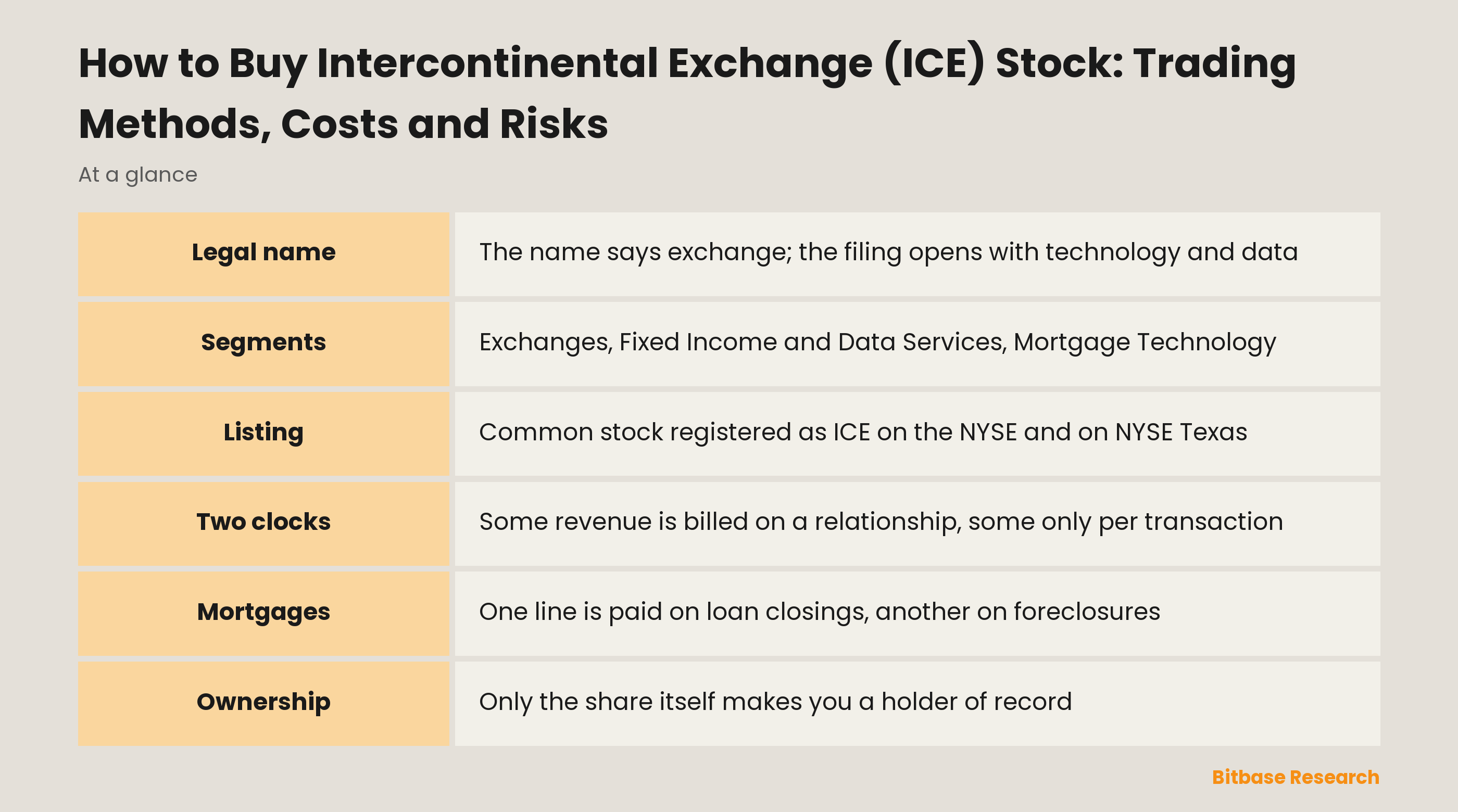
Read the first line of the annual report and the legal name starts to look like a historical artefact: "Intercontinental Exchange, Inc. is a leading global provider of technology and data to a broad range of customers including financial institutions, corporations and government entities." The word exchange sits in the legal name and not in the self-description, and that is the shape of the business rather than a drafting quirk.
Three reportable segments carry that business, and the filing names them as Exchanges, Fixed Income and Data Services, and Mortgage Technology. The first is the one the name promises: "We operate regulated marketplaces for the listing, trading and clearing of a broad array of derivatives contracts and financial securities." The second is described as a segment that "includes our fixed income execution, or ICE Bonds, CDS clearing, our fixed income data and analytics offerings, and other multi-asset class data and network services." The third has nothing to do with either. Its products, in the company's words, "connect the key stakeholders across the mortgage origination workflow and provide our customers with data services and technology that deliver greater transparency and enable significant customer efficiency gains."
Read the three descriptions next to each other and the intuition that buying this share is buying a trading venue does not survive: a marketplace operator, a fixed income data and execution business, and a software business selling into mortgage lending share one balance sheet and one ticker.
The corporate details are on the cover page and are worth reading rather than assuming. This is a Delaware corporation reporting on a fiscal year that ends each 31 December. Its Section 12(b) table registers the common stock under the trading symbol ICE and names two venues on which that registration stands: the New York Stock Exchange and NYSE Texas.
Why People Trade ICE
Owning an operator is a different exposure from owning what moves across it. The assets quoted, cleared, priced and financed through these businesses belong to other people. What the company holds is the plumbing, and the plumbing is paid in a mixture the filing states outright: "Revenues reflect a mix of both diversified transaction revenues and recurring data and listings revenues."
That sentence is why people hold the name through periods they would not hold a pure venue through. A business paid only per trade needs people to keep trading; one that also bills subscriptions, listings and data keeps invoicing whether or not anybody places an order. The mix does not make the share safe. It makes the share answer to more than one question, which is a different property and has to be analysed as one.
The same habit applies to listed operators that grew up in crypto rather than in commodities: open the filing and see how the top line is split before trusting the word printed on the ticker. That method is worked through on those names in our guide to crypto exchange and broker stocks, and the answers it produces there are not the answers here.
Routes into ICE, and What Each One Makes You
The direct route is a brokerage account that can reach the New York Stock Exchange, and it is the only one where the object left in your hands is the registered security named on that cover page. Settlement runs through the equity system, the trading calendar is the exchange's, and whatever rights attach to the common stock attach to you as a holder of record.
Exposure to a listed company can also turn up in other shapes, and each shape rewrites the terms. A tokenized stock comes from a third-party issuer: it is not a share, it confers none of a shareholder's rights, and it lives on that issuer's own structure, access rules and redemption terms, any of which the issuer can rewrite. A perpetual future is further away again: it holds no underlying asset at all, tracks a price, is margined, charges or pays funding, and can be liquidated while the position is still, in the holder's view, right.
Which of those shapes exists for any particular company is a question for the venue and for the issuer, never for the company's own filings. A 10-K describes the registrant. It says nothing about what other firms may have built on top of the registrant's shares, and it is not evidence either way. Bitbase keeps its own lineup of traditional-market instruments on its TradFi markets page, and the issuer's documentation is the authority on how any wrapped product is constructed.
Changing the container never changes the company inside it. What changes is the list of rights travelling with the position, the hours in which it can be moved, and the number of parties who must stay solvent for it to be worth what the screen says.
What Moves ICE
The top line runs on two clocks, and the filing labels them. Revenue from data and connectivity services is "largely recurring in nature," and so is revenue from listing fees. Those lines are billed on a relationship rather than an event. The transaction lines sit beside them and behave in the opposite way, arriving only when something happens. A reader watching one clock and ignoring the other gets surprised in both directions.
One segment is paid at both ends of the mortgage cycle. The filing is unusually direct here. "Revenue from the ICE Mortgage Technology network is largely transaction-based." Revenues from closing solutions "are largely transaction-based and are based on the volume of loan closings." And then the line that reframes the whole company: revenues from default servicing solutions "are largely transaction-based and are based on the number of foreclosures." Whatever changes how many loans get closed shows up in one of those lines. Whatever changes how many loans fail shows up in another. The two do not move together, and neither is a function of trading volume anywhere.
Contracted software arrives on a billing schedule. Part of the mortgage business is sold as software, where revenues "are based on recurring Software as a Service, or SaaS, subscription fees, with an additive transaction-based or success-based pricing fee," and revenues from servicing software products are "largely recurring in nature." Recurring here is a statement about how invoices are raised, not a promise about how long they will keep being raised.
The marketplaces answer to activity and to a rulebook written elsewhere. A fee charged per contract is earned when contracts change hands, whichever way prices went that week. The other input is embedded in the company's own wording: these are "regulated marketplaces," and the terms on which a regulated marketplace operates are set outside the company, by bodies that publish on their own timetable rather than on an earnings calendar.
Put together, this is a share priced off several clocks at once: transactions, subscriptions, listings, loan closings, foreclosures, and the rulebooks over all of it. Held as a proxy for market volatility, it is a fraction of what it is.
Risks and Limits
One ticker sits over businesses that do not share a cycle. A thesis about derivatives volumes covers part of the company; a thesis about mortgage origination covers a different part. Both can be right and still fail to explain the share, because the other segments were doing something else at the time.
Recurring is a billing word, not a guarantee. The filing uses it to describe how revenue is raised, and the description is accurate; it is not a statement that the underlying relationships continue. Subscriptions lapse, listings migrate, and contracts reach their end dates.
Regulation is a dependency the company names itself. Marketplaces described as regulated operate on permissions that can be reviewed and rules that can be rewritten, and neither process consults the shareholder. No amount of reading the revenue tables prices this risk in advance.
Wrappers add a party, and the added party is the new risk. If exposure is taken through anything other than the share, someone besides the company has to remain solvent and keep honouring their own terms. That dependency is separate from, and additional to, everything above.
What is deliberately missing here is also a limit. No market capitalisation, share price, earnings multiple, quarterly revenue or segment share appears above, because each of them changes and a sentence written once would misinform later. Those figures belong in the filings, where they carry a date.
How to Verify ICE Information
Go to the company rather than to commentary about it. The filings for Intercontinental Exchange, Inc. sit on SEC EDGAR under CIK 1571949, and the annual report on Form 10-K is where every line quoted above appears. Start at the cover page: the Section 12(b) table settles which security, which symbol and which exchange before any other question is worth asking. Item 1 then carries the segment descriptions and the recurring-versus-transaction language.
The company's investor relations site publishes the same filings alongside results dates and stock information. For anything about a wrapped or derivative product, authority rests with the issuer's documentation and with the product pages of whichever venue lists it; a company filing substitutes for neither.
One habit prevents most confusion here. A ticker is a label assigned by a venue, not a global identifier for a business, and the same short string can be attached to unrelated things in unrelated markets. Confirm the legal name and the exchange on whatever page you are reading before treating it as a page about this company; the same discipline that separates crypto tickers from stock symbols applies exactly here.
Conclusion
Buying ICE is buying a set of revenue clocks that happen to be owned together. Some tick when contracts trade, some tick when invoices go out, one ticks when loans close, and one ticks when loans default. The exchange in the name describes a segment, not the company, and the company says so in its own opening sentence.
So the useful preparation is not a view on trading volumes. It is a pass through Item 1 to see which segment does what, then a decision about which shape of exposure to hold, knowing only one of them makes you a shareholder.
Related reading
Other Bitbase articles on this topic:
- How to Buy CME Group (CME) Stock: Trading Methods, Costs and Risks
- How to Buy CrowdStrike (CRWD) Stock: Trading Methods, Costs and Risks
- How to Buy Dell Technologies (DELL) Stock: Trading Methods, Costs and Risks
- How to Buy and Trade NFLX: Netflix Without a Subscriber Count
- Base Meme Tokens Explained: Toshi and Brett
Disclaimer: This article is educational content from Bitbase Academy, provided for information only. It explains what a company or fund does and how the instruments referenced here differ from one another; it does not constitute investment, trading, tax, or financial advice, and it is neither a recommendation nor an endorsement of any security, token, or trading strategy. A tokenized stock is issued by a third party and is designed to give economic exposure to an underlying asset: it is not a share, it carries no shareholder rights, and it depends on the issuer's structure, eligibility rules, and redemption terms, which the issuer can change. Perpetual futures are leveraged derivatives that hold no underlying asset and can be liquidated, and trading hours, product availability, and eligibility differ by instrument and by jurisdiction and can change at any time. Written as of September 2026; verify everything yourself through company filings, the issuer's own documentation, and the product pages of the venue you trade on.
References
[1] Intercontinental Exchange FY2025 Form 10-K: registration, segments and revenue language (SEC EDGAR) www.sec.gov
[2] Intercontinental Exchange investor relations: filings, results calendar and stock information ir.theice.com