The revenue behind a pharmaceutical share carries an expiry date, and the company writes down what that date does. Eli Lilly and Company reports that a branded non-biologic medicine losing market exclusivity normally meets intense price competition from generic forms, and can shed a significant portion of its revenue in a very short period. Keep that in view while choosing among a registered share in an Indiana corporation, an Ondo token tracking it and a perpetual tracking only its price: not one of the three moves the date.
What Eli Lilly Sells, and for How Long
The company's description of itself is unusually short. It "was incorporated in 1901 in Indiana to succeed to the drug manufacturing business founded in Indianapolis, Indiana, in 1876 by Colonel Eli Lilly," and it discovers, develops, manufactures and markets products "in a single business segment—human pharmaceutical products." No second segment exists to steady a difficult year in the first.
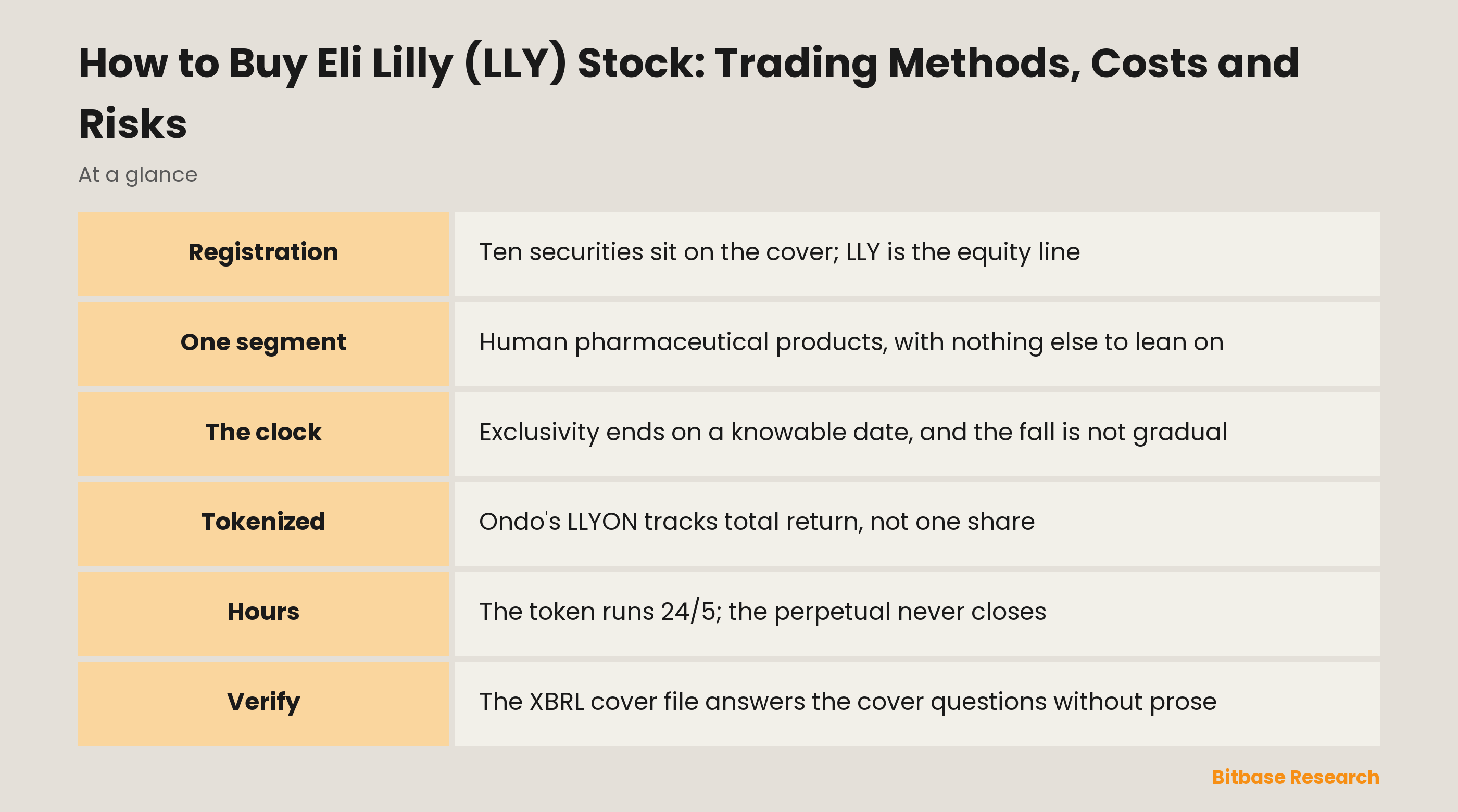
Two facts on the cover of that filing deserve attention before the ticker does. The state of incorporation is Indiana — a tagged field, not an inference from where the head office sits. And the common stock is one of ten securities registered under Section 12(b), all on the New York Stock Exchange; the other nine are note series with symbols of their own. LLY is the equity line on a cover page listing ten. The fiscal year closes on 31 December.
Selling is worldwide and deliberately local: the company adapts "our marketing methods and product emphasis in various countries to meet local customer needs and comply with local regulations." A medicine is not one product distributed widely, but one whose label, price and route to the patient are settled again in every country that approves it.
Why People Trade LLY
Exposure to a pharmaceutical company is not exposure to a product cycle. A regulator decides whether there is anything to sell; a patent decides how long it sells without a copy beside it. Approval is a precondition rather than a marketing problem, granted product by product and market by market; on the other half the company is direct: "Intellectual property protection is critical to our ability to successfully commercialize our life sciences innovations and invest in the search for new medicines and uses."
Concentration sharpens both halves. Among the risks the filing attaches to its forward-looking statements is a "dependence on relatively few products or product classes for a significant percentage of our total revenue and a consolidated supply chain." The clock is not spread thinly across a catalogue.
What links this ticker to a crypto venue is the wrapper, not the business — no line in this income statement answers to a token price. On the perpetual the funding leg is nonetheless priced by crypto-market positioning.
Where Each Route Stops Short of the Company
Bitbase quotes this ticker as Eli Lilly (Ondo Tokenized Stock), symbol LLYON. Read the issuer out of that title first: what the instrument is depends on who wrote it, not on the company whose name opens the line.
Ondo sets out three things about its stock tokens. They are total return trackers rather than one-for-one claims, built to reproduce the economics of holding the share with dividends reinvested net of withholding tax, so a token's price "will not always match the price of the underlying asset." They carry none of the shareholder relationship: no vote, no statutory information rights. And their calendar is 24/5 rather than continuous, with a smaller set of assets reachable outside those hours and pauses available around corporate actions and risk limits. Access is aimed at investors outside the United States and bounded by jurisdiction.
The perpetual is a different construction again, with nothing underneath it — not a share, not a token, not an obligation from the company. It follows a price, settles in stablecoin, moves a periodic funding payment between longs and shorts, and closes a losing position against a mark price rather than the last trade.
So the three routes stop at three distances: price, economics with an issuer's structure in between, and ownership with the rights attached. Choosing a wrapper chooses what is held and whom the holder relies on to keep holding it — never what the holding is exposed to. An exclusivity expiry, a regulatory decision or a ruling in a patent case arrives at all three on the same morning.
What Bitbase Lists Under LLY
Two surfaces exist for this ticker, and only one of them opens a position.
Reading happens on the price page, which carries the quote and chart for the tokenized stock and names the issuer in the instrument title — the first thing worth confirming.
Direction is taken on the perpetual contract. Margin is posted in stablecoin, liquidation runs off an index rather than the last print, and funding is charged or received for as long as the position stays open. How often it settles, where the margin tiers sit and how far leverage extends are the venue's parameters, published on its contract rules page — read them there rather than importing figures from a crypto contract.
The real difference from a crypto perpetual is not leverage but the reference market. Crypto spot never shuts; an equity shuts every evening, every weekend and on every exchange holiday, so the price this contract follows stands still for most of the week. On a pharmaceutical name that matters more than usual: a trial readout, a regulatory decision or a court ruling does not wait for the opening bell, and the contract stays live across a gap the share cannot be traded through.
Which surfaces a ticker has at all varies, so check Bitbase's tokenized stock and ETF listing rather than assume.
What Moves LLY
Exclusivity behaves like a clock, not an event. The filing states that "when a branded non-biologic pharmaceutical loses its market exclusivity, it normally faces intense price competition from generic forms of the product, which can result in the loss of a significant portion of the branded product's revenue in a very short period of time." Elsewhere it puts the same mechanism in one line: loss of effective patent protection can lead to "a severe and rapid decline in revenues for the product." The share can therefore move on a date years ahead, because the date is knowable and the fall is not gradual.
A copy cannot arrive before a legal gate opens. Generic versions reach the market through an abbreviated application under the Hatch-Waxman framework, and the company notes that "absent a patent challenge, the FDA cannot approve an ANDA until after certain of the innovator's patents expire." That clause is why patent litigation is a pricing event in this industry: a challenge does not change the medicine, it changes the date.
Biologics come through another door. The filing treats the two pressures as one — "generic pharmaceuticals and biosimilars can pose major competitive challenges to our business" — but a biosimilar is cleared on an abbreviated data package built from analytical and clinical similarity, a different test running to a different schedule.
Whoever pays sets the price that is realised. The company observes that "in the U.S. private sector, consolidated and integrated healthcare organizations significantly affect the competitive marketplace for pharmaceuticals." An approved medicine that is not covered is not a revenue line.
Some competition never passed through an approval at all. The company reports that it continues "to see the production, marketing, and sale of counterfeit, misbranded, adulterated, and mass-compounded incretins in the U.S. and other markets" — a channel no patent schedule predicts, sitting in the filing alongside the ordinary picture that "our products compete globally with many other pharmaceutical products in highly competitive markets."
What moves this share, then, is a legal and regulatory calendar rather than a commercial one — court dockets, agency decisions and payer negotiations, none of them timed to suit a trading session.
Risks and Limits
The token adds a counterparty the share does not have. LLYON is a claim on Ondo's structure, not on Eli Lilly and Company. It depends on the issuer honouring its own redemption terms, and eligibility is the issuer's to redefine. Settling on a blockchain changes none of that.
Three calendars overlap only in part. A New York session, a 24/5 token and a contract that never closes leave openings through which news reaches one venue while another is dark, repricing a holder who placed no order.
Leverage converts a gap into an exit. Liquidation is measured against a mark price, and funding accrues whichever way the position is going. A move a share or token holder would have sat through can end a levered position instead.
The wrapper never changes the underlying risk. Time-limited exclusivity, approval as a precondition and reliance on relatively few product classes reach all three routes unmodified.
One boundary deserves stating plainly: nothing here evaluates any medicine, and none of it is medical or investment advice. Whether a treatment works is settled by regulators and evidence, not on a price chart.
How to Verify Eli Lilly Information
The filings sit on SEC EDGAR under CIK 0000059478, file number 001-06351, and every sentence quoted above appears in the annual report there.
For the cover facts there is a shortcut that skips prose entirely. In the same folder as the annual report, EDGAR publishes a rendering of the XBRL cover data in a file named R1.htm: registrant name, state of incorporation, fiscal year and every registered security with its own title, trading symbol and exchange, all as tagged fields. That is where the count of ten comes from. Pull the same file for two consecutive years and whatever changed on the cover shows up immediately.
For the exclusivity and competition wording, Item 1 holds the sections on intellectual property, on competition and on generics and biosimilars, in the company's phrasing rather than a paraphrase. The instrument itself is governed by Ondo's documentation — the authority on backing, rights, hours and eligibility.
The market is checked on the price page, where the issuer appears in the instrument title — the check that matters, because three letters on a quote page can belong to an unrelated crypto project. No filing carries the funding interval, margin tier or leverage cap; those are the venue's.
Conclusion
Buying LLY starts with a question about ownership rather than price. One route is a contract on a number, one an issuer's tracker with the issuer's terms underneath it, one a share in an Indiana corporation — a single line among the ten securities on its cover page.
Behind all three is a single-segment pharmaceutical business whose right to sell is granted by regulators and whose protection runs out on schedule. Read the filing on exclusivity, approval and concentration before reading a headline about a medicine: the headline moves the price, the schedule sets the dates.
Related reading
Other Bitbase articles on this topic:
- How to Buy CrowdStrike (CRWD) Stock: Trading Methods, Costs and Risks
- How to Buy Dell Technologies (DELL) Stock: Trading Methods, Costs and Risks
- How to Buy ETHA: Fees, Trading Hours and Differences from Ethereum
- How to Buy ORCL: Oracle Cloud, the Token and the Perpetual
- Solv Protocol Explained
Disclaimer: This article is educational content from Bitbase Academy, provided for information only. It explains what a company or fund does and how the instruments referenced here differ from one another; it does not constitute investment, trading, tax, or financial advice, and it is neither a recommendation nor an endorsement of any security, token, or trading strategy. A tokenized stock is issued by a third party and is designed to give economic exposure to an underlying asset: it is not a share, it carries no shareholder rights, and it depends on the issuer's structure, eligibility rules, and redemption terms, which the issuer can change. Perpetual futures are leveraged derivatives that hold no underlying asset and can be liquidated, and trading hours, product availability, and eligibility differ by instrument and by jurisdiction and can change at any time. Written as of September 2026; verify everything yourself through company filings, the issuer's own documentation, and the product pages of the venue you trade on.
References
[1] Eli Lilly FY2025 Form 10-K, Item 1: exclusivity, generics and biosimilars, competition (SEC EDGAR) www.sec.gov
[2] XBRL cover page of the same filing: registrant, state, fiscal year and every registered security www.sec.gov
[3] Ondo Stocks overview: backing, rights and trading hours (issuer documentation) docs.ondo.finance