Holding QEW and holding a market-cap Nasdaq-100 fund means owning the same hundred companies in two different proportions, and what separates them is a rule rather than an opinion. QEW tracks an index that Nasdaq resets to equal issuer weights four times a year, while the cap-weighted version lets whatever has grown largest keep the largest slice. This profile covers what that reset costs, which line of the fund's own filings carries the annual charge, and why "equal weighted" describes four dates rather than every trading day.
What Is the Invesco QQQ Equal Weight ETF (QEW)?
The objective runs to one sentence: the fund "seeks to track the investment results (before fees and expenses) of the Nasdaq-100 Equal Weighted Index." Invesco Capital Management LLC is the adviser, the shares are listed on The Nasdaq Stock Market LLC, and the fund "generally will invest at least 90% of its total assets in the securities that comprise the Underlying Index."
The index belongs to someone else. Nasdaq, Inc. "compiles, maintains and calculates the Underlying Index," strictly in accordance with its own guidelines and mandated procedures. Invesco runs a portfolio against rules it does not write, and when the weights change, they change because Nasdaq's calendar said so.
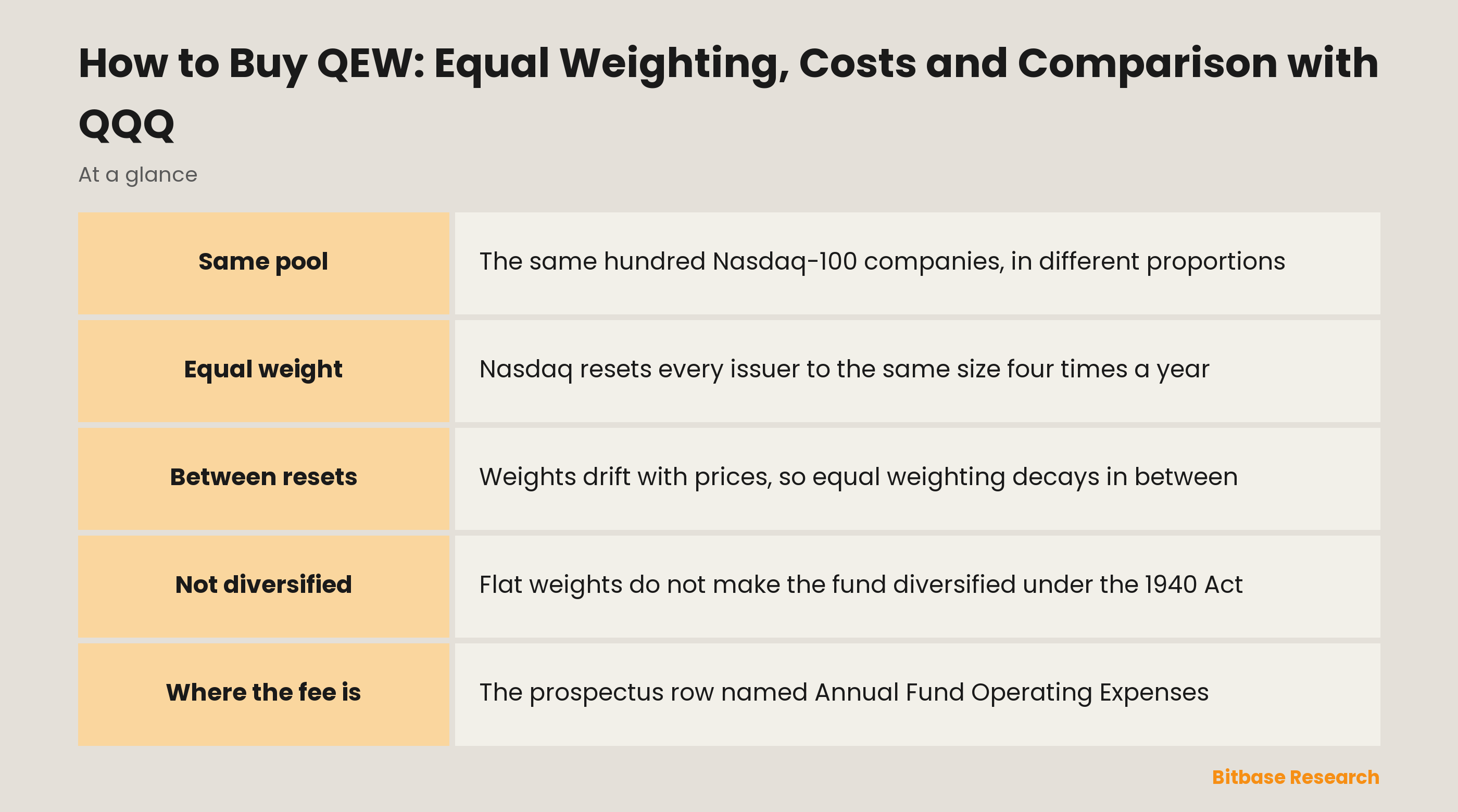
What those rules do is stated as a single contrast. The Underlying Index "contains the same securities as the Nasdaq-100, but each company in the Underlying Index is equal-weighted, rather than weighted based on each security's market capitalization." No screen, no quality filter, no tilt toward anything. Which companies get in is settled elsewhere, and the admission rules that decide Nasdaq-100 membership apply here unchanged. QEW inherits the roster and edits only the proportions.
One piece of labelling surprises people: the fund "is 'non-diversified' and therefore is not required to meet certain diversification requirements under the Investment Company Act of 1940." Holding a hundred issuers in equal slices sounds like the definition of diversifying, but the classification is a legal one under a specific statute and does not follow from how flat the weights look.
Why People Buy an Equal-Weighted Nasdaq-100
Because the constituent list is identical, the choice is never about which companies to own. It is entirely about how much of each, which makes it one of the cleaner comparisons in fund selection: one variable moves and everything else is held still.
Under cap weighting, a company's place is decided by its own success. Grow faster than the rest and the index holds more of you without anyone deciding to buy. Equal weighting removes that feedback loop on a schedule, trimming whatever has risen and topping up whatever has not. Whether that helps depends on what happens next; what is knowable in advance is that the two funds cannot behave identically, because arithmetic forbids it.
The reason people reach for it is usually concentration, and here the documents are more careful than the marketing case. Equal weighting flattens issuer size. It does not follow that sector exposure flattens with it, and the prospectus says so: the index "may be concentrated to a significant degree in securities of issuers operating in a single industry or industry group," and where it concentrates, "the Fund will also concentrate its investments to approximately the same extent." Weighting a list of large non-financial Nasdaq companies evenly changes how much of each you hold, not what kind of business the list is full of.
Three Ways to Reach the Same Hundred Companies
The fund itself is the obvious route, bought as a listed share through a broker with access to Nasdaq. That buys not the hundred companies but a share in a portfolio holding them, plus the adviser's obligation to keep tracking the index through every reset. The quarterly trading is done for you and paid out of fund assets.
The cap-weighted fund on the same pool is the second, and the comparison most buyers are actually making. Same names, different proportions, no scheduled reset. A fund that never rebalances toward a target has nothing to trade on a rebalance date, which is why the two carry different costs before either charges a fee.
Holding the hundred names directly and resetting them yourself is the third, and it shows what the fund is really selling: trades in every name that drifted, four times a year, the spread absorbed on each and the tax events generated personally. The fund does not make those costs vanish. It pools them.
One route does not exist for an individual. "Only authorized participants ('APs') may engage in creation or redemption transactions directly with the Fund," and those APs "have no obligation to submit creation or redemption orders." Everyone else buys from another holder on the exchange, which is why the price paid is not the fund's net asset value: shares "trade on a stock exchange at prices at, above or below the Fund's most recent NAV." That NAV "is calculated at the end of each business day," while the share price "fluctuates continuously throughout trading hours on the exchange." One valuation a day against a whole session of prices, and the gap between the two has a name and a measurement.
What Moves QEW
Start with the calendar, because here it is a mechanism rather than an administrative detail. Nasdaq's methodology sets a rebalance "conducted quarterly," using "the Last Sale Prices as of the close of trading on the last trading day in February, May, August, and November." Membership runs on a slower clock: "an index reconstitution is conducted annually." Four resets and one roster review.
Those reference dates are themselves a choice that can move, and recently did. The methodology's change log records that until the spring of 2026 the quarterly rebalance used the close "on the third Friday in March, June, September and December." Anyone comparing behaviour across that boundary is comparing two slightly different rules.
Between those dates the fund is not equal-weighted at all. The methodology is explicit that "other than as a direct result of corporate actions, the Index does not normally experience share adjustments between scheduled index reconstitution and rebalancing events." Weights are set on a reset date, then drift with prices until the next one. Equal weighting holds four times a year and decays continuously in between, so the exposure at any moment depends on how long ago the last reset was and how far the constituents have moved since.
Dispersion inside the list therefore matters more than its direction. When gains concentrate in the largest handful of names, a portfolio holding them at the same size as everything else cannot keep pace; when gains spread across the rest of the roster, the arithmetic runs the other way. The same news reaches both funds, and the weighting decides the amplitude.
Membership changes arrive from the parent index mechanically: a security removed from the Nasdaq-100 "is also removed" here, additions are mirrored "at the same time," and a replacement "will assume the weight of the removed company as of prior month-end."
Risks and Limits
The rebalance is a cost as well as a feature, and the fund names it. Returns may diverge from the index because the fund "incurs operating expenses not applicable to the Underlying Index, and incurs costs in buying and selling securities, especially when rebalancing." The qualifier is the point: rebalancing is singled out as the moment trading costs bite. A strategy defined by resetting weights has to trade to exist.
Those trades reappear as turnover. The fund "pays transaction costs, such as commissions, when it purchases and sells securities," paid from fund assets rather than billed, so they never show on a statement.
Sector concentration survives the weighting scheme, as above, and the non-diversified classification sits beside it. Neither is a defect; both are conditions a buyer accepts on entry.
Market structure adds its own limits. The prospectus warns of "the potential lack of an active market for the Shares" and of stressed conditions in which that market "may become less liquid," causing "a variance in the market price of Shares and their underlying NAV." A fund whose documents are dated 2026 also has a short public record behind it, which is not evidence in either direction.
How to Verify QEW Information
Fund questions are answered in fund documents, a different path from the one a company filing requires. The summary prospectus sits on SEC EDGAR under Invesco Exchange-Traded Fund Trust II, CIK 1378872, and it is the source for every quoted line above.
For the annual charge, go to the section headed "Fees and Expenses of the Fund" and find the row "Annual Fund Operating Expenses." That row is the expense ratio, in the one place it is stated under liability. Comparing it with another fund means opening the same table in that fund's prospectus, and checking the date on the document before trusting either figure.
For the rules, read Nasdaq's index methodology rather than a description of it, and go to the change log appendix at the back. That appendix is where a rule that moved is recorded, and the fastest way to learn whether the behaviour you remember still applies.
For the session and the holiday schedule, Nasdaq publishes its own trading calendar. The fund trades when its listing exchange is open, and no fund document overrides that calendar.
For what a given venue actually lists, its own tokenized stock and ETF directory is the register. A ticker's presence on Nasdaq says nothing about where else it can be reached.
Conclusion
QEW and a cap-weighted Nasdaq-100 fund answer a question about proportion, not about selection. The equal-weighted version buys the same hundred companies and refuses to let any of them grow into a dominant position, at the price of trading four times a year to enforce that refusal, and without touching the sector concentration the underlying list carries by construction.
That refusal is the product. Judge it by reading the rule that produces it and the table that prices it, both published, dated, and short enough to read in full.
Related reading
Other Bitbase articles on this topic:
- How to Buy CrowdStrike (CRWD) Stock: Trading Methods, Costs and Risks
- How to Buy Dell Technologies (DELL) Stock: Trading Methods, Costs and Risks
- How to Buy ETHA: Fees, Trading Hours and Differences from Ethereum
- How to Trade PLTR: Palantir Without Owning the Share
- What Is Arbitrum (ARB)? The Six Things That Share the Name
Disclaimer: This article is educational content from Bitbase Academy, provided for information only. It explains what a company or fund does and how the instruments referenced here differ from one another; it does not constitute investment, trading, tax, or financial advice, and it is neither a recommendation nor an endorsement of any security, token, or trading strategy. A tokenized stock is issued by a third party and is designed to give economic exposure to an underlying asset: it is not a share, it carries no shareholder rights, and it depends on the issuer's structure, eligibility rules, and redemption terms, which the issuer can change. Perpetual futures are leveraged derivatives that hold no underlying asset and can be liquidated, and trading hours, product availability, and eligibility differ by instrument and by jurisdiction and can change at any time. Written as of September 2026; verify everything yourself through company filings, the issuer's own documentation, and the product pages of the venue you trade on.
References
[1] Invesco QQQ Equal Weight ETF summary prospectus: objective, index, fee table and risks (SEC EDGAR) www.sec.gov
[2] Nasdaq-100 Equal Weighted Index methodology: weighting, rebalance calendar and change log indexes.nasdaqomx.com
[3] Invesco's product page for the fund: current documents and disclosures www.invesco.com
[4] Nasdaq trading calendar: session schedule and market holidays www.nasdaqtrader.com