Invesco's name sits on two funds whose stated objective is the same index, which is why choosing between QQQ and QQQM is not a choice about what you are exposed to. QQQM is the Invesco NASDAQ 100 ETF, offered under its own prospectus and bought the way any Nasdaq-listed share is bought, through a broker; Bitbase carries no market for this ticker. This profile reads that prospectus and shows which section settles the comparison.
What Is the Invesco NASDAQ 100 ETF (QQQM)?
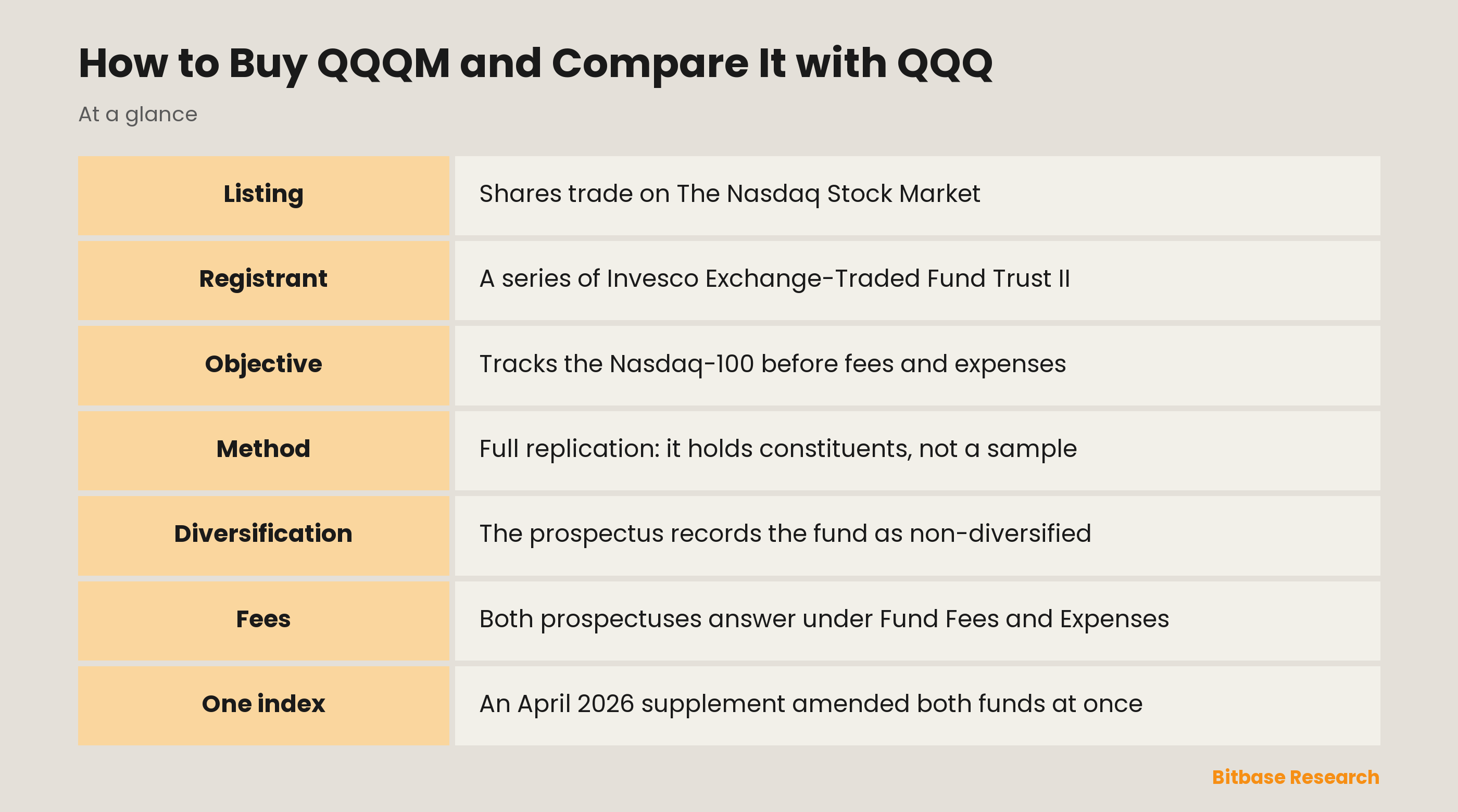
QQQM is the ticker for the Invesco NASDAQ 100 ETF, whose shares are listed on The Nasdaq Stock Market LLC. The fund is not its own registrant: it is one series inside Invesco Exchange-Traded Fund Trust II, and its documents reach the public through filings made under that trust. Searching by ticker will not find the paperwork; searching for the trust will.
The objective is one sentence, and a qualifier inside it does most of the work. The fund "seeks to track the investment results (before fees and expenses) of the Nasdaq-100 Index." Before fees and expenses describes the target, not the outcome — whatever the fund charges is subtracted from what a holder receives, so the gap between index and investor is, by construction, the fee.
How it pursues that target is stated just as plainly. The fund "generally will invest at least 90% of its total assets in the securities that comprise the Underlying Index," using what the prospectus calls a full replication methodology, holding the constituents rather than sampling them. Nobody is forming a view inside this fund. A rulebook is being copied, and the copying is the product.
One further line changes how the rest reads: the prospectus records the fund as non-diversified, and therefore "not required to meet certain diversification requirements under the Investment Company Act of 1940." A fund built to mirror a concentrated index needs permission to be concentrated, and that is where the permission is written down.
Why People Trade QQQM
A Nasdaq-100 fund turns a long list of decisions into one line item. Membership and weighting come from a published methodology rather than from anybody's conviction, so what a holder buys is that methodology's output — the appeal for anyone who wants the listed technology complex without defending a view on any single name.
It also explains why the QQQ comparison comes up so relentlessly. When two funds state the same index as their objective, neither can win on insight, and the argument collapses onto cost, mechanics and each fund's own administrative history. The useful question is not which fund invests better; it is which wrapper gives away less on the way through.
Crypto holders usually meet QQQM as the listed leg of a book whose other leg is on-chain. Both answer to the price of money without sharing a cash flow, and no prospectus undertakes to keep a correlation in place.
Same Index, Two Prospectuses
That the two funds track the same index is visible in one document. A supplement dated 30 April 2026 amends both prospectuses at once — QQQ's dated 22 December 2025 and QQQM's dated 19 December 2025 — because "Nasdaq, Inc., the index provider of the Nasdaq-100 Index, the Funds' underlying index (the 'Underlying Index'), has announced certain changes to the Underlying Index methodology, which take effect on May 1, 2026." One provider, one announcement, two funds amended together.
What differs is the wrapper. QQQ is registered separately under its own name, Invesco QQQ Trust, Series 1, and its prospectus carries a piece of history: "Effective after market close on December 19, 2025, the Fund was reclassified as an open-end management investment company." Before that, the same document records, it "operated as a unit investment trust." QQQM's prospectus describes a series of a registered trust. What a ticker resolves to on a crypto venue is a third question again — for QQQ, covered in the profile of that ticker.
Where the comparison is settled is easier to point at than to argue about. Both summary prospectuses carry a section headed Fund Fees and Expenses, in the same position, immediately after the investment objective. It is deliberately not reproduced here: a fee table gets refiled, and a figure printed in an article ages faster than the article does. Open both documents at that heading and the comparison takes a minute, on current numbers.
Buying either one is the same act. The prospectus is explicit that "individual Shares may only be bought and sold in the secondary market (i.e., on a national securities exchange) through a broker or dealer at a market price." Shares are created and redeemed at net asset value only with authorised participants, in blocks a retail buyer never touches. The price you pay is therefore set by an order book rather than by the fund's own valuation, and the gap that opens between a fund's value and its quoted price is a permanent feature of exchange-traded funds.
What Moves QQQM
Because the fund replicates rather than selects, the forces acting on it arrive through the index rules. The April 2026 supplement illustrates how. It restates the index as "100 of the largest domestic and international non-financial companies listed on U.S. Nasdaq-affiliated listing exchanges based on market capitalization," adds eligibility conditions built on a minimum three-month average daily traded value and a requirement that a security "must have traded for at least three full calendar months," and describes the weighting as modified market capitalization-weighted, which "takes into account the market value of the component securities subject to certain weight restrictions."
Several drivers fall out of that sentence. Non-financial is a rule, not a description, so an entire industry's news reaches this fund only indirectly. Listing venue is a rule too, so a company can enter or leave the eligible pool by changing where it lists, its business unchanged. And weight restrictions, not market value alone, decide how much of a given day belongs to the largest constituents.
The rest comes from the fund's own machinery: a policy expressed as at least 90% of total assets leaves room the fund is permitted to use, fees accrue continuously, and the quote can drift from the value of the holdings when the underlying market is thin. Methodology, meanwhile, changes by announcement, so a supplement can alter what the fund must hold on a date unconnected to any company's earnings.
Risks and Limits
Concentration is permitted by design. The prospectus records the fund as non-diversified precisely so it can mirror an index that is itself concentrated, and a holder inherits that shape rather than choosing it.
Documents expire quietly. A prospectus dated 19 December 2025 was already amended by a supplement on 30 April 2026, filed separately. Reading the prospectus alone, months later, produces a confident and out-of-date picture; checking for supplements is part of reading it, not an extra step. The same goes for the fee table, which gets refiled: a comparison made once was true once.
Availability is bounded by the exchange. Because individual shares may only be bought and sold in the secondary market through a broker or dealer, the hours in which a holder can act are the hours the listing exchange keeps, and nothing about the fund extends them. News arriving while the exchange is shut is priced when it reopens.
How to Verify QQQM Information
Start with the fund's own summary prospectus, filed with the Securities and Exchange Commission under Invesco Exchange-Traded Fund Trust II and available through EDGAR. Read it in printed order: the investment objective, then Fund Fees and Expenses, then the principal investment strategies, then the principal risks. Those four sections answer the fee, hours and risk questions in the fund's own words.
Then look for what came after. Supplements are filed separately from the prospectus they amend, and the one dated 30 April 2026 is the example to keep in mind: it changed the description of the index for both Nasdaq-100 funds without either prospectus being reissued. For the QQQ side, repeat the exercise under its own registrant and compare identically named sections rather than summaries of them. Invesco also publishes a product page for the fund, convenient for current figures, while the filings remain authoritative.
For trading this ticker on a crypto venue, check rather than assume: which tickers have a market here is a list that changes, and a ticker appearing in an article is not evidence that a market exists for it.
Conclusion
QQQM and QQQ state the same objective against the same index, and one supplement amends both when that index changes. The choice between them is therefore about wrappers, not exposure: two registrations, two prospectuses, two fee tables carrying the same heading in the same place.
What a holder owns, either way, is a replication policy and the fee charged for running it. Read the objective, read the fees, check for supplements, and remember that the price paid is a market price, not the fund's own valuation.
Related reading
Other Bitbase articles on this topic:
- How to Buy CrowdStrike (CRWD) Stock: Trading Methods, Costs and Risks
- How to Buy Dell Technologies (DELL) Stock: Trading Methods, Costs and Risks
- How to Buy ETHA: Fees, Trading Hours and Differences from Ethereum
- Russell 2000 Futures Trading: How RTY Tracks a Rebuilt Index
- RARI After the Rarible Sale: What the Foundation and the Token Still Govern
Disclaimer: This article is educational content from Bitbase Academy, provided for information only. It explains what a company or fund does and how the instruments referenced here differ from one another; it does not constitute investment, trading, tax, or financial advice, and it is neither a recommendation nor an endorsement of any security, token, or trading strategy. A tokenized stock is issued by a third party and is designed to give economic exposure to an underlying asset: it is not a share, it carries no shareholder rights, and it depends on the issuer's structure, eligibility rules, and redemption terms, which the issuer can change. Perpetual futures are leveraged derivatives that hold no underlying asset and can be liquidated, and trading hours, product availability, and eligibility differ by instrument and by jurisdiction and can change at any time. Written as of September 2026; verify everything yourself through company filings, the issuer's own documentation, and the product pages of the venue you trade on.
References
[1] Invesco NASDAQ 100 ETF (QQQM) summary prospectus: objective, 90% policy, non-diversified status (SEC EDGAR) www.sec.gov
[2] Invesco QQQ Trust, Series 1 (QQQ) summary prospectus: objective and the December 2025 reclassification (SEC EDGAR) www.sec.gov
[3] Joint supplement of 30 April 2026 amending both prospectuses for the Nasdaq-100 methodology change (SEC EDGAR) www.sec.gov