The same roster of companies can be sold as two different funds, and RSP is the one that throws the sizes away. Invesco's summary prospectus compresses the whole design into a single clause about what happens four times a year, and the rest follows from it: which companies the fund answers to, how often it trades, and what it can still be concentrated in.
What Is the Invesco S&P 500 Equal Weight ETF (RSP)?
RSP is an index fund listed on NYSE Arca, and its prospectus states the objective in one line: the fund "seeks to track the investment results (before fees and expenses) of the S&P 500 Equal Weight Index". Two indexes are named there, and keeping them apart is most of the work. The S&P 500 itself is the Parent Index, "designed to measure the performance of equity securities of larger U.S. companies"; the index RSP tracks is "an equal-weighted version of the Parent Index". Same roster, different arithmetic.
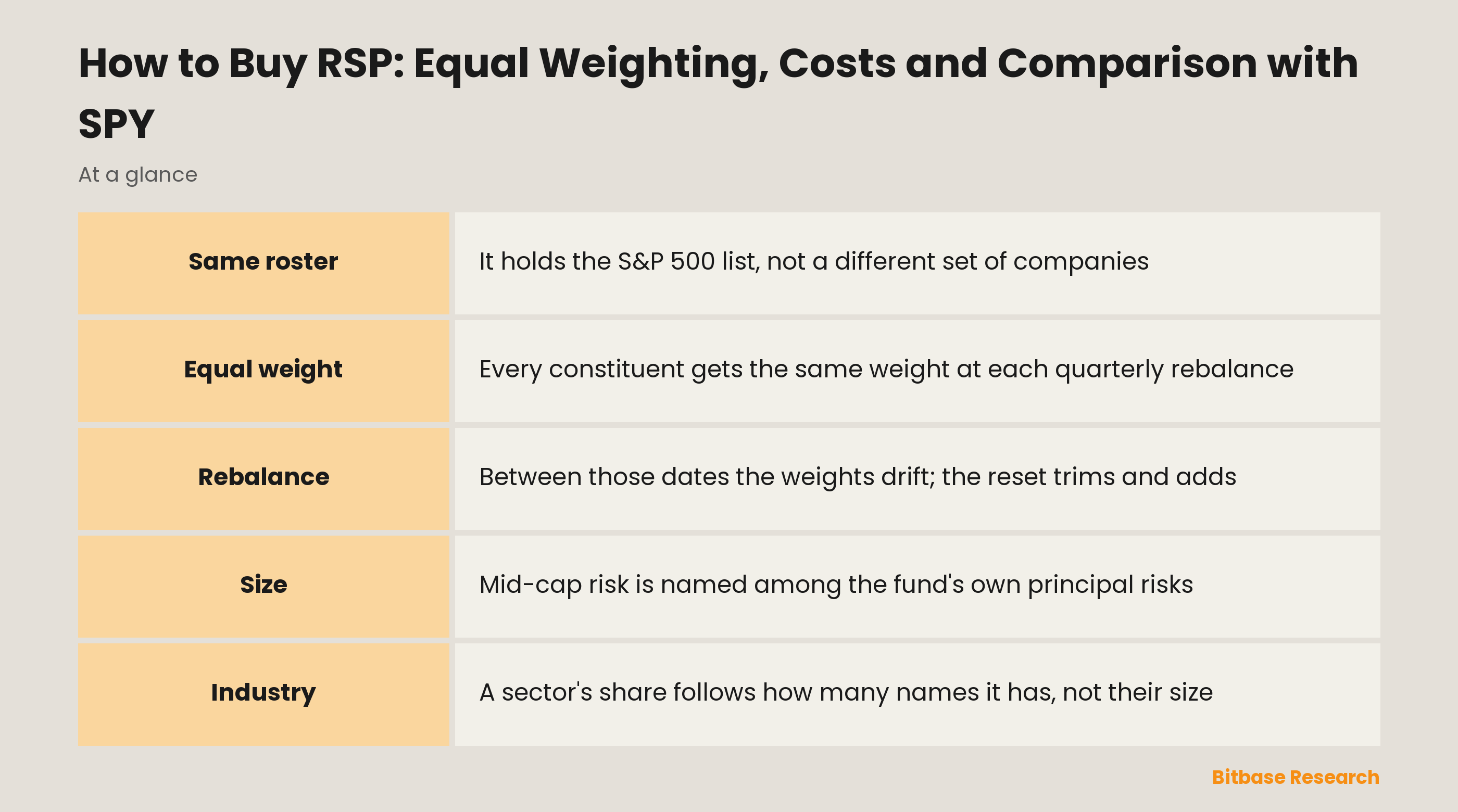
That arithmetic is defined rather than implied. Equal weighting means that, "unlike the Parent Index, which employs a float-adjusted market capitalization weighted methodology, the Underlying Index assigns each component security the same weight at each quarterly rebalance." Float-adjusted market capitalization weighting lets a company's size decide how much of it a holder owns. Equal weighting deletes that decision and re-imposes its own on a calendar rather than continuously.
The fund holds that index outright rather than approximating it, using a full replication methodology, "meaning that the Fund generally invests in all of the securities comprising the Underlying Index in proportion to their weightings in the Underlying Index." The rule itself belongs elsewhere: S&P Dow Jones Indices is the Index Provider that "compiles, maintains and calculates the Underlying Index". Invesco operates the fund; it does not write what the fund obeys.
Why People Trade RSP
A cap-weighted tracker answers one question: what did the largest listed companies do. Equal weighting asks a narrower one: what did a typical member of that same list do. When every constituent carries the same weight at the reset, an enormous company and a merely large one count for exactly as much. Applying that rule to a large basket on a schedule is also work, and someone who wants it applied without applying it is buying execution rather than an idea.
That turns the pair into a measuring instrument rather than only a holding. The SPY vs RSP comparison is unusually clean, because the companies underneath are the same on both sides, so a gap between them says something about breadth and nothing about stock picking — neither fund picked anything. One caveat: the trust behind SPY is a unit investment trust and RSP is an open-end fund, so two variables separate them and weighting is only the louder one.
The Routes In, and Which of Them Rebalances for You
Buying RSP through any broker that reaches NYSE Arca makes the buyer a shareholder of the fund, and the fund owns the companies. One wrapper sits between holder and businesses, and inside it the quarterly reset is somebody else's operational problem.
Assembling the same exposure by hand shows what that wrapper is worth. Every constituent has to be bought separately and then pushed back to an equal weight on the index's schedule, with the trades and the record-keeping that implies. The exposure is reproducible; the maintenance is the product.
Derivatives written on the S&P 500 look like a shortcut and land somewhere else. A contract on the parent index tracks the float-adjusted market capitalization weighted version, so it does not deliver equal weighting at all — the weighting scheme is precisely what it leaves behind.
A tokenized wrapper is a different shape again, issued by a third party rather than by the fund company, and backing, eligibility, dividend handling and sessions are then written by that issuer rather than by Invesco. Which tickers a venue carries that way is a published fact and not an inference: on Bitbase the tokenized stock and ETF listings keep it current. A perpetual futures contract sits further out still, holding no share of anything, costing funding to carry, and closable by liquidation.
What Moves RSP
The reset is scheduled, not provoked. Weights are equal at each quarterly rebalance and at no other moment; in between, prices move and equality decays. Restoring it means trimming whatever has risen relative to the rest since the last reset and buying whatever has lagged. Those trades come out of the calendar and the arithmetic, and they happen on quiet days as readily as on loud ones.
Breadth registers here, leadership does not. In a cap-weighted tracker a few very large constituents can carry the index while most of the roster goes sideways. Equal weighting forbids that: a move confined to the biggest names is diluted to the same weight as everything else, and a move spread across the list arrives at full strength.
Size reaches further down the roster than the parent index suggests. Among the fund's principal risks the prospectus lists Mid-Capitalization Companies Risk, warning that "investing in securities of mid-capitalization companies typically involves greater risk than is associated with investing in securities of larger, more established companies" — in the filing of a fund whose parent index measures "equity securities of larger U.S. companies". Equal weighting is why both sentences belong to one document: once size stops setting the weight, the smallest members of a large-cap roster carry as much of the fund as the largest.
Industry weight follows headcount. The prospectus warns that "in following its methodology, the Underlying Index from time to time may be concentrated to a significant degree in securities of issuers operating in a single industry or industry group", and the fund concentrates "only to the extent that the Underlying Index reflects a concentration in that industry or group of industries." Concentration in single companies is removed; concentration in industries is not, and the way it arises changes. An industry's share of the fund tracks how many names belong to it, not how large they are — so additions to and removals from the parent index move it, and a replicating fund executes those rather than assessing them.
Risks and Limits
The RSP investment risks worth reading first are written into the structure rather than into the market. Concentration, to begin with, has moved rather than vanished: equal weighting promises only that no single company dominates, and the industry disclosure above says the index can still tilt hard toward one group of issuers.
Index dependency is complete. The prospectus is blunt that "unlike many investment companies, the Fund does not utilize an investing strategy that seeks returns in excess of its Underlying Index." There is no discretion to skip a constituent and none to hold more of a better one.
Turnover is a cost the design implies. A portfolio that resets to equal weights on a schedule trades more than one that lets weights float, and the fund reports its portfolio turnover rate for the most recent fiscal year in the prospectus paragraph of that name. That rate is restated every year, which is the reason to read it rather than remember it.
Tracking is imperfect by construction. The fund's "return may not match the return of the Underlying Index for a number of reasons", beginning with operating expenses an index never pays. How far the result drifts is tracking error, a different measurement from the premium or discount at which a share changes hands on a given day.
The exchange price and the fund's own valuation are two numbers. Shares "trade on a stock exchange at prices at, above or below the Fund's most recent NAV", and the machinery that pulls them together is narrow, since only authorized participants "may engage in creation or redemption transactions directly with the Fund."
Wrappers carry risks of their own. A token depends on an issuer that is neither Invesco nor the exchange, on terms that issuer writes and can revise; a perpetual holds no fund share at all and can be closed out by liquidation. Neither changes what the companies do; both change what is held.
How to Verify RSP Information
Begin at the filing rather than at a data page. The summary prospectus is public on EDGAR, and it is the source for every quotation here: the objective, the equal-weighting clause, the replication language, the concentration policy and the risk headings.
The RSP expense ratio lives in that same document, in the section headed Fund Fees and Expenses, inside the Annual Fund Operating Expenses table, on the rows labelled Management Fees, Other Expenses and Total Annual Fund Operating Expenses. Comparing what two funds cost means opening both prospectuses and reading the same row in each, which is not the same exercise as comparing two figures copied off a comparison site: the filing carries a date, and the date decides whether the figure is still true. Invesco's product page for the ticker is dated too.
RSP trading hours belong to the listing venue rather than to the fund: the shares quote while NYSE Arca is open and stop when it closes, while net asset value is struck on the schedule the filings describe, so a session and a valuation are not the same event. Any wrapper referencing the ticker runs on its issuer's calendar instead.
For the rules the fund obeys, go to the index side. The prospectus names S&P Dow Jones Indices as the party that compiles, maintains and calculates the underlying index, so what belongs in the fund, and when the weights go back to equal, is settled at the index provider and not in Invesco's materials.
For SPY, do the same on the other side. Its prospectus states that "the Trust is a unit investment trust organized in the United States" and that "the Trust is not actively managed", already a different legal structure before any argument about weights begins.
Conclusion
Buying RSP is buying one rule applied to a familiar list: the same companies as the S&P 500, each carrying the same weight at every quarterly rebalance. Breadth shows up in the price where leadership would in a cap-weighted tracker, industry exposure follows how many names sit in a group rather than how big they are, and the portfolio trades on a calendar because the rule requires it.
The question to settle first is therefore not whether equal weighting is better, but whether the exposure being bought is the one that reads the whole roster — and whether it is being read out of the prospectus or out of somebody's summary of it.
Related reading
Other Bitbase articles on this topic:
- How to Buy ETHA: Fees, Trading Hours and Differences from Ethereum
- How to Buy IBIT: Fees, Trading Hours and Differences from Bitcoin
- How to Buy Intercontinental Exchange (ICE) Stock: Trading Methods, Costs and Risks
- How to Trade SHOP: Shopify, a Canadian Issuer on Nasdaq
- Yield Basis Explained
Disclaimer: This article is educational content from Bitbase Academy, provided for information only. It explains what a company or fund does and how the instruments referenced here differ from one another; it does not constitute investment, trading, tax, or financial advice, and it is neither a recommendation nor an endorsement of any security, token, or trading strategy. A tokenized stock is issued by a third party and is designed to give economic exposure to an underlying asset: it is not a share, it carries no shareholder rights, and it depends on the issuer's structure, eligibility rules, and redemption terms, which the issuer can change. Perpetual futures are leveraged derivatives that hold no underlying asset and can be liquidated, and trading hours, product availability, and eligibility differ by instrument and by jurisdiction and can change at any time. Written as of September 2026; verify everything yourself through company filings, the issuer's own documentation, and the product pages of the venue you trade on.
References
[1] Invesco S&P 500 Equal Weight ETF summary prospectus: objective, equal weighting, replication, concentration and risks (SEC EDGAR) www.sec.gov
[2] SPDR S&P 500 ETF Trust prospectus: unit investment trust structure and listing (SEC EDGAR) www.sec.gov
[3] Invesco product page for RSP: the dated figures the prospectus deliberately leaves out www.invesco.com