It discards every company that has not paid a dividend for ten straight years, then ranks whatever survives on four financial ratios. Those rules belong to the Dow Jones U.S. Dividend 100 Index, and SCHD is the Schwab exchange-traded fund built to track it. On Bitbase the same four letters lead elsewhere, to a Robinhood Classic Stock Token whose treatment of dividends, hours and rights is fixed by an issuer's terms and not by the fund's prospectus. Telling those two documents apart is the first job here; setting the index rules beside QQQ's is the second.
What Is the Schwab U.S. Dividend Equity ETF (SCHD)?
The summary prospectus that Schwab Strategic Trust filed with the SEC on February 27, 2026 states the objective in one sentence: "The fund's goal is to track as closely as possible, before fees and expenses, the total return of the Dow Jones U.S. Dividend 100 Index." Almost everything distinctive about this fund is a property of that index rather than a judgement made at Schwab.
The index, the same document says, is "designed to measure the performance of high dividend yielding stocks issued by U.S. companies that have a record of consistently paying dividends, selected for fundamental strength relative to their peers, based on financial ratios." Three separate tests hide inside that sentence, and they run in sequence.
A history test comes first. Eligible stocks "must have sustained at least 10 consecutive years of dividend payments," and must also clear a floor on float-adjusted market capitalisation and minimum liquidity criteria. A company that began paying last year is not a candidate, however large the payment.
A ranking follows. Whatever survives is assessed "by evaluating the highest dividend yielding stocks based on four fundamentals-based characteristics — cash flow to total debt, return on equity, dividend yield and 5-year dividend growth rate." Yield is one input of four; the others measure balance-sheet strength and the growth of the payment. That combination is what separates this index from a list sorted by yield alone.
Then the result is reshaped. Weights follow "a modified market capitalization approach," and two ceilings apply: no single stock may exceed 4% of the index, and no single sector, as the index provider defines sectors, may exceed 25%, both "as measured at the time of index construction, reconstitution and rebalance." Composition is "reviewed annually and rebalanced quarterly."
The fund then commits to follow, though not perfectly. Its stated policy is to "invest at least 90% of its net assets ... in these stocks" under normal circumstances. Its shares also change hands like any listed fund's: individual shares "may only be purchased and sold in the secondary market (i.e., on a national securities exchange)," so reaching them takes a brokerage account, not an account with the fund company.
Why People Trade SCHD
The attraction is a screen somebody else runs and publishes. Judging which companies have a durable payment record, and which of those look financially solid, is labour; the index does it on a fixed calendar and the fund copies the answer.
The two ceilings are the second reason, and they are easy to skip past. A conventional cap-weighted index lets its largest members grow without limit, while this one trims anything above 4% and any sector above 25% at each scheduled review. The portfolio that results is deliberately flatter than the market it is drawn from.
That is also the honest way to set it beside QQQ. The two funds do not differ by degree; they select on different things. Invesco's fund tracks the Nasdaq-100, which its sponsor describes as the 100 largest non-financial companies traded on the Nasdaq, so membership follows size and listing venue. SCHD's index starts from a decade of dividend payments and never looks at a company that fails that test. Comparing their returns answers a narrower question than comparing their rules.
Where the Prospectus Stops and the Issuer's Terms Begin
Everything above comes out of the fund's filing. What Bitbase lists under these letters is governed by a different document, written by a different company.
The price page names the instrument as the Schwab US Dividend Equity ETF and labels it a Robinhood Token, and that label decides what a buyer would hold. Robinhood's European site defines the product plainly: Classic Stock Tokens are "derivative contracts between you and Robinhood," priced at the prices of the underlying securities "without granting rights to them." The underlying assets "are owned by Robinhood and held with a US-licensed institution," and the tokens "do not grant any rights to the underlying shares or ETPs." Robinhood Europe, UAB issues them, supervised by the Bank of Lithuania, and the trading window runs from Monday 2 AM CET to Saturday 2 AM CET.
Dividends need a paragraph of their own, because this is a fund whose whole premise is dividends and two different things are easy to merge into one.
At the fund level, the prospectus is careful in its own risk language: "If stocks held by the fund reduce or stop paying dividends, the fund's ability to generate income may be affected." What the fund itself pays out, how often and how much, is answered by the fund's own documents and by nothing on a quote page.
At the token level, the mechanism is contractual and belongs to the issuer. Robinhood states that "if the underlying stock or ETP pays a dividend, Robinhood will pass on a corresponding amount to eligible holders ... in cash." That is a payment from a counterparty under a contract, not a distribution received as a holder of fund shares, and the same source says the tokens grant no rights to the underlying. Who counts as eligible, when the amount arrives and how tax treats it are matters for the issuer's terms. Read that section rather than assuming it mirrors the fund; no single document sets the two side by side.
Whether a ticker has one surface here or several is set by the venue and not by the fund; the tokenized listings carry the current answer.
What Moves SCHD
Dividend policy is index news here in a way it is not elsewhere. A company that cuts or suspends its payment breaks the eligibility test, and the index drops it at the next scheduled review regardless of what its share price has done. An event that would be merely bad news inside a cap-weighted fund is a membership event inside this one.
The calendar therefore does much of the work. Composition is reviewed once a year and weights reset every quarter, so the portfolio changes on published dates rather than in response to headlines, and the companies traded did nothing that day to cause it.
The ceilings push against a rally. A holding that breaches the single-stock limit is cut back at the following rebalance, the excess spread across everything else, and a sector past its own limit meets the same correction a level up. A market led by a handful of very large names will leave this index behind by construction, which is a design choice rather than a failure of execution.
One input moves continuously. Dividend yield is one of the four ranking characteristics, and yield is a ratio with the share price underneath it. Prices move daily while the ranking is recalculated only on the review schedule, so the holdings are always a picture taken at the last reconstitution.
Sector exposure is inherited rather than chosen. The prospectus commits that the fund "will concentrate its investments ... in a particular industry, group of industries or sector to approximately the same extent that the index is so concentrated."
Risks and Limits
A screen is not a promise. The prospectus names Investment Style Risk without softening it: the fund "may underperform funds that do not limit their investments to dividend paying stocks." A ten-year payment record describes the past and binds nobody. Concentration Risk, Tracking Error and Correlation Risk, and Market Trading Risk are listed alongside it.
The ceilings bind at moments rather than continuously. They apply "at the time of index construction, reconstitution and rebalance," so weights can drift past them in between without anything having gone wrong.
The fund is not the index. That 90% policy leaves a margin by design, and the prospectus warns separately that price and net asset value can part company, since "there may be times when the market price and the NAV vary significantly." That gap is the distance between a fund's price and its NAV, and it tends to widen exactly when markets are disorderly.
The token adds a layer of risk that no fund document mentions. It is a claim on a counterparty, and the terms that decide the most — eligibility, the dividend clause, the trading window, corporate actions — belong to that counterparty to write and to revise. The calendars disagree as well: a contract pausing only over the weekend keeps quoting while the exchange behind the fund is closed, so anything happening in that interval is priced with no fund quote to check it against.
How to Verify SCHD Information
Start with the filing, because it is free and it is what everything else summarises. EDGAR full-text search finds it by the fund's exact legal name; the document quoted throughout this page is the Form 497K summary prospectus filed by Schwab Strategic Trust and dated February 27, 2026.
Costs live in the same document, in a table. The fee section carries the headings "Shareholder Fees" and "Annual Fund Operating Expenses," and the expense ratio is a line inside the second. Reading it there beats reading it elsewhere for one reason: the table is restated each time the prospectus is filed, so the figure arrives with a date attached. The prospectus also points readers to the fund company's own site for the full prospectus, the Statement of Additional Information and the shareholder reports.
The index keeps a separate paper trail. The prospectus defers to "the index provider" for the definition of a sector, the signal that membership rules are published elsewhere and are not the fund company's to rewrite.
The token has no overlap with any of that. Robinhood's European pages are the only place its definition, its payment clause and its eligibility rules are set out. On Bitbase, the price page for this ticker carries the quote, and the instrument title names the issuer. A title naming no issuer is not describing the object you think it is.
Conclusion
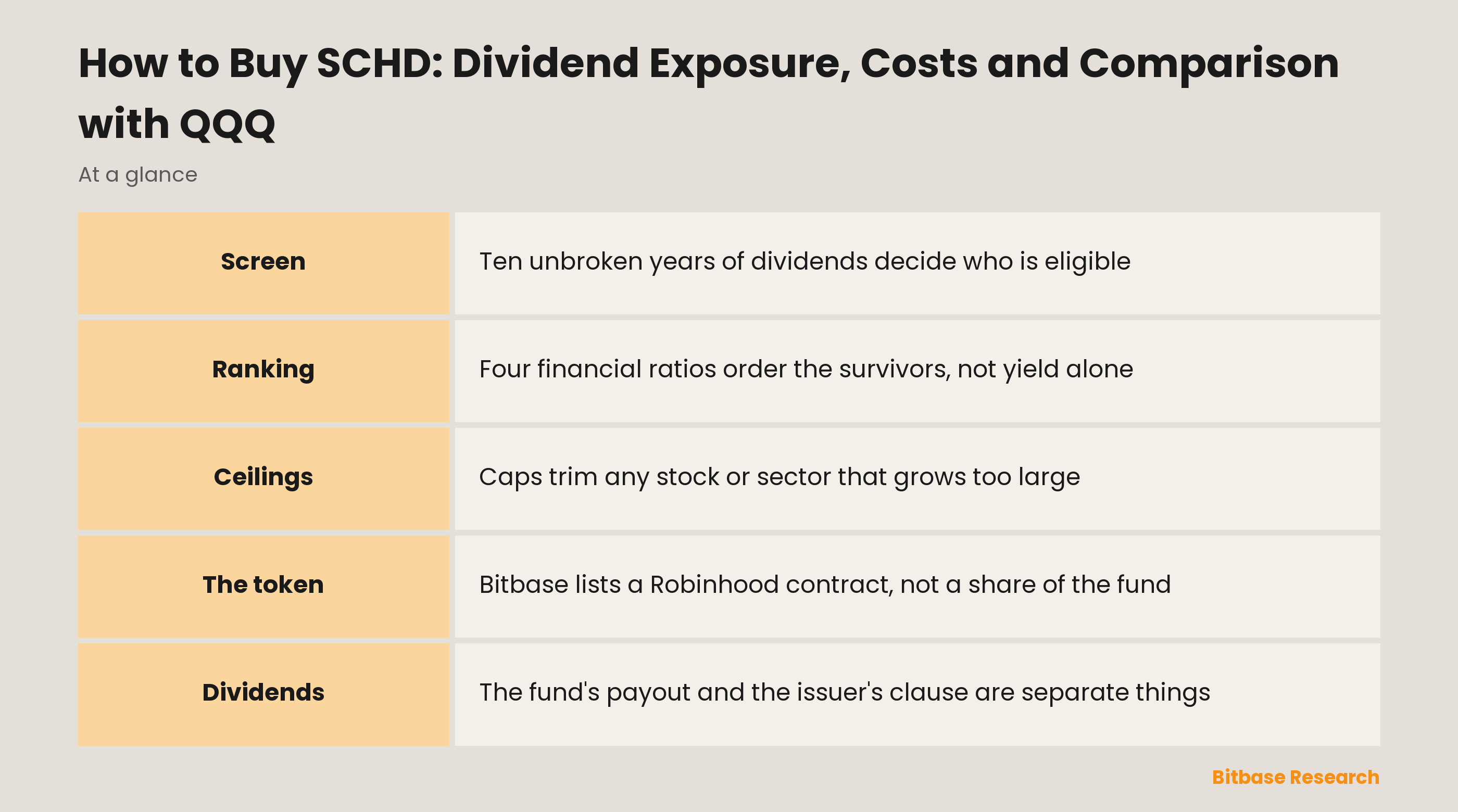
Buying SCHD means buying a rule set. Ten unbroken years of dividends decide who is eligible, four ratios decide the ranking, two ceilings decide the shape, and a published calendar decides when any of it changes.
On Bitbase the same letters resolve to a Robinhood Classic Stock Token, a contract that takes its price from the fund without being a piece of it, with hours and a dividend clause of its own. The prospectus will never describe that contract, and the issuer's terms will never describe the fund. Work out which of them governs what you hold before the order goes in.
Related reading
Other Bitbase articles on this topic:
- How to Buy ETHA: Fees, Trading Hours and Differences from Ethereum
- How to Buy IBIT: Fees, Trading Hours and Differences from Bitcoin
- How to Buy Intercontinental Exchange (ICE) Stock: Trading Methods, Costs and Risks
- How to Trade Stock Indices Without Owning the Index
- Fiat Rails Compared: Bank Transfer, Card, ACH and SEPA
Disclaimer: This article is educational content from Bitbase Academy, provided for information only. It explains what a company or fund does and how the instruments referenced here differ from one another; it does not constitute investment, trading, tax, or financial advice, and it is neither a recommendation nor an endorsement of any security, token, or trading strategy. A tokenized stock is issued by a third party and is designed to give economic exposure to an underlying asset: it is not a share, it carries no shareholder rights, and it depends on the issuer's structure, eligibility rules, and redemption terms, which the issuer can change. Perpetual futures are leveraged derivatives that hold no underlying asset and can be liquidated, and trading hours, product availability, and eligibility differ by instrument and by jurisdiction and can change at any time. Written as of September 2026; verify everything yourself through company filings, the issuer's own documentation, and the product pages of the venue you trade on.
References
[1] Schwab U.S. Dividend Equity ETF summary prospectus, Form 497K, 27 February 2026 (SEC EDGAR) www.sec.gov
[2] Robinhood Europe: what a Classic Stock Token is, who holds the underlying, hours and dividends robinhood.com
[3] Invesco QQQ: the Nasdaq-100 and how its membership is defined www.invesco.com